
• Photography
  • Interviews
  • Business
  • Reviews

Tiffinbox

Inspiring Photographers

  • Home
  • About
  • Blog
  • Contact

How To Grow Your Photography Business Without Pushing Customers Away?

April 20, 2010 by Guest

Scott Wyden, photographerThis is a guest post by Scott Wyden Kivowitz, a portrait & landscape photographer from New Jersey. He works in the repair industry for the extended warranty company Mack Camera & Video Service.

I love photography.  It is my passion.  But if you're like me then you have a full time job and shooting is on the side. With that said, I don't have the advertising funds to promote photography work.  The money I make from shooting helps pay my bills and that is about it.

So what can a person do to get customers without advertising?  Good question. Social media is one way.  With Twitter, Facebook, Flickr and so many websites growing daily social media websites is the easiest way to get your name out there. But you can over do it. Social media is a learning experience as well as a promotional tool.

If you tweet too much, you could loose followers.  If you share too much on Facebook you will loose fans.  If you post horrible photos on Flickr you will loose viewers.  But if you learn from your mistakes you can get them all back.

Sleeping Puppy

So here are some simple tips to help you grow your brand, get your name out there and develop your photography skills.

Talk to people; learn from other photographers.  Don't be afraid to ask questions, meet up and shoot, join conversations, comment on other peoples work and also ask for constructive criticism on your work.

Start a Facebook fan page. Share your work, links and helpful advice for your fans. Be creative and not spammy.

Share new photos on Flickr.  Tag and title them correctly, then spread the word.  If you share them they will come.
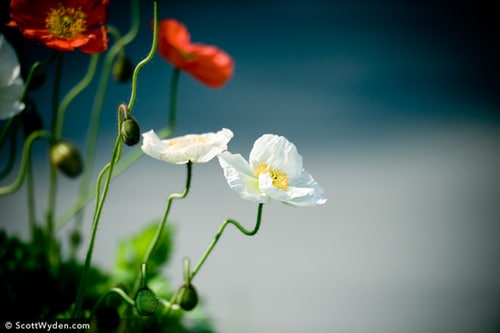
Flowers by Scott Wyden

So now you're sharing, growing your brand and on your way.  All for free right? There are buyers, models, couples and all types of potential customers checking out your work. You're not over doing it so you don't push anyone away… right?! You're listening to your friends, fans and followers.  If they tell you to stop tweeting so much, or to stop tweeting useless things, make sure you pay attention. As your brand grows you must grow with it.

While you're doing all this social media stuff, you should also be posting on your blog.  BLOG??? If you don't know what a blog is by now you need to learn quick and get moving on it.  Actually, you're currently reading a blog.  How about that! Blogs by nature attract search engines. Wait, isn't that free advertising?  Sure is baby!

Pen In A Pocket By Scott Wyden

On your blog you should be writing and sharing photography. You don't need to write a long winded article like this one, but keep it consistent.  Keep the articles flowing and build your brand.

Potential customers might read your blog and say “Wow this dude posts new photos from each event he shoots and they are awesome!” or maybe even “I want him to shoot our wedding”.  I mean, that's what I thought when I first saw Seshu's documentary wedding photography!

Again, keep the blog posts flowing and be consistent but don't overdue it.  If you post too much useless stuff it will push people away.

Now you're brand is growing still and you haven't spent a dime on advertising. Isn't that something?

So what about getting the gig?

That's where all of your hard work at sharing, writing, etc.. comes in to play.  As long as you do it right and share great work, customers will come.  The past few months have been busy for me shooting paid gigs.  However along the way I needed to shoot many charity gigs or trade for CD gigs.  We have to do what we have to do.  But the key is to keep shooting, keep sharing and keep loving photography.

Do that and the customers will come.  As Gary Vaynerchuk says in his book by the same name, go on and “Crush It“

Filed Under: Business, Photography

When Did Teaching & Learning Photography Become Such A Controversy?

April 19, 2010 by Guest

Jigar Champaneria This is a guest post by Bay Area-based wedding & portrait photographer, Jigar Champaneria.

Those of us in the world of wedding photography have been following a growing controversy about the variety of workshops offered to help photographers with everything. Whether it's marketing materials, technical proficiency, or general “awesome-ness,” there seems to be a workshop for it.

I can't say that I've taken many workshops or attended many seminars. Not because I think they're a waste of money, but because I personally need to experience things and work through them myself. For the most part, I openly rely on the generous sharing of knowledge from friends and colleagues who take the time to honestly share their experience. And after 6 years of photographing weddings, I'm trying to share as much as I can locally and on the web.

Bridegroom At Indian Wedding

So where's the controversy? Well, people like wedding photographer and entrepreneur Gary Fong and Pictage CEO, Jim Collins have blogged about it. For me, it boils down to trying to take that generous sharing of knowledge & experience and monetizing it. Don't get me wrong, I see nothing wrong with charging people for your time and experience, especially if you can teach students well. But as Jim Collins alludes to in his blog post, many of these workshops are ill-conceived for one of two reasons:

1) The workshop leader has great experience to share, but isn't a great teacher so it's difficult to impart the information well.

2) The workshop leader is just full of him or herself and thinks he can teach anyone how to be a great photographer who's radtastic in every sense of that made-up word.

Hmm … did that sound sarcastic enough? :)

Well, my sincere belief is that EVERYONE has something significant to share. They may not be able to easily explain themselves, but they've got something to share (heck, we all love to give advice, don't we?!). The leader who falls into “Reason A” above can pretty easily be identified: sincere, always has something helpful to contribute, BUT doesn't seem to plan things well or is unclear on what they're trying to teach someone. So even though this person has something significant to share, it's probably not worthwhile to attend a workshop lead by such a person. How do you know for sure? Well, check out the agenda of the workshop. If there isn't a written agenda, that's your first clue! If the agenda seems vague and the leader is unable to clarify, that's another sign to stay away. If the leader doesn't have many positive reviews of previous workshops he has lead, that's yet one more clue.

Indian Wedding By Jigar Champeneria

A few of these leaders will certainly fall into “Reason B” above. It may actually be pretty easy to tell these people from the rest, but let's try to stay away from the cynicism and just being labeled a “grumpy”. I think the main way to identify such a person is from the sincerity they exude. It's a gut feeling, but if you don't see sincerity coming from such leaders, then you may want to think a few times before signing up for their workshop. Sure, you might learn some great things, but I suspect you'll learn more  from the generous people across the web and in your PPA meetings who share their experiences with sincerity. I won't belabor descriptions of people who fall into “Reason B” since I really don't think we should dwell on it.

Before you click away from this blog post though, I want to mention something Jim Collins noted about “the sheep”. He certainly didn't call us photographers sheep, but in addition to calling out the rockstars, he called out the fanbois and fangirlz. And in many ways, we all fall into this category to some degree. We need to ask ourselves why we attend such workshops? Are we attending to bask in the glow of the rockstar? Are we going to learn how to be rockstars ourselves? Well, if there are enough of such attendees, is it really a surprise that there are workshop leaders who fall into “Reason B” above? So after reading this posting and the others around the web, we really need to look at ourselves and make sure we're attending workshops for the right reasons. And with that, here's a short list of questions that I think everyone should go through before signing up for their next seminar or workshop:

1) What do you want to learn? Portraiture? Off-Camera Lighting? Marketing yourself? If you don't know what you want to learn, well heck, maybe you need to think about things some more before spending hundreds of dollars.
2) Does the workshop you want to attend actually clearly indicate it will be teaching you such things? If not, ask the leader about that. They should be able to clarify what their workshop is about and hopefully they don't just promise you the world.
3) Does the workshop leader have experience teaching in the agenda topics? If not, then why are they charging?

If you don't feel comfortable with the answers to the 3 simple questions above, then I'd strongly suggest staying away from the workshop. Don't worry too much about bad-mouthing such leaders. The marketplace will take care of itself (eventually). And in the meantime, continue to share & learn openly with the wealth of websites, blogs, and twitter users out there. We're all here to help each other, even though we don't all charge for it.

Filed Under: Commentary, Photography, Workshops

Make Your Photos Sing (Part I)

April 13, 2010 by Guest

Phil Mackenzie avatarThis is a guest post by Phillip Mackenzie, a Pennsylvania-based wedding & portrait photographer.

When people hear that I have three degrees in music and I’m now turning to photography, they often give me a quizzical look and ask why I would make such a drastic change. I don’t think it’s all that drastic, in fact, images and music are far more intertwined in their compositions and affectations than you might think.

Imagine this.
You’re out somewhere and a song starts. The infectious beat creeps into your body and your foot starts to move involuntarily, tapping to the rhythm. Something deep and primal infects you, and when the song ends you just want to hear it again! Any music that ellicits this sort of reaction is “get up and dance” music. This is opposed to “sit down and shut up” music that tends to be more cerebral than emotional, and demands your utmost concentration and thought to understand, just like some photography.

Music is everywhere. And it dares you not to pay attention.
Music is one of the most powerful forces in existence, isn’t it? Plato thought so. For millennia, people have danced, kissed, fallen in love, cried, got angry about, even gone into battle to a soundtrack. There’s an immediate, gut-level reaction. For instance: you either love or hate bagpipes. I’ve never met anyone who was indifferent. (And if you are, I’d love to meet you!) If you love them, there’s no more rousing sound than the pipes and drums of the Royal Scots Dragoon Guard. If you detest them, you want to rip off your ears.

Images have power too.
Images can elicit the same gut-level reaction, be it positive or negative. Jill Greenburg’s series of portraits called “End Times” is provocative. Your opinion is immediate, strong, and gut-level. Has time ever escaped you as you’ve taken in an image? The same reason you can’t get a song out of your head is the same reason you can’t stop looking at a photograph. While I can’t really explain the magic “why” of everyone’s gut reaction, I can explain the “how.” When you hear a great song, you play it for your friends, tweet about it, make sure other people listen to it. When our clients see photos that sing to them, they can’t help but spread the word. All of a sudden that one photo (or more, hopefully!) can spread across the entire world like wildfire. If you create images that sing, they’ll do all the work for you. And here’s how to do it.

Break it down.
What was the last photo you saw? What do you remember? Did you feel great joy or desolation? Melancholy? A couple deeply in love with each other? Both music and photography have the ability to capture our emotions and put them into aural or visual form. They do it the same way, just using different vocabulary. Let’s look at the basic elements of music:

• Melody
• Rhythm
• Harmony
• Timbre
• Dynamic

These are the most obvious and affective elements of music, and they are all paralleled in photography. Today we’ll explore the first two, melody and harmony.

Hear the Melody, Be the Melody. (The Obvious, In-Your-Face Part)
When I mention a song to someone and they tell me that they don’t know it, I respond with “Oh, you know, the one that goes like this…” and then I hum or sing a few bars of the melody. Strictly speaking, the melody is the theme, the single most recognizable part of a piece of music. Usually it’s the first thing you recognize about a tune (sometimes it’s the rhythm, but more often than not you still can’t be sure until you hear the melody). Melodies are amazing creatures; they can carry emotion and meaning even without words. When there is a lyric, though, the melody serves as the structure by which we remember the words. Don’t believe me? Try to recite the lyric to your favorite song without thinking about the melody…it’s a challenge! It functions in the same way as the subject of your photograph. It is the most basic, in-your-face element of an image. Look at the following image for 5 seconds or so, then close your eyes and see what you recall about it.

Melody - Portrait

I’ll bet the first thing you remember is the girl’s incredibly bright and engaging smile. You might also recall the supporting color palette, and the contrast her hair color makes against the grassy background. All of those background details play a supporting role to her face, particularly the smile. This is the difference between melody and harmony. While you can distinctly remember a melody, the harmony tends to collect itself into large blocks or swaths of color or texture. While her smile may seem distinct in your memory, you may just recall the generally bright green color surrounding her without the various yellow leaves, and you’re not likely to remember the exact position of her left hand or even how curly or straight her hair might be. Melody. It’s what you remember.

Harmony: The Enabler. (The Bricks and Mortar of Music and Images)
If the melody is what you remember, the harmony is what helps you remember it. It’s what enables the melody to live and sing to our ears. It’s the rest of the Sistine Chapel ceiling that isn’t God and Adam. It’s the parts of New York City that aren’t tourist attractions. It’s the rest of the cast of a movie or a musical. In one-man shows, there’s always a supporting character even if it’s just the actor doing a different voice or personality (think Smeagol/Gollum in The Lord of the Rings), or speaking to an inanimate object like Tom Hanks did to his volleyball in Cast Away.

If I think of my favorite song, I might not be able to remember specifics about the harmony, but I can remember the “chunks.” In fact, it’s often incredibly difficult to sing a tune without hearing the harmony (either externally or in your “inner” ear). All you have to do is watch the auditions for American Idol for 5 minutes (or even 30 seconds) and you’ll hear that it’s quite difficult, and for some, impossible, to sing something without an accompaniment. Any time Randy Jackson tells them that their singing was “pitchy,” it would probably have been better with someone playing the harmony. Then again, if everyone sounded good with the harmony behind them, karaoke wouldn’t be any fun!

Think of your favorite song. Can you hum the harmony? How much about it can you remember? A melody can be made or destroyed by the harmony. In photography, the harmony could be called many things: the background, visual palette, scene, or frame to name a few. It’s the stuff in the image that’s not your subject. For a bridal portrait, the harmony might be a bright, vibrant, out-of-focus background and a bouquet.

Harmony - Portrait

Getting even more specific, the subject might be so small as just a person’s eyes, and everything else, including the rest of their body, becomes secondary. A fine example is Joe McCurry’s famous “Afghan Girl” (if you don’t know it, Google it now)—her indescribably hypnotic eyes are without doubt the focal point of the image. But without the rest of the image – her clothing, the framing, the green wall in the background that oddly matches her eye color – her eyes aren’t nearly as spectacular. The melody might be her eyes, but the harmony is the rest of the image. Nothing in that photograph is unimportant. Every element is there as part of the melody or the harmony to support it. Her eyes sing in that photograph and draw you in to see more.

Stay Tuned.
In Part II, we’ll look at the other elements and how all of them work in collaboration to produce a truly memorable song or spectacular image.

Filed Under: Art, Music, Photography Tagged With: Art, Music, Photography

  • « Previous Page
  • 1
  • …
  • 10
  • 11
  • 12

Subscribe To Tiffibox Treats!

Looking for a well-curated email newsletter that will leave you inspired and motivated about your photography business? Sign up below!

About Seshu

Seshu creates relaxed portraits of families and high school seniors in Avon, Connecticut. He also leads a successful headshot photography studio in Connecticut, helping professionals from a variety of disciplines project the very best versions of themselves. He created Tiffinbox as a way of inspiring photographers, to create better images and successful businesses. [Read More]

Email Templates For Headshot Photographers

Email Templates for Headshot Photographers

Recent Posts

  • How Capture One Changed My Event Photography
  • 10 Steps To Stay Positive In Times Of Great Stress
  • Why You Need To Read “Personal Branding For Photographers” Now
  • How To Master Your Website Content Step By Step?
  • Tony Taafe’s TNT Method For Headshot Photographers

Recent Comments

  • Stephen Davison on Are You A Business Owner Who Is Smart, But Stuck?
  • Ben A. on Don Giannatti Clinches The 8th Annual Tiffinbox Award
  • Dan on Don Giannatti Clinches The 8th Annual Tiffinbox Award
  • Donald Giannatti on Don Giannatti Clinches The 8th Annual Tiffinbox Award
  • Stephen Davison on G.E. Masana’s 6 Strategies For Wedding Photography Success
  • Naveen Kumar on Weddings In India Are More Than Being At The Right Place And At The Right Time
  • kartick on Weddings In India Are More Than Being At The Right Place And At The Right Time
  • Leonid Farbman on 6 Uncommon Trends To Grow Your Photography Business
  • Willow and Finch Wedding Photography on 11 Reception Tips To Help Your Wedding Photography
  • Web Designer Malaysia on How To Optimize Your Squarespace Website For Search Engines
  • Creastan on An Interview With Photojournalist G.M.B. Akash
  • Cindy Brown | Atlanta on An Open Letter To A Local Photographer

Become a Patron!

Copyright © 2026 · Tiffinbox · Site Design by Heather Mackan Creative · Built on Genesis