• Photography
  • Interviews
  • Business
  • Reviews

Tiffinbox

Inspiring Photographers

  • Home
  • About
  • Blog
  • Contact

As A Photographer, Is The Compelling Frame Within Your Reach?

September 13, 2017 by Seshu | Editor & Publisher

The Compelling Frame

If you caught yesterday's Apple announcement about the new iPhones launching soon, you'll know the advances in technology are truly stupendous. We are most definitely in the midst of a golden age in the visual arts. Technology is making it possible to create billions of photographs every day. Yet, world and humanitarian photographer, David duChemin believes the majority of the images produced on a daily bases fall short because they lack soul. In other words, the photographs we mass produce are not compelling enough.

The photographs we see today often don't stop us in our tracks or stir our curiosity or evoke an emotion. They tend to be much of the same trite look at our beautiful and surprising world. When we do encounter a photograph – be it our own or photographed by someone else – that has an impact on us, we remember it more vividly, almost as if we can experience it again and again.

Some are indeed so compelling that they create a response within us, perhaps, even a set of actions that affect humanity the world over. Now, don't you want to make an impact, however small or big, with your photography?

But what stands in the way? Practicing and producing the same photographs again and again is of no use to anyone. We've also been told about the classic rules of composition – the rule of thirds or the golden spiral – but these have held us hostage for far too long.

Going Beyond The Rules

We have limited ourselves with our visual vocabulary to go deeper and create stronger images. David duChemin, who has authored nearly 10 books on photography (see below), insists that it is possible to learn the visual language, or syntax, that is essential in creating compelling photographs.

Understanding and then expressing ourselves by using this new visual lingo, expands our abilities to do so much more. Better yet, you'll never ever feel like you are in a creative rut again.

Interviewing David

David just launched The Compelling Frame, an in-depth course for photographers eager to consistently create compelling frame. I spoke with him at length about how photographers can stop spinning their wheels and get on the path to making photographs that make them truly proud of their accomplishments. Give this a listen (approximately 35 minutes):

What's In The Course?

Just as soon as I recorded my interview with David, I knew I had to be a part of his course, so I signed up!

Here's what is in the course: 19 awesome lessons (videos you can watch again and again), 31 creative exercises, an opportunity to study the masters, a ton of bonuses that are actually useful and a vibrant and exclusive community called The VISION-DRIVEN.
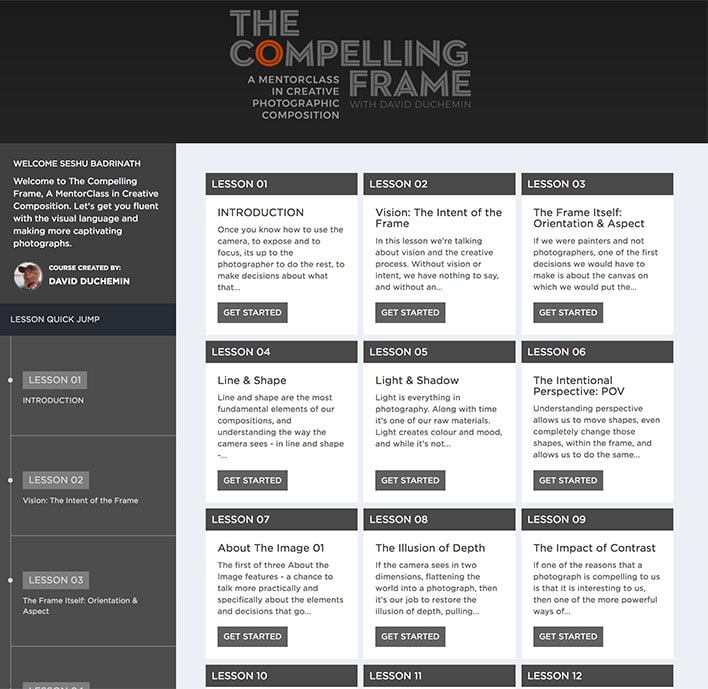
The Compelling Frame: You've got 1000 words; learn to say something great with them!

I'm willing to bet that a year from now, my photographs are going to be several levels above where they are today because of The Compelling Frame course and The VISION DRIVEN community online.

This course is open only for a very short duration. I suppose that's one way to really gauge who is serious about elevating their craft, right? Here's my recommendation and it isn't biased in any way (the links in this post are not affiliate links at all):

You could continue making photographs and not sense any momentum in your artwork or you could spend a modest amount of money ($295), to enroll in this course (yes, with me) and truly accelerate your growth.

Enrollment for The Compelling Frame ends in about eight days. My suggestion is that you don't wait. Jump in now.

David's Books

Money could be tight, or now may not be the right time for you to be a part of this course, in your path as a photographer. I get it. So, really the next best thing would be to read David's advice through his books (these are affiliate links):

  • The Soul of The Camera
  • The Visual Toolbox
  • Within The Frame
  • Photographically Speaking
  • Visionmongers
  • A Beautiful Anarchy
  • Vision & Voice
  • The Print And The Process
  • How To Feed A Starving Artist

I'm going to sound like a total fan boy, but I own every book David has written. In an environment where there is so much noise, David's words of wisdom are a clear and consistent signal that is well-timed. Wherever you are in your photographic journey, I highly recommend David's resources for photographers.

I've followed his work as a photographer and a teacher for a long time and in 2011 chose him to win the first Annual Tiffinbox Award.

Visit David's website, follow him on Facebook and Instagram. His YouTube channel is one of my favorites. You are in for quite a thrill.

And, to answer the question this post poses: yes, the compelling frame is most definitely within your reach. With the right guide, the right community and a lot of intentional practice or play, photography will cease to be a foreign language and it will become more intuitive for you.

Filed Under: Interviews, Photography Tagged With: Art, course for photographers, david duchemin, Education, Learning, making images with impact, Photographers, Photography, soulful photographs, Teaching, the compelling frame, visual language, visual syntax

What’s Fundy Designer & What’s New With Album Builder V.6

January 30, 2014 by Seshu | Editor & Publisher

If you have been at it as a wedding photographer, you've at one point or another wanted to create a wedding album for your clients. The process can be tedious, long and overly stressful.

Andrew Funderburg, or at least his company, Fundy Software, is a household name now. I interviewed “Fundy” several years back when I was attending the Mystic Seminars. His programs evolve … constantly. His applications Fundy Album Builder and Fundy Album Proofer are, by a very wide margin, the industry leaders in their respective niches.

I heard from Fundy that he was working on something revolutionary. In most other cases if someone came up to me and dropped that kind of language, I would be very skeptical. Not in Fundy's case because he has time and time again delivered on that promise and made the lives of thousands of photographers more efficient, and perhaps even more meaningful.

Andrew Funderburg, Fundy Designer & Album Builder, V6

When you have an opportunity to interview the guy who defines and directs how wedding photographers run a major part of their business, you jump at the opportunity to see what he is cooking up next. Fundy and I sat down and chatted and he shared his screen with me, showing me the various features of Fundy Designer & Album Builder version 6.0.

The video is long, but well worth your time, if you are considering either buying or upgrading from your current version of Album Builder. We talk about his beginnings, where his ideas come from, what the new version of the software looks like and what we can expect in the future.

Do note that tomorrow (January 31, 2014) is the last day to upgrade at an insanely low price of $30! It would be absurd if you didn't upgrade.

February 1, early-bird pricing will end. Album Builder v6 will be $329, Upgrades from v5 will be $79, upgrades from v4 will be $179, and upgrades from v3 will be $279.

I believed in Fundy's ideas before he even launched his company and that belief is even stronger after seeing what he is bringing to the table now and what features are planned in the coming months. Frankly, it's time again to be excited about photographing weddings and designing wedding albums with ease, efficiency and elegance.

Filed Under: Album Design, Home Middle Right, Photography, Weddings Tagged With: A Wedding Album, Album Builder, Andrew Funderburg, Art, books, Create A Wedding Album, designing, Fundy, Fundy Designer, Fundy Software, layouts, version 6, Wedding Album Designer, wedding albums

The Art & Disposability Of Digital Photography

June 28, 2012 by Emily Buchanan

Emily Buchanan is a writer and blogger working for Howling Basset, a network of wedding photographers in Kent, UK. She'd cautiously call herself an amateur photographer and prefers to shoot with film (she, too, has a serious case of OCN and it is contagious). Follow Howling Basset on Twitter and Facebook.

By now, it’s a dated debate.Does the ease of a digital dark room hinder the legitimacy of an image or are we all just suffering from a strand of OCN (Obsessive Compulsive Nostalgia) bought on by digitalisation and social anxiety? Has the accessibility of photography served to dilute its artistry? Is this affected by the contemporary culture of cataloguing life online? Well?

In this ever-updating age, questions rotate in a perpetual thought-storm like transient objects of wonder. We are barely granted the time to form an opinion before the Next Big Thing has flipped the industry on its head and it’s time to reassess contemporary culture again. But whichever side of the fence you find yourself on, it’s important to take a balanced approach.

In 1936 Walter Benjamin wrote, “In the age of mechanical reproduction, art gradually loses its traditional and ritualistic value.” This theory bridged two states of human progression and so two states of art. The dust had barely settled since the Industrial Revolution and the Second World War was about to provoke an accelerated fast-forward into the modern age. What, then, would Benjamin make of art and mechanical reproduction today and which party would he align himself with?

Andy Stonier of Howling Basset defines one school of thought, “I believe there's no real difference between digital and analogue photography in terms of photographic art. They're merely different techniques for capturing a scene. Whether the image created is on film or a CCD it matters little; what counts is the idea.”

And sure, there’s a lot of weight to this argument. Quality photography is dictated by a certain compassion and understanding of the subject, alongside an innovative idea that challenges social conceptions or embellishes a moment, not to mention composition and technical now-how.

The trouble is, quality photography can be achieved using both digital and analogue cameras, it’s just that one instrument is distinctly more convenient than the other. Long have photographers bemoaned the loss of romanticism and solitude that came hand-in-hand with a day in the dark room. And indeed, it just doesn’t feel quite as poetic to plug a camera into a laptop and fiddle with exposure on Photoshop. Rick Adam of Destroy Everything shares this second school of thought, citing the skill involved in analogue photography compared to the point-and-shoot culture that’s now encouraged by social networking, “You have to be a lot more resourceful when shooting film,” says Adam in an interview with Digg Magazine, “for one you shoot fewer photos, but in doing so I think you learn a lot more about composition, lighting, etc… Looking at the bigger picture it’s not hard to see that technological advancements have affected photography drastically. Digital cameras have given people the chance to take and upload images to the Internet instantaneously. These days it’s easy to take some photos, build a website and call yourself a photographer.”

So where’s the resolution? Does the accessibility of photography make it easier to feign a career in the industry or, to put it another way, if one can afford professional gear, does one become a professional photographer? No, say many, for the tools don’t make the photographer. A good photographer needs ‘the eye,’ and that cannot be bought or sold.

Personally, I think the medium is evolving, just as all art forms have evolved and continue to do. If that weren’t the case, we’d still be painting stoic portraits of monarchs or eroticising reclining nudes. I think our online sharing habits have promoted a rebirth of photography as art. Sure, some would argue that this has diluted its quality, but the same can be said for every creative outlet. The internet provides a platform of expression for everyone, whether they’re good or not. This is something that shouldn’t be chastised, it should be celebrated. After all, the cream will always rise to the top and whether a traditionalist likes it or not, digital post production has the power to transform a moment in time into a work of art.

To quote Tolstoy, “Art is a human activity consisting in this, that one man consciously by means of certain signs, hands on to others feelings he has lived through, and that others are infected by those feelings and experiences them.”

So, tell us, do you think digital photography is disposable? Do you photograph with intent more with film versus digital?

Filed Under: Art, Commentary, Photography Tagged With: Art, art form, digital camera, digital photography, emily buchanan, News, photographic art, Photography, photography as art, Photojournalism, quality photography, visual journalism

Tara Gentile: Infrequently Asked Questions

May 1, 2012 by Seshu | Editor & Publisher

Tara Gentile, a thought leader and creative business coach. She brings creative thinking to branding, product development, and marketing that incorporates both strategy and high touch design. Her approach to business in the You Economy resonates with MBAs, PhDs, and graduates of the school of life. She writes frequently for the Daily Worth, Design*Sponge, and Etsy. Bestselling author, Jonathan Fields, named her blog a Top 22 Single-Voice Business Blog of 2012. She’s the author of several popular digital guides including her latest on the relationship between personal art and money, The Art of Earning.Visit her websites: Reclaiming Wealth and KickStart Labs

Tara Gentile | Kickstart Labs1) You project a tremendous sense of discipline. Who do you attribute this trait to? Your mother, as you say, instilled in you the habit of saving. So, she would be my first guess.

I think you're right – my mama taught me discipline. Her business – she supported my brother & I as a seamstress – was driven by her values & personal priorities. She wanted to be present in our lives as much as humanly possible: picking us up from school, attending softball games, being there when we were sick.

So naturally, she found the discipline to work at the wee hours of the morning to get a batch of alterations complete or the strength to canvass the wealthy neighborhood a few minutes away with flyers about her business.

I think her disciple also emanates from just how much she loves & is challenged by her work. She still owns a sewing business even though she doesn't need to work. She truly wants to be at her sewing machine crafting new garments & altering old.

My discipline is very much the same. I want to work as hard as I do. I want to provide for my child. I want to model entrepreneurship & self-determination for my child. I'm also driven to discipline by my clients because I want to serve them at my highest level all the time.

But my personal discipline is also paired with a deep appreciation for time off. I don't push myself through “not feeling like it.” If I don't feel like it, there's a reason and I respect that reason. I do something else instead — even if that something looks frivolous on the outside.

I work hard & I play hard. It's a good life and one I'm happy to lead.

2) If I can speak for photographers as a collective, I would say we sincerely believe we can be both profitable and pursue our art. But we also a lot that gets too easily derailed. What would your advice be to stick to the path we initially imagined we would be on?

First, make sure you're not trying to do more than you can for the sake of money. Photographers (and web designers and web developers) all fall into the category of trying to work too much. As in, you try to accumulate too many billable hours. You work more to make more money because that seems to be the easy way to do it.

How can you make more money working less? Charge more for what you do. Create other revenue streams (i.e. sell prints at the right price, create books, diversify your services). Run your business smarter (i.e. create systems for referrals)

Second, make sure you're differentiated within the market. If where you shine is taking pictures of families with small children, make sure everyone knows that's your specialty. If you're the master of black & white, show that on your website and have a “no color” policy. You'll be able to charge more for your best work instead of making less doing more things.

The average joe doesn't know the difference between you and the 50 other photographers in your geographic area. Make it obvious. Show average joe that you understand his unique needs. Be the best match or tell him to go somewhere else.

Tara Gentile | The Art Of Earning3) In your seminal ebook, The Art of Earning, I get the feeling you are giving us artisans permission to pursue our dreams, which includes honing our craft and creating a sustainable lifestyle for ourselves and our families. Am I reading that right?

Yes! And right there you've hit the nail on the head. It's a two fold mission in becoming a thriving artist:

a) Hone your craft. Get better at what you do. Don't just learn about business — learn to become a better artist! Keep up with trends, invest in equipment, learn new skills.

b) Create a sustainable lifestyle. Make the money you need to live the way you want to live. Nothing is out of your grasp if you name it & work towards it. Don't aim for getting by, don't aim for working 100 hours per week. Aim for sustainable and thriving.

4) You say “transformation is valuable” and I agree. But who gets to place value on that transformation? Let's say a wedding client of mine is looking at a picture I took of her and her late grandmother on the dance floor. How does one put a dollar value to that emotion the bride is feeling at that moment? And how is that value conveyed to my client without sounding like a used-car salesman?

This is one statement from the book I might back pedal on a bit today. Not because it's untrue but because it needs context.

People don't actually buy “personal transformation.” No one believes there is a lump sum of money they can plop down & become better, smarter, richer, or prettier because of the service they've just bought. However, overall transformation is something that can be broken down into its parts. Those parts can be bullet-pointed, named, and price tagged.

For a photographer, transformation may be seeing yourself as you've never been seen before. It might be capturing the beauty of friends & family gathered 'round. It might be providing the best souvenirs from a moment in a child's life.

No kidding, there is no set fee for “the bride & her late grandmother on the dance floor” but that doesn't mean the fee should be low just because it's a beautiful moment either. Charge what you need or want to charge and then back it up with the language that you use to describe the service that you offer.

Break what you do down into tangible bits. Let people feel into having you as their photographer and give them a sense of what both the experience of being photographed & the experience of seeing the photos will be like.

Don't worry about sounding like a used car salesmen. This is ridiculous! You're not a used car salesmen. You weave beautiful stories when you talk to friends about what you do – weave those same stories for your potential clients.

Then say with confidence, “This is my fee.” And give them the space that they need to say, “Yes.”

5) Is having or making that “third choice” – beyond saving/investing or spending it on “stuff” – the driving force behind the art of earning? Also, do you recommend you declare this third choice to your clients so that they understand WHY you are doing what you are doing for you and your business?

Yes, the art of earning is always about earning with purpose. It's not about earning more for the sake of earning more — and it's not about earning enough to “get by” or “have just enough.” If you've built your business with a big ambition, and I hope you have, then earning money is a byproduct of working towards that big ambition.

The more you serve, the closer you come to your ambition, the greater your realize your purpose, the more money you stand to earn. Not in a drain-'em-til-they're-dry way but in a whole-hearted people-see-the-value way.

6) In a world where there are other artisans also providing a similar service, how does one distinguish oneself? Is it by clearly defining how we will deliver either an experience or product full of meaning to the client?

First – let me say – differentiation is so important! It's probably the biggest thing standing in between you and more money, you and better clients, you and full artistic self-expression. It's true!

I could talk all day about differentiation but I want to define it in two ways today:

First, your values define you. What are your values? How do you prioritize? What makes you stand up and say “yes!”? My values include wisdom, excellence, and equality. I know I resonate with someone else's work when I see those same values echoed back at me. I can instantly align with both their purpose & their modality.

Talk to me in values. Tell your story in values. Explain your process in values. Give me something to say “yes!” to.

Second, your value drives you. What are you really selling? What are people really paying for? Understand your value from your customers' perspectives. Interview them about how they received your services and what was important to them in the experience.

Don't paint in broad strokes. Use fine detail. Share others' experiences and allow me to see myself in their examples.

Tara Gentile | The Art Of Earning7) How much does faith personally direct you to help people?

Great question. Up until about 6 months ago, I didn't realize how much my faith & my previous academic study of that faith had carried over into my business. My faith not only directs me to help others but has shaped my whole outlook on business & the commercial system.

Especially observant folks have noticed that I have “Bonhoeffer chick” in my Twitter bio. Bonhoefferchk was my first blogging handle. But the theology of Dietrich Bonhoeffer is also the theology I ascribe to personally. That theology has also directly impacted my approach to business.

Bonhoeffer posited that “Jesus is a being for others.” Jesus' sole purpose was to live his life for others. While great self-love & self-acceptance is a necessary part of that kind of faith, it manifests itself outwardly in service. That's the kind of business I know seek to run and the kind of business I direct my clients to run, as well.

Yes, you must self-express through your great work. Yes, you must have a high self-worth to increase your net worth. But in the end, it's service of others that pushes you onward. It's service that defines your success. Your work exists for others not merely for yourself.

Those are the kind of businesses I want to see in control of the new economy.

Are YOU part of the “new economy” that Tara mentions? I highly recommend you follow Tara Gentile on Twitter. Sound off below to tell us what you thought about this interview. If you would like more such interviews, please help me spread the word. Thank you!

Filed Under: Business, Interviews, Photography Tagged With: Art, Business, competition, creative business, kickstart, kickstart labs, labs, personal art, photo business, Photography, tara gentile, the art of earning

Why You Should Consider Artist Residencies If You Are A Passionate Nature Photographer

December 21, 2011 by Joe Decker

Today's guest post is by Joe Decker, a nature photographer, writer and educator who lives in Northern California. Follow Joe Decker on Twitter to learn more about his workshops or read his blog. Learn about composition from him from his e-book, Tuesday Composition.

While I've had the opportunity to teach and work with hundreds of talented nature and landscape photographers, few if any of them ever consider artist residencies as a tool of developing their photography.

That's a pity.

Art Residencies by Joe Decker

Residencies offer artists a place to stay and focus on art. This adobe cabin is used to house resident artists at Petrified Forest National Park

What are artist residencies?  Residencies are programs which grant artists a place to live while they focus on their work. These programs can take many forms. In some cases, these residencies are created by fine arts programs, many of those residencies pull in several artists at a time with the hope of encouraging interdisciplinary work or at least a sharing of ideas. Many parks and organizations that manage natural areas have residencies which are usually more solitary, but that put the artist in close connection with the landscape, in part with the hope of encouraging artwork that promotes and communicates the features of that park. Even some commercial concerns create residencies, my shipboard arctic residencies provided me incredible access to hard-to-reach areas of the planet, with the expectation that I'd also provide some work back in the form of workshops and material for a passenger DVD.

Art Residencies by Joe Decker

Residencies are offered by many types of organizations, from fine arts collectives and parks to commercial cruise lines.

Why do so few photographers apply for such opportunities?  Part of the disconnect is cultural. There has always seemed to be a quiet divide between the photography community and the fine art community, and while artist residencies are a staple of the traditional fine art community, they're rarely if ever talked about in the photographic communities I've been a part of. There's also a mystique factor, because of this “quiet divide”, Many times talented, creative photographers make the mistake of thinking that their work won't be accepted by something they perceive as being part of the snooty “fine art” world. in reality, most residencies, particularly those applicable to landscape and wildlife photographers, are juried by people who do understand the creative potential of the photographic medium, and see art more broadly than many photographers might imagine.

Of course, there are some practical challenges to accepting a residency. Not everyone can afford the luxury of putting eight weeks into nothing but developing a new body of artwork. However, many people, particularly many talented amateurs, could afford two or three weeks if they understood the value they could get from a well-chosen residency.

Why You Should Consider a Residency

Why would a photographer wish to invest a few weeks in a residency? The most important reason to consider a residency is the opportunity for focused time. Whether you're a professional or an amateur, it is unlikely that you get to spend nearly as much uninterrupted time making photographs as you'd like. Whether it's the “day job at the factory” or the usual grind of marketing and selling your photographic work, the inevitable distractions of day-to-day life really get in the way of digging deeply into a photographic project. A few weeks dedicated to a project can bring depths to your work.

Cost is another reason. Few residencies offer anything in terms of cash, but there's no question that the value of simply having a decent place to stay for a few weeks in an area you'd like to work is substantial. My arctic, ship-board residencies are probably the most extreme example of this, the cabin that I stayed in during my Svalbard residency this year probably would have cost around twenty thousand dollars if I'd paid for it retail.

Climbing Lizard by Joe Decker

Some residencies offer access to unique resources, whether they be archeological, geological or cultural.

Which brings me to access. Every residency I've been awarded has offered me unique opportunities in terms of access to the locations I'd be working in. In my National Park residency, not only did I have the run of the park at night and sunrise t (when the park was otherwise closed to visitors), but I also had enormous support from the staff there, from access to their geologic archives to guidance on a couple hikes to lesser-known park locations, as well as access to many archeological resources. My arctic residencies included the support necessary to get me and my camera near to polar bears without risking my life.

Polar Bears by Joe Decker

Residencies often offer a variety of forms of other support, from access to art making equipment to support in getting to unique and otherwise inaccessible or dangerous locations.

How To Apply

First, find a program that's relevant to the kind of work you do, or at least the kind of work you'd like to do. You are more likely to be awarded a residency if it's clear how you and your work fits in with the opportunity being offered, and you'll are far more likely to benefit personally and professionally from a residency if the specific opportunity inspires you. If you're a wildlife photographer, you might want to skip that urban art center opportunity, unless you have a clear plan for applying your skills and interests to a new environment–and even then, you'll need to make a solid case in your application as to why you're the best person to benefit from the residency.

Carefully research each residency you apply for, and respond to each residency individually. In applying for my Petrified Forest residency, I proposed projects that both inspired me and that leveraged the unique features of that park, such as it's archeological resources and it's incredibly dark sky. The Park Service's own web site and in-park informational signage gave me a great deal of information about what they believed to be key features of the park, reflecting that understanding in my own proposal likely helped me win that particular residency.

Whether you're a professional or not, it is essential that you show that you're serious about your work. Few of these opportunities care about whether you make your living at photography, but all of them will care about whether you bring a serious, committed attitude to your art. There are many ways to show that in your application that don't require having been “in business” for ten years–have you being showing your work consistently over a period of time? Have you been published broadly?  Have you won awards or other recognition over time? Do you have references that can attest to the quality and longevity of your efforts?

Finally, don't give up. While there are a lot of residencies out there, there are also a large number of artists, not just photographers but painters, poets, sculptors and videographers often vying for the same slots. With effort and focus, you can take advantage of this wonderful opportunities to further your photographic efforts.

If you made it this far down, I have to ask you if you are now considering artist residencies to elevate your own craft. What, in Joe's article, moved you to make that decision? If you have any follow up questions for Joe, please feel free to ask him in the comments section below.

Joe has offered his e-book, Tuesday Composition, to one lucky person who comments below. Winner announced on December 30th.

Filed Under: Art, Nature, Photography Tagged With: Art, artist, artist in residence, artist residency, artist residency program, arts, Education, fine art, joe decker, landscape photographers, national parks, nature, nature photographer, nature photographers, photographer, Photography, residencies, residency, theatre

  • 1
  • 2
  • Next Page »

Subscribe To Tiffibox Treats!

Looking for a well-curated email newsletter that will leave you inspired and motivated about your photography business? Sign up below!

About Seshu

Seshu creates relaxed portraits of families and high school seniors in Avon, Connecticut. He also leads a successful headshot photography studio in Connecticut, helping professionals from a variety of disciplines project the very best versions of themselves. He created Tiffinbox as a way of inspiring photographers, to create better images and successful businesses. [Read More]

Email Templates For Headshot Photographers

Email Templates for Headshot Photographers

Recent Posts

  • How Capture One Changed My Event Photography
  • 10 Steps To Stay Positive In Times Of Great Stress
  • Why You Need To Read “Personal Branding For Photographers” Now
  • How To Master Your Website Content Step By Step?
  • Tony Taafe’s TNT Method For Headshot Photographers

Recent Comments

  • Stephen Davison on Are You A Business Owner Who Is Smart, But Stuck?
  • Ben A. on Don Giannatti Clinches The 8th Annual Tiffinbox Award
  • Dan on Don Giannatti Clinches The 8th Annual Tiffinbox Award
  • Donald Giannatti on Don Giannatti Clinches The 8th Annual Tiffinbox Award
  • Stephen Davison on G.E. Masana’s 6 Strategies For Wedding Photography Success
  • Naveen Kumar on Weddings In India Are More Than Being At The Right Place And At The Right Time
  • kartick on Weddings In India Are More Than Being At The Right Place And At The Right Time
  • Leonid Farbman on 6 Uncommon Trends To Grow Your Photography Business
  • Willow and Finch Wedding Photography on 11 Reception Tips To Help Your Wedding Photography
  • Web Designer Malaysia on How To Optimize Your Squarespace Website For Search Engines
  • Creastan on An Interview With Photojournalist G.M.B. Akash
  • Cindy Brown | Atlanta on An Open Letter To A Local Photographer

Become a Patron!

Copyright © 2026 · Tiffinbox · Site Design by Heather Mackan Creative · Built on Genesis