• Photography
  • Interviews
  • Business
  • Reviews

Tiffinbox

Inspiring Photographers

  • Home
  • About
  • Blog
  • Contact

Bryan Caporicci

Bryan Caporicci is an award winning wedding and portrait photographer based out of Fonthill, Canada. Bryan is a Fuji X-Photographer. In 2011, he was awarded his Craftsman of Photographic Arts (CPA) designation by the Professional Photographers of Canada (PPOC), making him one of the youngest photographer in Canada to receive this level of achievement. Bryan is also a speaker, blogger, mentor and author, and has an educational website for photographers all about the business of photography at Sprouting Photographer. Bryan also hosts a podcast called the Sprouting Photographer podcast, and it can be found at SproutingPhotographer.com/iTunes

5 Essential Steps To Creating A Display Advertisement Marketing Program

May 6, 2014 by Bryan Caporicci

FB---OG-Shared-LinkMy last post on Tiffinbox.org, titled “How Photographers Can Create a Well-Rounded Marketing Plan” was a huge success! It even made it into Seshu's top-5 articles of all time, which is a huge honour, so thank you for giving it all the love! Seshu has given me the opportunity to write here again, and so I wanted to take one of the ideas that I touched on in that last article and go deeper with it.

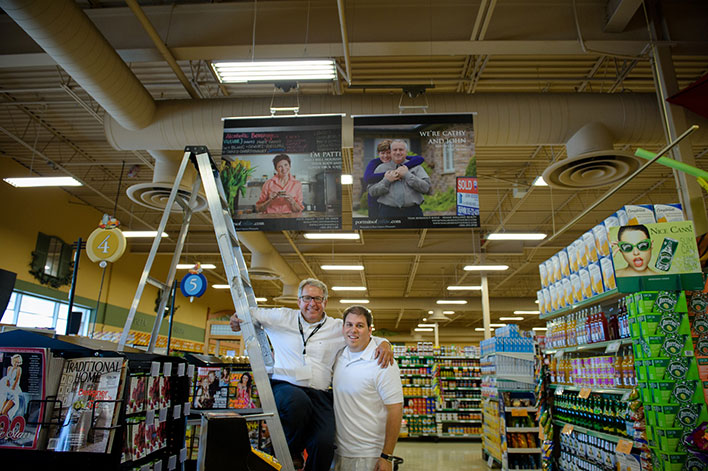
Display collaboratives (otherwise known as display advertising) is a co-marketing initiative where you hang your prints at a third-party location or business (target location), with the intent of creating brand awareness and community recognition for your work. What's great about display collaboratives is that it is an idea that is applicable to every genre of photography in every market. No matter what your specialty or target market, this is a great marketing program that you can use to grow your business.

Why display advertising?

DisplayAdvertising_003If the benefits of display collaboratives aren't inherently obvious, then I'll take a moment here to explain. You are basically creating a win-win-win situation. Normally, a win-win would be good enough for me, so that extra “win” in there makes this that much better!

The target location wins because they get unique, custom art displayed in their space that is highly specialized. They get to support a local artist, and they'll also gain recognition, awareness and ultimately more business throughout the promotion of the display advertising. More to come on the promoting part later.

Your clients who are in the images being displayed wins because they get to be “famous” for a short period of time. They can brag to their friends and family that their family
portrait, wedding image or child's portrait is hanging in a prominent, popular place in town.

You win because you get be in front of a completely new audience, you get to re-enforce your brand in your community, you get to build a solid relationship with a local business and you gain access to their audience throughout the promotion of the display advertising.

How to set up a display advertising collaboration

Ultimately, you will want to have several displays up in a few different locations – the idea is to “be everywhere” and re-enforce your brand and your presence in your community. I recommend starting with one location at a time, and working your way up from there.

Throughout the whole process, remember to continually build value, be professional and continually show respect and appreciation for everyone involved. This is as much about the finished pieces on the wall and the exposure as it is about the relationships and impact you can make throughout the whole process. Throughout the process, promote and share on social media behind-the-scenes pictures, ideas and teasers to build excitement for the project that you're working on with the target location.

Here is a 5-step process to take you from idea to fulfillment for setting up a successful display collaborative campaign.

Step 1 – Determine the target location

DisplayAdvertising_006First let me say that this is not a marketing initiative that is done well through “cold-calling” potential target locations. This is the kind of marketing program that you want to run collaboratively founded on existing relationships. I'm not suggesting that you have to be best friends with the target location, but instead what I'm saying is that display collaboratives are best executed when there is a pre-existing mutual trust and respect. Look at your “rolodex” of local contacts and discover some locations where your target client might frequents.

Here are a few examples of locations that might be a good fit:

  • If you're a wedding photographer that targets the high-end bride, perhaps a wedding boutique on the main street in your quaint town would be a good fit.
  • If you're a wedding photographer who specializes in the vintage style, then perhaps a good fit would be a local brewery or a new-age rustic flower shop.
  • If you're a child photographer looking to photograph for families who are in the middle-to-upper professional working class, then maybe a good fit would be a higher-scale local dentist office.
  • If you're a child photographer looking to photograph for more middle-class, DIY, stay-at-home Mom's who want to spend good money on great photography, then a good fit might be a local children's clothing boutique.

You can see how there are so many opportunities once you start choosing partners based on target market.

Golden nugget: If you want to really find out the best places to partner with, then simply ask your 5 best clients where else they shop during the week. Better yet – ask them where they go to buy Christmas presents around the holidays. This will show you what kind of consumer they are, where they shop, and what their spending habits are like.

As I mentioned earlier, it's best to have a pre-existing relationship before you start bringing up the idea of display advertising with a target location, so if you don't already have a relationship with the target location you're approaching, then you need to spend some time building and nurturing a relationship before you “jump into bed” together. Network, get to know each other, build up that mutual trust and respect, and then move on to the next step. If you already have a solid relationship, then move on forward.

Step 2 – Propose the idea of display advertising

It's simple to bring up the idea of doing a display collaboration with a target location. You want to propose the win-win-win situation to them, explain the benefits and minimize the objections. I recommend having this discussion in-person, and be sure to bring a sample print  similar to one that you would display so that they can see the value.

You must consider this a creative marketing expense, and so I recommend that you do not charge for the prints. This is an advertising opportunity for you, and much like you'd pay a magazine to be in front of their audience, you are covering the expenses here in exchange for being in front of this new audience. Discuss the idea of having your logo on the prints, or at the very least, ask to have business cards on display nearby.

Step 3 – Decide size, placement, duration and (optionally) rotation

Another benefit to having the discussion in-person is that you can start to brainstorm right away where and how big the prints might be able to be displayed. You are the expert here, remember; you are a professional photographer and a part of your job is to design wall art, so be generous with your recommendations, but remember that it is ultimately their space, so you need to also be respectful to their wishes.

Step 4 – Hang the prints yourself

Once you've decided on sizes, images and placement, be sure to get the prints made as quickly as possible. Bring the finished pieces into the space personally and hang them yourself at a mutually agreed upon time. Once again, show your professionalism. This is when you are presenting the “deliverable”, so the excitement should be at it's high. If you want to really make an impact, deliver a special surprise with the finished piece for all of those involved. Whether that means bringing a bouquet of flowers, a small gift or giving them a gift certificate for personal portraits themselves, do something at this point to exceed their expectations.

Step 5 – Promote it!

DisplayAdvertising_001This is when the real work begins. You need to promote the display collaboration as much as possible. Help to deliver the target location's “win” part of the equation and get them more visibility. Tweet, Instagram, Facebook and Blog as much as you can. Share images, videos, stories of the whole process everywhere and anywhere you can. Get the local media involved and see if it would be something they'd be interested in running in the local paper or on the radio. Here's an idea – consider running some sort of contest to get buzz going. Be creative here!

Don't forget to reach out to those who are actually displayed in the portraits you have hanging on the wall and tell them that their images are up (they should have been aware ahead of time). Tell them that they should go check it out and to tell all of their friends and family about their “moment of fame”.

Think Outside the Box – Be Creative!

Display advertising as I've presented it thus far has been fairly straight forward – you hang some of your work in another space. There are so many more ways to “spin it” if you really think outside the box and get creative. I have written a “part 2” to this article where I share some specific ideas for getting creative with collaborative display advertising opportunities, in fact, one of my ideas will even generate you money – lots of money! If you're interested in getting the second part delivered right to your inbox, then head on over to this page on the Sprouting Photographer website, leave me your e-mail address and I'll send it to you right away, free of charge!
Filed Under: Business, Home Middle Right, Marketing, Photography Tagged With: Art Display, Business, communication design, Display Advertisements, Display Advertising, Marketing Initiatives, Marketing Plans, Marketing Programs, Targeted Marketing

How Photographers Can Create A Well-Rounded Marketing Plan

March 24, 2014 by Bryan Caporicci

The internet has done great things to help us market ourselves as photographers, and social media in specific has made it possible for us to reach a large audience even easier. It is a double-edged sword though. While it's true that you can reach more people now, the same is true for everyone else. The social media space has become very crowded and the perceived barriers to entry in becoming a “photographer” have gone down significantly because of this.

Standing Out In Your Market by Bryan Caporicci

Standing Out

How do you stand out marketing yourself as a photographer online, then? Well, that is a whole other discussion, but I would suggest that a good place to start is to go “back to the basics” and adapt an offline component to your marketing strategy. Let's quickly recall a few of the online marketing strategies that we use today, along with a few buzzwords that have become commonplace:

  • Social media
  • Social networking
  • Engagement on Facebook
  • Content marketing on our blogs
  • RT's and @ mentions of other businesses on Twitter

What would it look like if we stripped away the “online” component to these terms and strategies?

  • Social media
  • Social networking
  • Engagement on Facebook
  • Content marketing on our blogs
  • RT's and @ mentions of other businesses on Twitter

We're left with media, networking, engagement, content marketing and relationship building. It's no surprise that these are the foundations of “traditional” business marketing, and we've just adapted them to social media and the internet. A lot of the time, though, we've forgotten about the roots of where they came from. Let's explore.

  • Media is defined as the main means of mass communication (television, radio, newspapers).
  • Networking means to interact with other people to exchange information and develop contacts, especially to further one's career.
  • Engagement is a marketing strategy that directly engages consumers and invites and encourages them to participate in the evolution of a brand.
  • Content marketing is defined as providing consistent, high-quality content that solves people's problems.
  • Relationship building is a marketing strategy that recognizes the long-term value of relationships and extends communication beyond intrusive advertising and sales promotional messages.

The Foundations of Marketing

Using these marketing foundations as a starting point, I would suggest the following 5 ways that you can use the basics of business marketing to increase your local awareness offline and ultimately get more business: speaking, networking, press, co-marketing and direct-mail.

I am a big believer in the idea of being specific, giving examples and taking action on what we learn. All articles that I write for my educational website Sprouting Photographer ends with an “action item” that gives a specific point of follow-up. For this article, I'd like to give 18 examples of how you can put into play each of these 5 marketing basics right away.

Marketing For Photographers

Speaking

  • Give a presentation to a local business clubs re: business portraits.
  • Give a presentation to the local Rotary Club about what you do as a photographer.
  • Present to a Mom group re: family and child portraits.
  • Put on a workshop to teach the basics of photography at the library.

Networking

  • Seek out local business associations such as the Chamber of Commerce or a local BIA and become a regular attendee to the networking meetings. Focus on building relationships and not just handing out business cards.
  • Personally reach out to local business owners and connect one-on-one. See how you can help each other.
  • Attend local niche trade shows and network with the organizers, sponsors and businesses. If you specialize in family portraits for example, a “home show” would likely have many businesses that serve a similar market as you do. This would be a great networking opportunity.

Press

  • Donate to a cause and attach your name to a newsworthy event/charity.
  • Volunteer your time locally.
  • Offer help to the local media – maybe they need photographs, or perhaps they'd like your opinion on a photograph-related topic.
  • Send press releases once you've built an established relationship with the local paper.
  • Offer to write a column in the paper.

Co-Marketing

  • Offer to decorate local businesses with wall portraits and wall art. Display your business card with it.
  • Run a promotion with a local business that has a similar audience as yours. You can share each in each other's customer base.
  • Exchange a stack of business cards with local like-minded business owners and offer to help market each other.
  • Offer a local business a few gift certificates to give their top-tier clients as a gift from them.

Direct-Mail Postcard Mailings

  • Come up with a specific, time-sensitive offer and mail it to 10,000 homes in the area via a post-card drop.
  • Repetition is key – plan to do one per month for at least 6 months.

Creating a well-rounded marketing plan is crucial for long-term success as a photographer. We need to include online and offline marketing strategies to ensure that we are in front of as many prospective clients as possible. The ultimate testimony to a consistent offline local marketing initiative is when your clients start telling you that they “see you everywhere” – that is a well-executed branding and awareness campaign!

Filed Under: Marketing, Most Popular Posts, Photography Tagged With: Business Marketing, Foundations Of Marketing, Marketing, Marketing Basics, marketing plan, Photographers, social media, Social Network, Social Networking

3 Factors That Influence Photography Pricing

March 13, 2013 by Bryan Caporicci

Bryan Carporicci dives into three influencing factors when it comes to pricing your photography. If you have read his first article on pricing, you are in for a treat again. He co-wrote a book for photographers with fellow photographer Robert Nowell called “Pricing for Profit.”

In the book I co-wrote with Robert Nowell, titled “Pricing for Profit”, we share our belief in the idea of calculating your prices based on Cost of Sales. Certainly this is the best starting point, but there are other factors that must be considered when calculating your prices, most importantly quality, perceived value and confidence.

Quality

The quality and artistic measure of your work will have a healthy influence on how you can price your photography. In order to sell something to someone, you have to provide a quality of service or product that the client couldn’t produce on their own. If your photography resembles the basic snapshot-style of images that anyone could take with their own point-and-shoot camera, chances are you cannot charge anything in the neighborhood of what we are suggesting. If, on the other hand, your photographs exhibit a quality of light, posing and finesse that makes your work stand above the competition, then you certainly can demand a premium for your creative fees.

Perceived Value

We have all heard the saying that beauty is in the eye of the beholder, and this is true of the professional photography industry. The way that a client perceives a product or service is directly related to the price that they are willing to pay for it. People buy things not necessarily for the thing itself, but rather for the way that the thing makes them feel. This has been proven to be true time and time again in all kinds of business environments.
Perceived value can come from things such as how we package the goods that we deliver our clients, to the length that we will go to to provide exceptional customer service. If you create a higher perceived value for your photography and your products, then you can demand a higher price for those products and services.

Confidence

Confidence is a photographer’s ability to sell him or herself and his or her products or services without any hesitation or apology. It is especially important for starting out photographers, to disassociate themselves from their own price list. We have often heard photographers saying that they would never buy photography at the prices that they themselves charge. As a result of that thinking, they find it extremely difficult to sell to others when they don’t believe in their own pricing system.

You need to be confident and sure of your pricing structure, and you need to present it in such a way that instills confidence in your client. If you don’t believe that they will buy, it is likely that they will sense that. If you don’t believe that what your selling is worth the price you’re charging, they will see that as well. This is why it is important to be extremely confident in the prices that you are asking for your photography.

Next week, I’ll be going into detail about the last “influencing factor” for pricing – the Cost of Sales model. This is the only measurable way to calculate your pricing, and it’s where things start to get fun!

How do you arrive at your photography pricing? What factors do you use to arrive at your numbers? Discuss below!

Filed Under: Business, Photography Tagged With: Photography, photography industry, price, Pricing Strategies, your photography

“I Love Photography, Not Numbers” – Let’s Discuss Your Pricing, 1 of 3

March 6, 2013 by Bryan Caporicci

Today's guest post is by Bryan Caporicci, a professional photographer based in Canada. Bryan has quickly become an educator on various topics and has been a keynote speaker at numerous workshops and seminars. He co-wrote a book for photographers with fellow photographer Robert Nowell called “Pricing for Profit.” He is also a featured blogger for the Huffington Post.

If you are new to photography, it may surprise you to know that the time you spend running a photography business will be taken up mostly by business and less by photography. If you have been running a photography business for a while, I think that you’ll agree to this fact.

The vast majority of us get into photography because we are creative and visual. Those that are able to make their business flourish however, realize early on that they need to have a strong understanding of business in order to make their career successful.

Photographers are unique in the sense that we almost start our business backwards. The majority of successful businesses are founded by people who studied business first and then decided what they were going to sell second. For example, how many accountants do you know who decided one day “I’m good with numbers” and started their own accounting firm? Most accountants will go through extensive training and internships before they even considering starting their own company. With photography though, most don’t have formal business training, marketing experience, or a financial background. We just know that we love photography and want to do it full-time.

There are an unlimited number of resources on the topics of photography and business (this blog included), however in doing some research, I’ve been unable to find a definitive guide that clearly outlines a step-by-step process to pricing photography services and products. In addition, I’ve never found a resource that actually spelled out how to plan and organize your photography business volume.

In an attempt to help photographers take their business to the next level and start making a living from photography, Robert Nowell and I wrote a book called “Pricing for Profit” that was modeled after our popular seminar series with the same title.

While nothing will replace the value of formal education, extensive research, continuing education courses, business workshops, and so on, our book is designed to be a means of taking the mystery out of pricing your photography for a profitable bottom line.

For the next 4 weeks, join me as I share some insight into the concepts behind our book here on Tiffinbox and help you uncover the most efficient way to price your photography work to make a viable living.

Stick around – it’s going to be a wild ride!

More about Bryan Caporicci: Since his start in the industry eight years ago, Bryan has rocketed to the top of the photography industry in his market area. Bryan was one of the youngest photographers in Canada to receive his Craftsman of Photographic Arts and in 2012, he was named one of the top 25 most inspiration wedding photographers by Wedding Bells Magazine. Bryan's photographic philosophy is simple – he believes in photographing people being themselves. He believes in genuine, pure and simple imagery and he feels that photography is best enjoyed only once it's printed.

Filed Under: Business, Photography Tagged With: Bryan Caporicci, Pricing For Profit

Subscribe To Tiffibox Treats!

Looking for a well-curated email newsletter that will leave you inspired and motivated about your photography business? Sign up below!

About Seshu

Seshu creates relaxed portraits of families and high school seniors in Avon, Connecticut. He also leads a successful headshot photography studio in Connecticut, helping professionals from a variety of disciplines project the very best versions of themselves. He created Tiffinbox as a way of inspiring photographers, to create better images and successful businesses. [Read More]

Email Templates For Headshot Photographers

Email Templates for Headshot Photographers

Recent Posts

  • How Capture One Changed My Event Photography
  • 10 Steps To Stay Positive In Times Of Great Stress
  • Why You Need To Read “Personal Branding For Photographers” Now
  • How To Master Your Website Content Step By Step?
  • Tony Taafe’s TNT Method For Headshot Photographers

Recent Comments

  • Stephen Davison on Are You A Business Owner Who Is Smart, But Stuck?
  • Ben A. on Don Giannatti Clinches The 8th Annual Tiffinbox Award
  • Dan on Don Giannatti Clinches The 8th Annual Tiffinbox Award
  • Donald Giannatti on Don Giannatti Clinches The 8th Annual Tiffinbox Award
  • Stephen Davison on G.E. Masana’s 6 Strategies For Wedding Photography Success
  • Naveen Kumar on Weddings In India Are More Than Being At The Right Place And At The Right Time
  • kartick on Weddings In India Are More Than Being At The Right Place And At The Right Time
  • Leonid Farbman on 6 Uncommon Trends To Grow Your Photography Business
  • Willow and Finch Wedding Photography on 11 Reception Tips To Help Your Wedding Photography
  • Web Designer Malaysia on How To Optimize Your Squarespace Website For Search Engines
  • Creastan on An Interview With Photojournalist G.M.B. Akash
  • Cindy Brown | Atlanta on An Open Letter To A Local Photographer

Become a Patron!

Copyright © 2026 · Tiffinbox · Site Design by Heather Mackan Creative · Built on Genesis