• Photography
  • Interviews
  • Business
  • Reviews

Tiffinbox

Inspiring Photographers

  • Home
  • About
  • Blog
  • Contact

Has The Commerce vs. Craft Conundrum Killed Your Passion?

November 19, 2012 by Ron Dawson

Ron Dawson is president and creative director of Dare Dreamer Media, a new media marketing and film and video production agency that focuses on helping brands tell cause-driven and inspirational stories. He writes about the art and business of filmmaking and photography at DareDreamerMag.com and hosts Crossing the 180: The Filmmakers Podcast that Breaks the Rules. Follow Ron on Twitter and Facebook.

Photographers are passionate people. The Nikon vs. Canon battle (or is that Canon vs. Nikon) is right up there with Mac vs. Windows. Democrat vs Republican. Back Street Boys vs. New Kids on the Block (Or should that be Justin Bieber vs. One Direction?) Well, I suppose that artists in general are passionate. You have to be passionate about your art if you plan to make a living at it. Wait, let me amend that. You actually DON'T have to be passionate about your art if you want to make a living at it.

Let that sink in a bit …

Are you fuming? Are you perturbed? Did I ruffle your feathers? Burst your bubble? Put a kink in your armor? Throw a wrench in your … well, you get the idea.

If you're like many professional photographers I have come across, a statement like the one I just mentioned could be enough to send you into a social media frenzy akin to a jihad. “How dare I say you don't have to be passionate about your craft?”

I can say it because it's true. You do not have to be passionate about filmmaking or photography or quilting to make a living at it. Do you really think the owner of Glamour Shots is “passionate” about photography? I don't know if he/she/it is? I just know that it's one of the largest photography businesses in the world and it's blatantly obvious it's not built on a passion for the craft.

Likewise, we are all familiar with the “starving artist”. That individual who is true to his/her craft. Pure in heart and spirit. She would rather slit her wrist than Photoshop in a sky. Would not be caught dead using a point and shoot. And some of them even think film is still alive (Ouch! Why'd you have to go there Ron?)

A Brief History

Jesh de Rox

The $20,000 Man

This is one of those debates you can never win. It's kind of like arguing about religion. Either you believe it or you don't. Some of you may be converted then fall to one side vs. the other. But in the end, most of you are firmly encamped in your beliefs. And woe to the person who says otherwise.

I was first introduced to the passionate sides of this debate a few years ago when well-known, award-winning photographer Jesh De Rox held a free webinar. At the end he pitched a 1-day workshop that cost $20,000. That is not a typo. Twenty thousand dollars. OMG. You would've thought he publicly lambasted the Pope or something. (That workshop wasn't the main pitch, it was actually more of a “would you like fries with that” kind of pitch.) The blog post I wrote about it to this day remains the most popular.

There have been other provocative luminaries in the photography world who have caused their fair share of eyebrow-raising and vitriol spewing: Jasmine Star. David Jay (can you say “Photo System“). Gary Fong. Denis Reggie. Kevin Swan. All these guys at some point or another did (or continues to do) something related to their business that rubs the aforementioned “auteurs” the wrong way.

The “heroes” on the other end of the debate are people like my good friend Zack Arias. Zack is in essence the patron saint of photography. He is awesome. His craft is undeniable. But here's the irony. He also has a lot of great business advice to give too. Despite the fact that Zack often leads (or at least inspires) the social media frenzies I mentioned, at least he's a person who is not so blinded or enamored by “the craft,” that he doesn't also realize the importance of “the commerce” aspect. But, I pity tha fool who gets on the wrong side of Zack's massive photography following.

Striking a Balance

In my humble opinion, it all comes down to striking a balance. Look, if you want to do your art strictly for art's sake, then keep it as a hobby. Spend as many hours as you like in the editing room. Take as many shots as you want so that you have 20,000 images to cull through. Go HDR crazy!

But if you want to make a living at your craft… If you want to quit your day job and support your family, then you will have to make choices. Choices that may contradict the purist in you. You may have to do jobs that are “good enough” and not “great.” You may have to take work that doesn't inspire you. You will have to put systems in place that curb your creativity, e.g. you can't take 20,000 images at a wedding or portrait session. Nor can you spend 30 minutes on each photo making it look just right.

Likewise, you should be invested in improving your craft. Continuously educate yourself. Keep up with the latest technologies. Go to workshops. Watch online videos. Read books. Allocate some time during the week to practice. All of these things are important. (Although, I could still make the argument that they are not crucial when it comes to growing your business. But I don't think some of you could handle it).

Conflicted

The two sides of Ron. Businessman. Artiste.

I have a confession to make. I am sincerely conflicted on this topic. Only in as much as for the past few years I've actually been passionate about getting back to my “roots” as a filmmaker. Among my clients and friends, my work is seen as exceptional and I'm known for my craft. When I first got started in the business, even among my peers, I was lauded for my craft. But within the filmmaking industry itself, my “fame” (for lack of a better word, for I would hardly say I'm “famous”) came about because of my business prowess, not my craft. I co-wrote (with my wife) a business book about filmmaking. I was on Zacuto's Film Fellas, mainly to represent the business voice of the industry. The lectures I was asked to make at expos like WPPI and WEVA were related to things like social media and branding. For a while, no one was interested in a Ron Dawson seminar on “How to be a Filmmaker.” Much of that was my own doing. I too frequently preached the “good enough” sermon. My pendulum swung too far to the commerce side.

It was that Zacuto Film Fellas recording that changed that. I was moved by the passion of my co-guests, Patrick Moreau (of StillMotion fame) and Kevin Shahinian, world-class wedding filmmaker who makes the most amazing concept films. After being exposed to their passion for excellence, I was moved to focus more on the craft-side of my business. That was the year I started shooting with DSLRs primarily. I actively started changing my brand in the filmmaking world. I changed my profile pic to more of an “artist” style. I used to write exclusively about business on my blog. Now I try to balance it with a healthy does of art as well. I started teaching the craft more online and at WPPI. And here's the biggest kicker: I actually believe that I will be able to improve my business by putting out higher quality work. After two years of interviewing top filmmakers on my podcast, I've learned that personal work can play a huge role in getting noticed and winning larger jobs. So I'm working on doing more personal work (my current opus is Mixed in America, a documentary series about race relations and personal identity among biracial people.)

But, regardless of how much I get into my craft, I will never forget the importance of maintaining my business. I keep my systems in place. I still do “good enough” when the client hasn't paid for “great.” I'm looking for people to fill in the roles where I'm weak (or need help). I use social media and marketing strategies. I do what I have to do to make the business grow.

But if my love for my craft continues to grow, who knows. I may actually forgo the business to go back to the corporate world so that I can indeed focus on my craft the way I want. There is no shame in that. In fact, that is what I think many of you should do. Turning your passion for art into a business is often a sure-fire way to kill that passion. Keeping it “on the side” is one of the four ways in which I believe an artist can maximize his/her creative output.

Challenge

My challenge to you is to take an honest assessment of where you fall on the commerce vs. craft scale. Do you lean more to one side vs. the other? Do you need to make an adjustment and strike a balance? Ask a loved one or a spouse to give you feedback. It just may be time for a change.

Filed Under: Business, Commentary, Photography

How To Be A More Productive Photographer

November 15, 2012 by Luke Clum

Today's guest blogger is Luke Clum, a Seattle based graphic designer, developer and photographer. He's an outdoorsman, loves alpine climbing and is crazy about earl grey tea. Follow him on Twitter @lukeclum.

Photographer On A Mountain by Luke Clum

Maintaining a productive photography business requires juggling tasks and activities involved in both business and creativity. It can often be difficult to switch back and forth between these modes without wasting valuable time. The best solution for becoming more productive is time management. Here are some guidelines to help you optimize your time.

Assignment Dashboard

An assignment dashboard helps organize your tasks into time blocks so that you can avoid wasting time deciding what to do next. Plug all of your tasks – both business and creative – into a daily list. Enter your assignments vertically and your progress horizontally so that you can check off the parts you've finished, as well as see what comes next.

Limit Availability

Another way to use your time efficiently is to create communication guidelines with your clients. Delegate certain times solely for responding to calls and emails. It can be tempting to immediately respond when an email pops up or your phone rings, but constantly pausing your work progress is counterproductive.

Creative types know that there are only so many times throughout the day that inspiration really flows. Photography also has prime shooting times based on weather, lighting, etc., so it's important to prioritize these hours. Control your own time by staying focused during prime creative windows.

One thing you can do to put your mind at ease during those times of unavailability is create an email/voicemail auto response, letting your clients know when you will be available.

Tools

If you're still having trouble ignoring calls during creative time segments, various apps can help enforce your schedule.

1) RescueTime: This app monitors the programs you access in any period of time, so you can get a picture of how much time you're wasting. If this isn't enough to keep you on task, set RescueTime to Focus Mode. This allows you to preset a period of time that you want to get work done, and dictate which programs the app will block during that time.

2) Coffee Break: If you're a photographer who gets immersed in your work for hours at a time without realizing it, this app reminds you at scheduled times to take a short break. By alerting you and dimming your computer screen, it helps you develop a balanced routine of productivity and rest.

Inspiration

If you find yourself lacking ideas, there are inspirational resources you use to help get your creative juices flowing again. A great way to elicit creativity is to search images on a visual based photo site, which provides tons of eye candy to inspire you.

On the other hand, if you've ever had an idea come to you and then vanish from your memory, you can create a photo inspiration lightbox to group and save your ideas.

Coastline

After taking all this into consideration, remember that the key to being truly productive is to produce something.

All photos via Shutterstock

Filed Under: Business Tagged With: business person, More Productive, Photography Business, Productive

3 Reasons You Should Attend The One Day Intensive Workshop

November 10, 2012 by Jason Aten

Jason Aten is a Michigan based wedding photographer. After a career in marketing and sales management for a Fortune 100 company, Jason became relentlessly drawn to the ability to impact people’s lives through photography. So in 2001 he quit his job to start his own photography business. Jason applies his previous marketing and sales experience to his photography business and now takes the time to educate others with his “Starting Out Right” one-day intensives and resource guides. You can find more posts like this on the Starting Out Right blog.

There's a lot of talk about workshops lately. There's a lot of people that are frustrated by the perceived direction our industry is taking. There's a lot of strong feelings about different workshops, and whether they offer value to photographers and our industry.

With that in mind, I want to help share some expectations – to be sure you understand all the reasons you should consider attending a ONE DAY INTENSIVE.

Starting Out Right, One Day Intensive

But first, here are five reasons you shouldn't:

1. You want to become a better photographer. You won't. I'm not going to talk about understanding your camera, or composition, or lighting, or post processing. This isn't a workshop to help you be a better photographer, so if that's what you're looking for – don't bother coming.

In fact, no workshop will make you a better photographer. You might learn some good techniques, but in reality – the ONLY way to become a better photographer is to shoot more. Who cares about your first wedding – I got excited when I had to replace a shutter after 118,000 exposures.

2. You want to be rich. Sorry, can't help you there either. There's no secret to becoming rich. There's no fast-track or easy road. Some people get lucky… good for them, but I can't teach you that. No one can teach you. By the way, if you're thinking about starting your own small business to get rich, forget it. 95% of them fail.

3. You want to be like _______ (insert photographer here). Attending a workshop won't make you anymore like someone else – then visiting the pet store will make you more like a golden retriever. You won't leave the ODI more like me (and that's good for both of us… trust me). If you pay money to go to a workshop, hoping that some magic dust will rub off on you, you're fooling yourself and wasting your money. It doesn't work that way.

4. You want someone to tell you the short cuts. Guess what. The most successful people in ANY field – ANY industry – are the people who work the hardest, for the long haul. A workshop presenter can help give you tools, but then you have to do the hard work. There's no secret recipe, and anyone that tells you that there is – well, I think you know what to think about them.

5. You are PASSIONATE about photography. That's great. I love photography too. I also really love ice cream, but that doesn't mean I open an ice cream stand. If you're passionate about photography – by all means, keep taking pictures. It's a wonderful hobby :)

BONUS 6. You want to hang out with a SUPER successful rich, super-star photographer. Sorry, not me. I run a pretty small business focused on taking care of a small number of clients. My wife and I drive a 5 year old car, own a nice home, and spend a lot of money on diapers. Most days, I come home from my studio, and the first thing I do is change a stinky diaper, clean up crayon from the walls, and do the dishes. I'm just normal. My life is probably a lot like yours.

We're not rich. But I work very hard at treating my business like a business, and it exists to support my family. Our business does really well, and we have wonderful clients. I get to shoot some really wonderful weddings, and I love that I get paid well to do what I do. Our portrait business is thriving in a world where people tell you that you can't sell prints. But, let's be realistic – I run a studio in a town of 7,500 people. If you think that this workshop is going to be about how much money I spend on cars, or sunglasses, or new camera gear – you'll be disappointed.

By the way, you can get a LOT of the information I talk about by reading this FREE blog. So why would anyone come? Here are 3 reasons:

You're ready to build a photography business that is both profitable and sustainable.
It's easy to be to think that running a photography business is about taking beautiful photos and becoming a master of marketing. In reality, there's so much more. The average small business loses money for it's first 3 years, and then goes out of business in less than 5 years. Why? Because running a business is hard work, and it's about more than just photography. It's okay that you love photography, but if it's going to be a business, then it has to make money. The ONE DAY INTENSIVE will help give you the tools to build something that is both profitable AND sustainable.

You want to build a business around this photography thing you do that supports the life you want to live.
So many photographers (and small business owners in general), find themselves slaves to their business. They find themselves pouring their life into something, and many simply burn out. I believe that your business should support your life, instead of living simply to run your business. The ONE DAY INTENSIVE is for people who want to take care of their family by building something real.

You want to learn about best practices that you can use as you work HARD to do it right.
The One Day Intensive will teach you the business principles and best practices you need to know to grow a successful photography business. It's not about short cuts, magic tricks, or secret formulas. It's about knowing what it means to run a business. You might struggle with understanding how to control your expenses, set up your business, rationalize your pricing, managing your client experience, or sales. You're willing to invest your time by spending a day digging deep. This is no fluff. It's not a feel good workshop. It's not “fun.” But ask anyone who has attended – you're learn how to do it right.

Interested in learning more? Check out www.startingoutright.net/workshops Use code “tiffinbox” and you'll save $50.

Filed Under: Business, Photography, Workshops Tagged With: 3 Reasons, Attend, Day, Intensive, Jason Aten, Photographers, Workshops

The First Job For Photographers: Get To Know The Business

September 24, 2012 by Seshu | Editor & Publisher

This is Russ Klettke's interview with Brian Dilg, who is Chair of Photography at the Photography School at the New York Film Academy. In addition to 20 years of professional teaching experience around the world, Dilg's work has been published in The New York Times, Time Out, Village Voice and covers of books published by Simon and Schuster, Random House and Hyperion. He has also worked in post-production for major fashion houses, consumer products manufacturers and media organizations. He also has won awards as a filmmaker and worked as a director, cinematographer and editor of narrative, documentary, music video and commercial films.

Q: What do you tell photography students about careers in the industry?

As an instructor at a New York-based school of photography (The Photography School at the New York Film Academy), I regularly provide advice to student commercial photographers and photojournalists about the kinds of careers they may achieve. It is hugely beneficial for them to envision the heights to which they can aspire – we are is New York, after all, where you can become the best of the best in almost every endeavor – but it is also essential to consider the entry point at which one can enter the profession.

I have a quick way of summarizing what a career in photography likely will entail. In your first job, you probably will be someone’s assistant, and a lot of your time will not involve taking pictures. Across the later arc of your career, you are likely to be self-employed and therefore must have business skills – in addition to your acumen and artistry as a photographer.

Q: So, they are to start from the ground up – but does that mean actually taking photos?

Let’s discuss first things first. The role of the photographer’s assistant, or someone who works in the administrative and support side of photography, is not just about paying dues. You will learn vital parts of what makes a photographer valuable to his or her clients and their craft. Between what you shoot and what is ultimately used in print editorial, multimedia advertising or online publications there is a lot of editing, organizing, legal documentation, processing and selling. Long-term, every photographer has to know how this works and how to manage it.

Q: We suppose this varies, depending on the type of photographer the student hopes to be one day, yes?

The specific path you wish to take – smaller-scale commercial (including weddings), larger-scale commercial (fashion and advertising photography), and photojournalism – would likely involve these entry level positions:

Smaller-scale commercial – Most established photographers need assistants to help with lighting, equipment, on-location support and administrative tasks. Work with a pro and learn to be a pro. Often, the assistant will price out a job (some use contract templates found on Blinkbid.com) and handle client contact to some extent.

Larger-scale commercial – The digitech assistant on advertising, high-end fashion and other large-budget commercial shoots may appear to be the most popular person in the production. As they work on the computer tethered to the camera, clients and talent might be clustered around them as they identify whether or not the shoot is getting them what is intended – in real time. The work doesn’t end there, as a lot of organizing and file backup is required post-production, along the path that selected images take to become a final product.

Photojournalism – While the budgets for photojournalists are shrinking for print media, rare is the project where the assistant can travel with the photographer to newsworthy locales – unfortunately. But there is plenty for the photojournalist’s assistant to do in the office: editing, cropping, backing up files, processing prints and communicating and invoicing are all in their role. This person gets a first-hand look at what clients (media) want and need, and the value they place on good images.

Of course, assistants in each category need to be working on developing their own skills and portfolio, even when that is not their full-time responsibility. For example, the photojournalist should seek out local media assignments, enough to develop credits and tear sheets. Commercial photographers-in-training should jump at any opportunity to work with smaller clients.

Q: Is it essential for the photographer to also be a businessperson?

Concurrent with developing a portfolio, the photographer needs to become comfortable with the business imperatives of a photography career. Indeed, the first job for photographers is to get to know the business. In addition to the skills development mentioned above, the future independent photographer needs to understand the importance of selling in their career. By selling, we mean relationship development. You’re only as good as you hope to be and working as much as you want when clients know you and trust you. That boils down to a personal style, your professionalism, how fun you are to work with and your ability to establish reasonable expectations on the part of your clients – on top of providing top-quality photography.

Do you agree that the first job for photographers who are either professionals or want to go pro should be to get to know the business? Sound off below in the comments section. Your voice counts!

Filed Under: Business, Photography Tagged With: commercial photographers, new york film academy, photographer, Photographers, Photography, photography school, Photojournalism, school of photography, visual arts, Wedding Photography

3 Companies That Are Disrupting The Photography Industry

September 4, 2012 by Jimmy Moncrief

This is a guest post by Jimmy Moncrief, a wedding photographer in Chattanooga, Tennessee, and co-founder of Ciderr.

Every decade there is a new technology that usually disrupts an industry. Ten years ago, there was a max exodus from film to digital due to the rapidly falling prices of digital cameras and the rapidly declining costs of post-production in digital format. Yes, I understand digital photography was around earlier than this, but digital really gained traction about ten years ago.

A couple of days ago, I was very fortunate to speak with Mike Hanline, the President of WHCC. I was fascinated by the fact that his lab went completely digital in 2000. This prescient move, was well ahead of the industry. Now, WHCC is an industry leading lab provider because they embraced new technology ahead of their time. Below are three companies that are disrupting the photography business with new technology.

“The status quo sucks.” – George Carlin

Ciderr – big brands have always used wedding registries to increase brand awareness and to increase sales. Ciderr, now gives that power to photographers and other wedding vendors. Ciderr, lets businesses upload their products and services in a registry. All high-quality wedding vendors get some variation of this email: “I love your products, but can’t afford them.” Now they can! The wedding vendor, can offer the bride and groom a personalized registry. The bride and groom pick the products and services they want, and then create their personalized registry. Then the bride and groom share the link via email, facebook, and twitter and get their friends and family to help pay for that portion of the wedding!

Ciderr by Jimmy Moncrief

Pinterest – yes, it’s significantly smaller than Facebook and Twitter. The media reports traffic to be in a range of 10-15 million, while Facebook has over 850 million and Twitter has over 100 million. However, it has better referral traffic for your website. Shareholic.com reported in July that referral traffic from Pinterest was greater than Twitter, SumbleUpon, Bin and Google! Essentially, this means Pinterest might bring a smaller amount of traffic to your site, but it will be higher quality.

Pinterest Screen Shot

I love how Melisa Jill organizes and displays her photography on Pinterest.

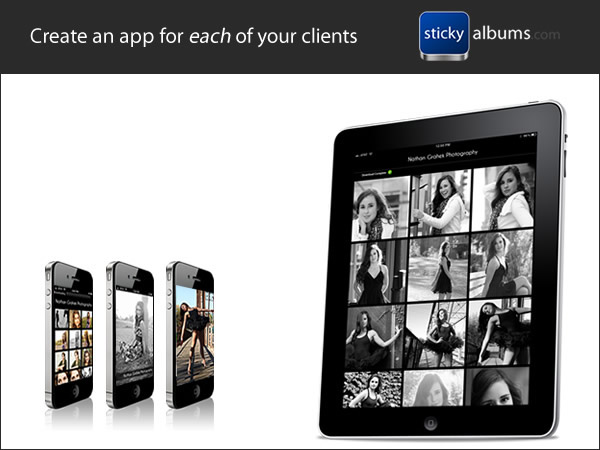
Sticky Albums – Sticky Albums lets you create digital photo album – which your clients can save to their iPhones and iPads as a separate app. This is how the vast majority of clients want their app anyway, so it is a great convenience for the client. The best part however, is how this service helps your marketing. All the photographs include your logo! So when the client shares these pictures, your brand is being marketed.

Sticky Albums

In summary, photographers are in a great position to embrace new technology for marketing and establishing a competitive advantage. I would love to hear in the comments how photographers are using the above mentioned resources for their photography business. Also, please let me know of any other innovative businesses out there helping photographers grow their business.

Filed Under: Business, Photography Tagged With: Business, ciderr, digital media, digital photography, disrupt, jimmy, moncrief, photo sharing, Photography, Photography Business, photography industry, pinterest, Wedding Photography

  • « Previous Page
  • 1
  • …
  • 16
  • 17
  • 18
  • 19
  • 20
  • …
  • 29
  • Next Page »

Subscribe To Tiffibox Treats!

Looking for a well-curated email newsletter that will leave you inspired and motivated about your photography business? Sign up below!

About Seshu

Seshu creates relaxed portraits of families and high school seniors in Avon, Connecticut. He also leads a successful headshot photography studio in Connecticut, helping professionals from a variety of disciplines project the very best versions of themselves. He created Tiffinbox as a way of inspiring photographers, to create better images and successful businesses. [Read More]

Email Templates For Headshot Photographers

Email Templates for Headshot Photographers

Recent Posts

  • How Capture One Changed My Event Photography
  • 10 Steps To Stay Positive In Times Of Great Stress
  • Why You Need To Read “Personal Branding For Photographers” Now
  • How To Master Your Website Content Step By Step?
  • Tony Taafe’s TNT Method For Headshot Photographers

Recent Comments

  • Stephen Davison on Are You A Business Owner Who Is Smart, But Stuck?
  • Ben A. on Don Giannatti Clinches The 8th Annual Tiffinbox Award
  • Dan on Don Giannatti Clinches The 8th Annual Tiffinbox Award
  • Donald Giannatti on Don Giannatti Clinches The 8th Annual Tiffinbox Award
  • Stephen Davison on G.E. Masana’s 6 Strategies For Wedding Photography Success
  • Naveen Kumar on Weddings In India Are More Than Being At The Right Place And At The Right Time
  • kartick on Weddings In India Are More Than Being At The Right Place And At The Right Time
  • Leonid Farbman on 6 Uncommon Trends To Grow Your Photography Business
  • Willow and Finch Wedding Photography on 11 Reception Tips To Help Your Wedding Photography
  • Web Designer Malaysia on How To Optimize Your Squarespace Website For Search Engines
  • Creastan on An Interview With Photojournalist G.M.B. Akash
  • Cindy Brown | Atlanta on An Open Letter To A Local Photographer

Become a Patron!

Copyright © 2026 · Tiffinbox · Site Design by Heather Mackan Creative · Built on Genesis