• Photography
  • Interviews
  • Business
  • Reviews

Tiffinbox

Inspiring Photographers

  • Home
  • About
  • Blog
  • Contact

The Sylights Interviews: 1 of 4 | Michael Guarisco: Using Lighting Diagrams

December 19, 2011 by Olivier Lance

Olivier Lance of Sylights last wrote a guest blog post here back in August about why one should use lighting diagrams. He is back with a short series of quick interviews with photographers. Here is the first one, with Michael Guarisco, an amateur photographer living in Nancy, France. He shares his knowledge and tutorials here (in French).
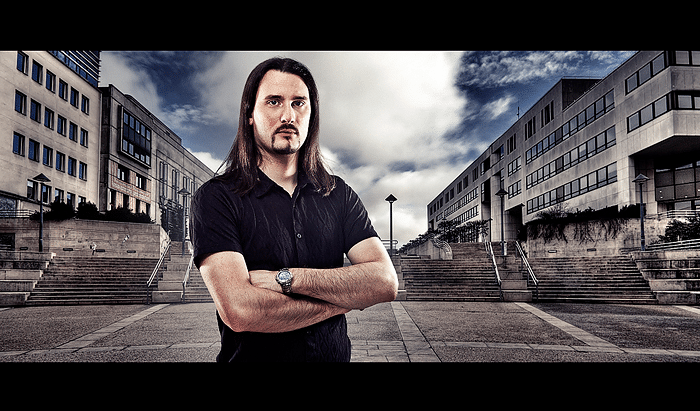
Michael Guarisco | French Photographer

Sylights: This picture is a composite image of at least two photos: one of the model and one for the background. Why did you choose this technique?

Michael Guarisco: This compositing technique is similar to the one used by Joel Grimes, an American photographer. He used it in some ads for Nike, for instance. I'm a fan of this style he achieved, so I wanted to try it myself. I love this work in different phases, it brings in several constraints: on lighting, on the choice of the background, and a heavy post-processing. I wouldn't make it my specialty but it's really instructive!

S: What is your workflow for that kind of compositing?

MG: I take a picture of my subject in a studio on a seamless background (black or white, depending on the subject's clothes, as I need a good contrast) to facilitate his extraction. The point being to find an effective lighting with three light sources, with the right modifiers, etc. … I know Joel Grimes uses large softboxes or beauty dishes. As an amateur, I'm happy with some simple umbrellas! After having processed and extracted my subject, I set off to find my background according the subject's attitude and style. It can take a lot of time, one needs to move and search a lot to find the background that will fit both the processing and the subject. When I've found my background, I take 5 photos with different exposures to perform an exposure fusion. Then I retouch the image a bit to get a satisfying result. If the subject's extraction has been done properly, the final compositing is done easily.

S: How do you make sure that the lights on your subject match those of the background? Do you have any special tips to achieve this?

MG: It's true that it's difficult to have matching lights between the background and the subject. You must simulate light coming from behind the subject to make it look real. Though I don't necessarily look for a perfect, logical lighting, I do make sure that my resulting picture as a whole looks coherent (prevailing color, temperature, etc.). I work a lot with the curves tool; I use it on my subject so that it integrates well into the background, then I use another curves layer on the complete image (I have a fondness for a slight cross-processed look). I completely assume using compositing and I think it's normal that anybody might see my picture is composited, but it's important not to neglect the image's fluidity. I want to hear people saying, “Yes, it's composited, but it works well!”
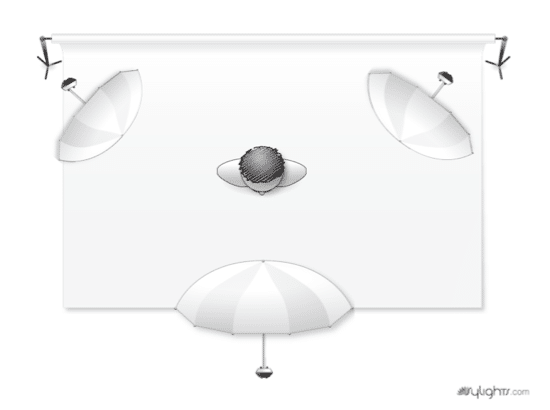
Michael Guarisco Lighting Diagram

S: What's the place of lighting diagrams in your work? Do you use them as a preparation tool or rather as a documentation tool?

MG: Lighting diagrams are certainly the most important aspect of working with flashes! First of all, they allow one to quickly learn what setups lead to different types of images. It's a very educational tool! Then, even when you're more experienced, it's still useful to plan a session by sketching a bunch of setups we'd like to use. I've always worked with lighting diagrams, I use them for myself as well as for showing others how I've created a photo, on my website. Even in the middle of a chat, a diagram scribbled in the corner of a napkin makes oral explanations way easier! In that sense, Sylights lets anyone archive flash photographs; the sharing aspect pops out, as anybody can understand how each posted image has been created. Moreover, when we work with many different setups it's pleasant to be able to find them back easily on the website!

Filed Under: Interviews, Photography Tagged With: amateur photographer, compositing, diagrams, Joel Grimes, light diagram, Lighting, michael guarisco, olivier lance, photo shoots, photographer, visual effects

Quick And Simple Photo Shoots

June 24, 2011 by Dan Watkins

Today's guest blog is by Dan Watkins, a widely-published photographer based in Boston, Massachusetts. He is a frequent contributor to the Improper Bostonian. Follow him on Twitter.

I was recently on-location at a Boston restaurant, photographing some food to accompany a magazine piece, when the manager struck up conversation. He reminded me that, when scheduling the shoot, I had mentioned only needing about twenty or thirty minutes to photograph. He then said he was ‘curious' to see what I would produce in such a short time.

The word curious appears in quotes because the tone in his voice led me to believe he actually meant ‘skeptical'. After talking with him more, it turned out most photographers the restaurant had worked with previously did produce great images, but either took a really long time doing so or used so much lighting equipment and modifiers that it became a serious disruption to the restaurant's customers and staff.

This conversation made me realize that there must be something to the adages ‘keep it simple' and ‘less is more' – even when applied to photography. So how can one keep it quick and simple on shoots?

Plan Ahead

My 20-30 minute estimate was based on the fact that we would only be shooting one or two dishes and that I was going to shoot predominantly with available light (adding just an off-camera speedlite if necessary). Since I knew the dishes would need to be prepped, cooked and plated, I also knew I could use that time to check out the location, look for a few good angles to use as backgrounds, and start setting my camera and flash accordingly. I was confident that a half hour would be more than enough time to get plenty of options for the magazine.

Food Photography By Dan Watkins

Food Photography By Dan Watkins - Cocktail

Minimize Lighting Gear and Utilize Available Light Instead

There are instances where shooting with ambient light rather than relying heavily on additional equipment is okay. Sure it's fun to see what sort of stylized images you can create with a four-light or more setup, but that might be something better suited for personal work instead of a client shoot in a public space. Just because you've grown an arsenal of lighting and modifiers doesn't mean there's anything wrong with leaving them home and going back to basics now and then. Less equipment also means less to go wrong, allowing you to focus more on making great photos!

Know How to Control The Available Light

Using ambient light as a main light source isn't enough if you aren't sure how to make it work for you. Pay attention to the quality, color and direction of the light on location and use it to your advantage. For example: using your aperture to control how warm or cool a space lit with tungsten appears on camera, or angling subjects so windows behind them or to the side provide a nice rim-light to separate them from the background.

Food Photography By Dan Watkins - Salad

Food Photography By Dan Watkins - Main Meal

Trust Yourself

Many photographers are far too critical of themselves. While this mentality might have its advantages while editing down a portfolio, for example, it usually doesn't help while on a shoot. Part of the reason a client hires a professional photographer is for their eye. They trust you have the confidence to portray their subject effectively, and so should you.

Know When You've Got The Shot and Move On

Gut feelings play a part in other aspects of professional photography – from what clients we choose to work with, to negotiating creative fees – so there's no reason to ignore them on a shoot. If it feels like you've got the shot, you probably do. It's easy to feel the pressure to over deliver and keep photographing a subject from every possible angle to ensure the client has many options. Most clients, however, prefer choosing between a few really strong images to narrowing down hundreds of minor variations.

Food Photography By Dan Watkins - Fried Fare

Food Photography By Dan Watkins - Variety

While I hadn't even considered my minimal gear and fast-paced process on similar shoots before this conversation, the simple and quick nature of the session was not lost on the manager. In fact, as soon as I finished he asked about my availability and interest in coming back to photograph for the restaurant.

None of this is to say you should always rush through your shoots. Nor should you leave your strobe kit packed away long enough to gather dust. But knowing when and how to work quickly and simply to bring out a location's most flattering light, as well as having the confidence to know when you've got the shot and wrap things up, are definitely attributes that some clients will notice and appreciate.

Food Photography By Dan Watkins - Entree

Food Photography By Dan Watkins - Cocktail

Filed Under: Photography Tagged With: Boston, boston restaurants, dan watkins, Flash, food photography, improper bostonian, lighting equipment, photo shoots, photographer, photographic lighting, Photography, quick and simple, shooting, simple photos

Subscribe To Tiffibox Treats!

Looking for a well-curated email newsletter that will leave you inspired and motivated about your photography business? Sign up below!

About Seshu

Seshu creates relaxed portraits of families and high school seniors in Avon, Connecticut. He also leads a successful headshot photography studio in Connecticut, helping professionals from a variety of disciplines project the very best versions of themselves. He created Tiffinbox as a way of inspiring photographers, to create better images and successful businesses. [Read More]

Email Templates For Headshot Photographers

Email Templates for Headshot Photographers

Recent Posts

  • How Capture One Changed My Event Photography
  • 10 Steps To Stay Positive In Times Of Great Stress
  • Why You Need To Read “Personal Branding For Photographers” Now
  • How To Master Your Website Content Step By Step?
  • Tony Taafe’s TNT Method For Headshot Photographers

Recent Comments

  • Stephen Davison on Are You A Business Owner Who Is Smart, But Stuck?
  • Ben A. on Don Giannatti Clinches The 8th Annual Tiffinbox Award
  • Dan on Don Giannatti Clinches The 8th Annual Tiffinbox Award
  • Donald Giannatti on Don Giannatti Clinches The 8th Annual Tiffinbox Award
  • Stephen Davison on G.E. Masana’s 6 Strategies For Wedding Photography Success
  • Naveen Kumar on Weddings In India Are More Than Being At The Right Place And At The Right Time
  • kartick on Weddings In India Are More Than Being At The Right Place And At The Right Time
  • Leonid Farbman on 6 Uncommon Trends To Grow Your Photography Business
  • Willow and Finch Wedding Photography on 11 Reception Tips To Help Your Wedding Photography
  • Web Designer Malaysia on How To Optimize Your Squarespace Website For Search Engines
  • Creastan on An Interview With Photojournalist G.M.B. Akash
  • Cindy Brown | Atlanta on An Open Letter To A Local Photographer

Become a Patron!

Copyright © 2026 · Tiffinbox · Site Design by Heather Mackan Creative · Built on Genesis