• Photography
  • Interviews
  • Business
  • Reviews

Tiffinbox

Inspiring Photographers

  • Home
  • About
  • Blog
  • Contact

How Photographers Can Get A Grip On Their Expenses And Create A Profitable Business

June 25, 2013 by Jason Aten

Jason Aten is a photographer and the author of Starting Out Right: Building a Profitable and Sustainable Photography Business. In addition, he is the CEO of NinetyNine Beans, which provides Full-Service Accounting for Photographers. You can read more posts like this on his blog: www.startingoutright.net

Some of the most common questions asked by photographers are: how much should I charge? How do I set up packages? Should I do packages or a la Carte pricing? These are all great questions. They are important questions. Often, though, the problem is that this is the first question a photographer is asking – before they ask some other, very important questions.

Numbers

The first question I encourage people to ask themselves is this: how much does it cost you to be in business? I know it's not necessarily as sexy a question – and it's a hard one to answer – but it's impossible to really start figuring out things like pricing and packages, without a good grasp on the answer.

Do you know how much it costs you to be in business? Do you have a system in place to track your expenses? Surprisingly, even though they are running a small business, many photographers don't have a good system in place. In my business, I TRACK EVERYTHING. I want to know where my money is coming from, how I spend it, and whether or not it helps – or hinders – the business.

Start by tracking your expenses. Start with the expenses you have, whether you photograph anything or not. These Fixed Expenses include things like Administrative Expenses (insurance, supplies, training and education, etc), Capital Expenses (new gear, large purchases that you depreciate, real estate, etc), Advertising Expenses (website, business cards, marketing materials, bridal shows, etc), Overhead Expenses (utilities and expenses related to a physical space like electricity, gas, etc), and Employee Expenses (wages and benefits for all non-sales related employees).

Next, track all of the expenses that go into the products and services you offer. In addition to what the lab charges you for an 8×10, this includes all of the expenses that go into SELLING and PRODUCING a product. These are your Cost of Sales Expenses, and include things like the wholesale cost from your lab, design charges, editing and processing expenses, shipping, sales related labor, retouching and travel.

Understanding these two types of expenses will give you a good idea of what it will cost you to be in business – which gives you a good idea of where to start when thinking about pricing for a profit. It seems like a lot of work, and it is, but its worth it.

Second, develop a system to help you keep track of revenue and expenses on an ongoing basis. Even if it's just a simple spreadsheet – that's better than nothing. There are some great tools available, including Quickbooks (and their online version). My personal favorite is Kashoo, which makes it super easy to input transactions, track expenses and generate really useful reports you can use to make decisions about your business. Many of the photographer-specific Customer Relationship Management tools (like ShootQ and others) have features that make it easy to keep track of your revenue and expenses.

Whatever system you choose, using it will only be as useful as the effort you put in. Make a commitment to understanding the financial health of your business by getting a grip on your numbers. Understanding what it takes to be profitable and sustainable means that you can make decisions that help your business grow – and add value to your life.

By the way, once you're using a system to track your expenses, it becomes easier to measure your performance. The Professional Photographers of America publishes benchmarks to help you measure the financial health of your business. Those benchmarks are designed to help every photographer take home 35% of their gross revenue as owners compensation and profit, and can help you evaluate where you may need to make changes in your expenses.

Finally, it's worth it to hire a good accountant that understands your needs. Someone who knows small businesses and can help you set up a plan – and stick to it. Accountants aren't just for saving money at tax time! A good accountant can make you money all year long by helping you know exactly where you stand. Having an accountant can mean having a trusted financial advisor on your team, helping you make the right financial decisions for your business.

Want to know more? We're hosting a free webinar this Wednesday designed to help photographers “GET A GRIP ON THE NUMBERS: Bookkeeping Basics for Photographers.” Simply visit www.ninetyninebeans.com/webinars to sign up for FREE.
Filed Under: Business, Photography Tagged With: Administrative Expense, Capital Expense, Expense, Expense Insurance, Fixed Expenses, Overhead, Overhead Expense, Photographers, Pricing, Track Expenses

Why You Should Buy Angela Pointon’s E-Book – “Worth More: A Simple Way To Create The Photography Brand, Pricing and Packages That Command The Money You Deserve”

June 18, 2013 by Seshu | Editor & Publisher

Do you ever wonder what your value proposition is to your potential client? In other words, what do you bring to the table that your “rightest” client will eat up and then thank you for it by paying you what you are really worth?

It's a simple question. But it's not so easy to answer or explain. Thankfully, Angela Pointon of Steel Toe Images has a new book out called “Worth More: A Simple Way To Create The Photography Brand, Pricing and Packages That Command The Money You Deserve.” [affiliate]

Long title, I know.

I just got done reading an advance review copy and I have to tell you the worksheets and exercises she puts you through are the very first steps any photographer must take to create a sustaining and successful business. It's critical that you define who your clients need to be and then work through your pricing and packaging that meets your target client's expectations. There is really no better way to synchronize your values with those of your clients.

From Worth More: “So we’re going to figure out your ONE awesome thing by conducting another written exercise. And honestly, there’s a chance you’re not doing anything awesome right now.”

When things are in sync, you get to make a living at something you love to do. No one can or should deny you that, especially you. So, here is what I am urging you to do. Watch this video below. Based on what you hear from Angela, figure out if you ant to be a thriving photographer or a struggling photographer. If it is the former, buy Angela's book. It's on sale from today through June 23 for $79. It goes up to $99 after that date.

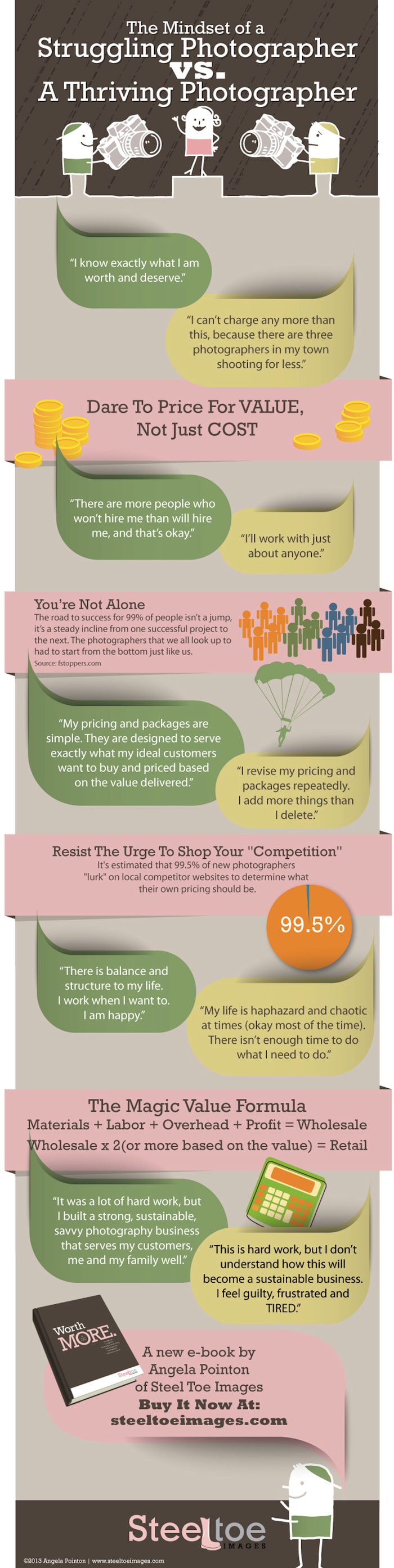
Angela also sent me this infographic that allows you to compare the two different photographers in the world: thriving or struggling –

Worth More By Angela Pointon

Now, let me be very clear about one thing. As I read through the e-book, Angela wants you to complete exercise after exercise so that the answers guide you to some startling and positive conclusions. If you are the type that buys info products and just sits on them, don't buy this book. That would be a sheer waste of money. However, if you are open to trying new things and actually doing what Angela prescribes, I'll guarantee that you will see incredible results.

So, why should you buy Angela Pointon's e-book? Very simply, reading it and doing the exercises will be transformative (with a little elbow grease) for your bottom line. Imagine not having to struggle to find the “rightest” clients. Imagine having time to spend with your loved ones. Imagine being able to create a nest egg that keeps growing. All because you spent a few hours gaining some much needed clarity on whom you want to serve and why.

For me saving $20 is still something. I'm going to bet it is for you too. So, get the book before the price jumps on June 24th.

Filed Under: Books, Marketing, Photography, Photography Business Tagged With: Angela, brand, Photography, pointon, Prices Packaging, Pricing, Worth, Worth More

Should Photographers List Their Prices? If So, Where?

June 26, 2012 by Angela Pointon

Angela Pointon is the founder of Steel Toe Images. She inspires photographers and other creative people to kick major butt through her consulting sessions, blog, emails, workshops and her first book (coming soon), called “ A Swift Kick In The Pants: Business Smarts For Us Creative Types”. Follow Angela on Twitter or on Facebook.

Should You List Your Prices, And If So, Where?

Pretty much every photographer I meet asks me this question. And whether you’re just starting out or have been around for years, it’s something that challenges many.

Angela Pointon With Money

Never In Expensive Print

A photographer I met with recently was about two years into the business. They thought that glossy brochures were a mandatory marketing “must” and printed a boatload when their business first launched. That was mistake #1. Mistake #2 was printing them with prices mentioned. When you need to increase prices (which they did), those brochures become useless. Ouch.

Price sheets should be printed off one or two at a time, never more. As your business grows, your price will typically increase. You never want to have a price written somewhere that isn’t easy to change.

Maybe On Your Website

If you receive most of your business through referrals, these consumers already have a price point in mind, because they probably already asked your past client. But if your business is a blend of referrals and completely fresh clients, you might be thinking that pricing can help attract them to you.

Consumers are busy these days. If you do not list your pricing, some will be frustrated that your price isn’t listed publicly for the entire world to see. So if you aren’t going to list prices (more on that in a minute), make it very easy for them to request it. Have your phone number and a quick form on the website (asking just a 3-4 questions… not a gazillion) and respond within 24 hours with an unbelievably well written and remarkable email or amazing phone conversation about what makes your business different. Attached to that, include your most recent price list.

But Seriously, Why List It?

Now we get to the why. Why… I mean, really… why list pricing on your website? What do you feel it is going to accomplish? You do not want someone choosing you based on price. So why go there right away?

If you and I were going on a date, I wouldn’t ask you how much you were planning on spending on me the first time we met. And you shouldn’t let people be so rude as to judge your value from a website visit alone, either. After all, what makes your business unique and what establishes your value is so much more than a price.

But ignore me if you must. If you’re going to list prices, be a tad vague. List starting prices and clarify that exact pricing will be provided. Give yourself the opportunity to at least engage with them, discuss your style and what you have to offer before you can have the only deciding factor be price.

Don’t Wait Too Long

If you do decide to remove pricing from your website, telling a potential client your pricing at a face-to-face meeting is too late. You’ve already invested time in them, and remember: you are qualifying them as much as they are qualifying you. Before you sit down with anyone, communicate how you’re unique and what you have to offer, and state your typical pricing range or send them your pricing sheet. Ask them if it’s within their budget. If it’s not and they aren’t willing to adjust their budget to afford you, you’ve saved yourself a ton of time. Spend that precious time on more qualified clients, instead.

How has listing or not listing prices worked for you or against you? I’d love to hear your stories!

Filed Under: Marketing, Photography Tagged With: angela pointon, Business, competition, increase prices, list price, Marketing, photographers list, potential clients, price, price list, price sheet, Pricing, suggested retail price, time based pricing

Small Business Smarts For Photographers

March 15, 2012 by Jared Bauman

Today's guest post is by Jared Bauman who has built a photography studio in Southern California that photographs over 200 events and sessions annually. In business for a decade, Jared's clients fly him across the world to document their big events. Jared is a Co-Founder and President of ShootDotEdit, the #1 post processing partner for the professional wedding photographer. Known for his business background, Jared has released several educational DVDs and tours the country speaking to photographers about their small business. Follow him on Twitter.

Think Like An Owner

Mention that you’re a small business owner to anyone, and more than likely the response is along the lines of “Wow, you must make a lot of money and have a lot of time off!” Contrary to popular opinion, being a business owner seems to be synonymous with being a jack of all trades and master of none. Being a small business owner is overwhelming, time intensive, and all consuming.

In his book “The E-Myth”, Michael Gerber talks about going to work ON your business, rather than IN your business. By stepping back and watching your business, you learn to develop a system that will work outside of you. Systems don’t make mistakes … Only people do. So by developing a system, you can ensure that your business will run smoothly and effectively, providing the best possible product and experience for your clients.

Think of how much time we waste each day. Imagine if you weren’t the owner of the business … But merely just an employee. What would the owner think of how you spend your time on a daily basis? Are you working just to get things done? Or are you going to work and acting like an owner, working on tasks that only an owner can to grow and advance the business?

Determine the tasks in your business that only you can do. Spend time developing a system at your studio. It takes a lot of effort. But, by creating a manual for your systems and operations, you’ll be on the path to working ON your business, rather than IN your business. And this is where you’ll experience all of the freedom that small business owners dream about.

Efficiency

As small business owners, we are responsible for every part of our business. Most days, we juggle email, phone, calendar, billing, editing, production, IT … All in addition to our busy shooting schedule!

Because of this, becoming hyper-efficient at the tasks we are required to do becomes imperative. If we HAVE to do the task (reference the previous entry for more on that), then we need to perform the task as quickly and efficiently as possible. This is the only way we’ll be able to spend our time growing our business, rather than just operating it.

Here are some great tips for becoming more efficient in your daily tasks:

1) Set up Drafts and Rules in your inbox to handle frequently asked emails. Typically speaking, most of the emails we receive … We’ve answered before. Save your answer as a Draft, and next time you get that same email, copy it over as a response. Add a personalized intro and close, and send it off!

2) Utilize Rules to sort through emails that you can delay for later.

3) Utilize shortcut keys. Apple has a well-developed set of shortcut keys, along with Gmail. Shortcut keys can shave minutes off of your daily activity, but these add up to hours each week. You can see what that adds up to each year.

4) Take advantage of software like Text Expander to further reduce duplicated time.

5) Maximize your usage of a To Do list app, like Wunderlist or Things. Tasks that can be handled quickly (under 2 or 3 minutes) should be taken care of right away. Anything else is placed on your to do list, with a defined due date.

6) Much of this seems mundane and somewhat extraneous. However, if you can maximize efficiency on day-to-day tasks, you leave yourself able to do more of what you love…. And isn’t that what we all got in this for?

Pricing & Packaging

Pricing. It’s often the last thing we think about as photographers. We focus on our website, our branding. We pour over reviews of the latest gear, and try to learn how to light for every situation. Email monopolizes our time, and fulfilling client orders takes up our off days. And yet, pricing is one of the most important pieces of our small business.

Believe it or not, there is actually a science behind Pricing. From the beginning, you should set your goals BEFORE you construct your pricing. Do you know how much you want to work? Do you know how much you want to make? All of these things should be taken into consideration as you construct your pricing.

Confusion is usually the main reason prospective clients don’t book. Confusion enters the picture when the pricing is introduced. It might be confusion through the structure of the pricing, and they couldn’t find a package that suited their needs. Or maybe they were interested in an album, and there were just far too many options. Maybe they didn’t see an engagement session anywhere, it wasn’t in the packages, and they couldn’t find it on the a la carte list.

Simplifying the pricing process gives you a huge advantage when it comes to booking.

Here are a few tips to keep in mind:

1) Have an odd number of packages. This gives your pricing a “natural middle” point, which naturally guides your clients towards certain options.

2) Whenever possible … Less is more! Reduce the number of options available.

3) Don’t show them the whole menu. Save the details for later.

At the end of the day, keep it simple, and remove confusion at all costs. This will ensure you give yourself the best chance of booking the wedding, and working with the couples you really want as your clients.

Filed Under: Business, Photography Tagged With: Business, business background, business owner, competition, educational dvds, human behavior, jared bauman, management, Marketing, owner, photographer, Photographers, Pricing, professional wedding photographer, small business, small business owner, smarts, solid foundation, time management

4×6 Print, $6 Or $60, Who’s Right?

December 20, 2010 by Seshu

Fundy, AvatarThis is a guest post by Andrew “Fundy” Funderburg, the creator of the Fundy Album Builder and Fundy Album Proofer. Please check out the free trials available at http://www.fundysos.com. If you were looking to design albums yourselves, I highly recommend Fundy's products.

I've seen many forum posts on pricing prints for photographers and they usually all end badly. There are those that defend the high price points due to labor, business costs and what the market will bear. And those defending the low end price points, focus on auto-fulfillment, and what the market is willing to pay.

So who's right? Well the answer is simple, both price points are correct?

How can this be? Well, ‘correct' pricing is based only on two things.

1. What the market is willing to pay for something.
2. That a price is profitable according to retail pricing rules.

Let's take a closer look. It's pretty easy to find out if people are willing to pay a certain price for something. You simply throw it out there in the marketplace and if people pay money for it, then it is a viable price. You can move the price point up and down. When it goes down, more people buy it, when it goes up fewer people buy it. Pretty soon, you find the happy price point, quite a few buyers at a profitable price point.

What is profitable? Well, according to the Professional Photographers Association of America, you'll want to have at least a 35% cost of goods mark up to be profitable – that is, pay your bills, run a profit and grow your business. A 35% cost of goods, simply means that for every $1.00 you make, it costs you 0.35¢. If you sell ice cream on the street corner, and you buy it for 0.35¢ and sell it for $1.00, then you have a 35% cost of goods.

To get retail pricing of goods, simply take your costs and divide by the percentage (35%=0.35). So, if something costs you $10 to create for your client:

$10 ÷ 0.35 = $28.50

We'll use this simple formula to prove both arguments are correct. We did this recently in a speaking engagement we had at ProDPI headquarters. We were using our new pricing program, Prosper™ during the demonstration.

Here in our settings, we have our cost of goods set at 25%, a good COG for an established photographer. We've also estimated our hourly rate in our studio for the work we do.

Prosper Settings Window

Now, let's look at two scenarios. The first being a photographer who is selling art prints for a portrait sitting or of the bride and groom in a posed shot. This is a special order, the photographer is going to retouch the print, have it shipped to the studio and the bride or groom (probably the bride) are going to come in and pick it up.

Print Pricing Scenario 1

As you can see we've calculated that we spend 15 min. finding, opening and retouching the image. We've set aside 10 minutes contact time with the client on the phone and 10 minutes time meeting the client in the studio to chat and $5 for shipping to our studio. Prosper™ has done the math for us, and calculated all of our costs and divided by 0.25. The total is $57. I'm going to just round that off to $60. So, you can see that with this business scenario, $60 for a 4×6 is the proper amount. And if the photographer educates the client about the quality of the print, it should sell.

Print Pricing Scenario 2

As you can see, quite a bit has changed here. In this scenario, we've used numbers for an auto-fulfillment. This photographer shoots the wedding, does minimal batch retouching with an action and uploads the whole wedding for anyone to buy. After that, they are done. We've added the price of the print to the calculation and allotted 5 minutes for a quick call or email if the client asks about the delivery of the print. As you can see, Prosper™ has done the math for us and come out to $7 for a retail price on this print. I've rounded down to $6 for the purpose of this discussion.

So, as you can see, depending on how your run your business, $6 or $60 can be the right price for a 4×6 print. It all depends on how much work you are putting into the final product. The only mistake you can make is creating a fine art print and pricing it like an automated fulfillment print.

The simple matter of fact is, if you know your cost of goods then calculating your pricing is easy Junior High School math.

Prosper™ is a product of Fundy Software. You can find out more here about a free trial and the limited time pricing special happening right now.

Filed Under: Business, Photography Tagged With: andrew, Business, business costs, competition, Fundy, highest price, how to use, Marketing, photographer, photographic printing, price, price prints, Pricing, print, printing pricing, retail price, retailing

  • 1
  • 2
  • Next Page »

Subscribe To Tiffibox Treats!

Looking for a well-curated email newsletter that will leave you inspired and motivated about your photography business? Sign up below!

About Seshu

Seshu creates relaxed portraits of families and high school seniors in Avon, Connecticut. He also leads a successful headshot photography studio in Connecticut, helping professionals from a variety of disciplines project the very best versions of themselves. He created Tiffinbox as a way of inspiring photographers, to create better images and successful businesses. [Read More]

Email Templates For Headshot Photographers

Email Templates for Headshot Photographers

Recent Posts

  • How Capture One Changed My Event Photography
  • 10 Steps To Stay Positive In Times Of Great Stress
  • Why You Need To Read “Personal Branding For Photographers” Now
  • How To Master Your Website Content Step By Step?
  • Tony Taafe’s TNT Method For Headshot Photographers

Recent Comments

  • Stephen Davison on Are You A Business Owner Who Is Smart, But Stuck?
  • Ben A. on Don Giannatti Clinches The 8th Annual Tiffinbox Award
  • Dan on Don Giannatti Clinches The 8th Annual Tiffinbox Award
  • Donald Giannatti on Don Giannatti Clinches The 8th Annual Tiffinbox Award
  • Stephen Davison on G.E. Masana’s 6 Strategies For Wedding Photography Success
  • Naveen Kumar on Weddings In India Are More Than Being At The Right Place And At The Right Time
  • kartick on Weddings In India Are More Than Being At The Right Place And At The Right Time
  • Leonid Farbman on 6 Uncommon Trends To Grow Your Photography Business
  • Willow and Finch Wedding Photography on 11 Reception Tips To Help Your Wedding Photography
  • Web Designer Malaysia on How To Optimize Your Squarespace Website For Search Engines
  • Creastan on An Interview With Photojournalist G.M.B. Akash
  • Cindy Brown | Atlanta on An Open Letter To A Local Photographer

Become a Patron!

Copyright © 2026 · Tiffinbox · Site Design by Heather Mackan Creative · Built on Genesis