• Photography
  • Interviews
  • Business
  • Reviews

Tiffinbox

Inspiring Photographers

  • Home
  • About
  • Blog
  • Contact

Getting Your Business Financially Prepared For The New Year (Sponsored By Outright)

December 30, 2011 by Jennifer Dunn

Today's timely guest post is by Jennifer Dunn of Social Street Media. She writes for a variety of clients, including Outright.com, the easiest way to manage your small business finances online!

No doubt you’ve already started the task of organizing everything for the end of the year. Or, at least, you’ve thought about it a lot! It’s never a fun thing to do, especially since it comes during one of the busiest times, the holidays.But considering your photography business’ future is very important at the end of the year. During the rest of the year it’s easy to put things off until later, including evaluating where our ventures are headed. When the New Year stares us down, it’s easier to commit to working a plan.

So what tasks are ahead for the savvy freelance photographer? Let’s take a look.

Take Photos

Hey, who would’ve thought? But these aren’t the usual beautiful landscapes and portraits you usually take. These are plain old boring office and workstations photos! Nonetheless, these pics can help you when it comes time for taxes. Your home office and/or workstation may be available for deductions from your small business. But if you don’t have evidence of anything you use daily for your work, it does nothing for you. Furthermore, your tax agent will know all the deductions you can feasibly pull off, but only if they know what you have set up for your office. While you’re at it, take stock of all your equipment as well. Along with your receipts, they will help authenticate the deductions you’re taking from your taxes.


Outright.com - Free Yourself from Accounting
Go Over Receipts and Contracts

Speaking of receipts, you’ll want to get all those in order before the rush of the tax season approaches. Times are tough, especially for those doing it on their own – naturally, you’ll want to squeeze every dollar you can out of your taxes. That’s why it’s important to have an up to date and accurate record of your exploits in 2011.

Do you know how much money you made and from where? Have you calculated all your expenses and categorized them properly? What about that DSLR you invested in earlier this year, did you take that into account? Everything has to have physical proof for it to work as a deduction, and every job you worked should be properly inventoried.

Going over receipts and contracts is especially important this year because of upcoming changes to your taxes like the PayPal 1099.

PayPal 1099

If you haven’t heard of this mysterious document, the PayPal 1099 is the newest tax document you may encounter in 2012. A lot of freelancers and small business owners operate through PayPal and other payment processing services like it, which means a lot of money is exchanged through these services. The IRS has taken notice, and now requires PayPal to report to them. This means you may get the new PayPal 1099 form. However, there are a few stipulations that may exclude you. For one, you must have made 200 or more transactions through PayPal. Also, those 200 transactions must have netted you $20,000 or more. If this sounds like you, then you’ll get the new form.

Luckily, it’s nothing complicated, just another tax form. However, it may mean you should wait until you actually get the form to start your taxes. Nothing like a little procrastination, huh? Check out the Outright Tax Center for more information on the PayPal 1099 and other important tax info for self-employed photographers.

What else do you typically do to ready your business for the New Year?

Make 2012 a win-win year. Did you know you can support this site by signing up for Outright? It takes just a few seconds. Outright.com – Automate your bookkeeping so you're always organized and ready for taxes.
Disclosure of Material Connection

Filed Under: Business, Photography Tagged With: Business, ebay, economics, finance, freelance photographer, jennifer dunn, outright, paypal, Photography, Photography Business, preparation, receipts, tax, tricks

Are You Really A Professional Photographer?

November 16, 2011 by Andy Bondurant

Some of you may recall Andy Bondurant's steamy blog post from almost a year ago called “What's Too Sexy For High School Seniors?“. Well he is back, with more advice for photographers. He is the co-founder and director of Senior Portrait Artists. You can find him on Twitter and Facebook.

I recently ran across a question on the question/answer/information site Quora. Here was the question, “How can I dress like a professional photographer?”

I can hear some of the responses some of you have come up with already. “Great, another amateur, jumping into photography taking more of my clients.” But wait just a minute more, because what I found truly disturbing was the first response.

You can visit the site for the full response, but here is the first line:

“This is an awesome question. In my experience shooting events, it's less important how you dress and more important how your equipment looks.”

What?

The right equipment for the right job can make a huge difference in getting the shot you want and need. By no means does it make you a professional. In fact, it may put you out of business quicker than anything else you could do. Professional equipment is expensive, and much of it is not necessary to begin a business.

Over the past 8-10 years, I've had the blessing of having multiple opportunities each year to watch great, professional portrait photographers work on location shoots. Most of the time they have exactly what they need, when they need it. However,many times I would hear things like, “Oh, I wish I had …” Then they move on to get a great shot without the piece of equipment they just mentioned.

So what is that makes GREAT photographers GREAT? It's not the equipment, and it goes beyond just training. Here are 3 qualities I've found seems to be similar among photographers who are professional.

1. Relationship.

The best photographers seem to be able to connect with their clients quickly and efficiently. If you want to get images that truly portray a subject's personality you need that person to trust you. You need them to believe you are going to make them look incredible.

If the client doesn't trust you it shows in their eyes. It shows in their body posture.

Personality is not necessarily the biggest factor in this either. Having a fun, outgoing personality helps, but I've seen more reserved photographers do just as well as larger than life photographers.

The key to building relationship is caring. Building trust means truly and genuinely caring for the client and how they look and feel.

2. Time.

Above, I mentioned greatness is more than equipment or training. Having the right equipment and training only take you so far. Having the right equipment without enough time using it will result in sub-par images. Having the correct training without time to practice and perfect that training will lead to a less than perfect product.

Malcolm Gladwell in his book Outliers calls this the 10,000 hour rule. His premise is anyone who excels in their field has spent 10,000+ hours perfecting it before they become “known” for their skill. He references The Beatles, Bill Gates and others who fit this theory.

There is no substitute for time in photography. The more time you spend shooting, editing and perfecting, the better photographer you will be.

3. Consistency.

John Pyle wrote an article for The Collective arguing that this one point is what truly makes a professional photographer professional.

The ability to get a great shot no matter the circumstances, time of day, or the not having the “right” equipment is what sets the pro apart from the amateur.

Consistency is directly related to #2. The more time you have doing photography the more consistent product you will create.

Let me wrap up by telling you one more thing.

I'm not a photographer. Before you completely forget what I've written based on that statement, think about this: Each one of the above points (relationship, time, consistency) applies to any profession.

I don't care if you are a doctor, lawyer, lock-smith, banker or pizza maker all 3 of these qualities will be found in the great ones. It will have nothing to do with the equipment they do or don't have.

It will be about creating relationships, having time invested in their profession, and consistently giving great service and/or creating a great product.

What do you think? Is Andy right on the money about this? Discuss below!

Filed Under: Business, Photography Tagged With: andy bondurant, consistency, factors, photographer, Photography, professional, professional equipment, professional photographer, professional photographers, professional portrait photographer, relationship, senior portraits, visual arts, visual journalism, Wedding Photography

Allen Murabayashi, CEO Of PhotoShelter On Photography & The Photo Industry

October 17, 2011 by Seshu | Editor & Publisher

For editorial photographers, looking to archive and sell or license their images, PhotoShelter offers a solution that is hard to pass up.

I caught up with Allen Murabayashi, the company's CEO last week and spoke to him briefly about the state of the photography industry, what we can expect to see out of PhotoShelter in the coming years and why those meaty guide books the company publishes helps to educate photographers about the current marketing trends.

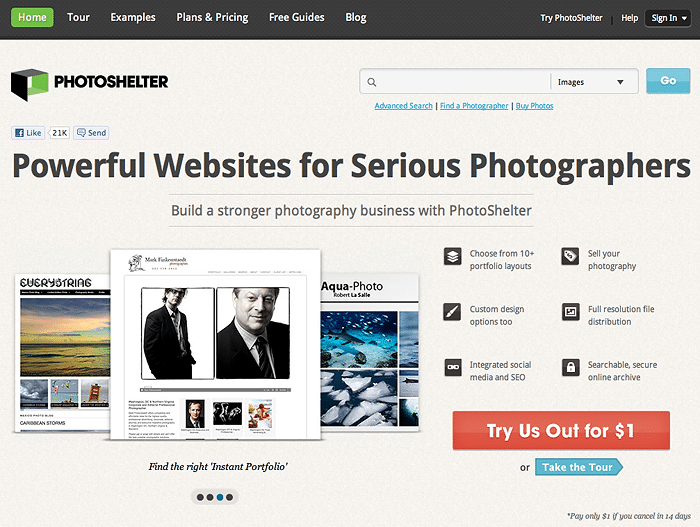
PhotoShelter Home Page

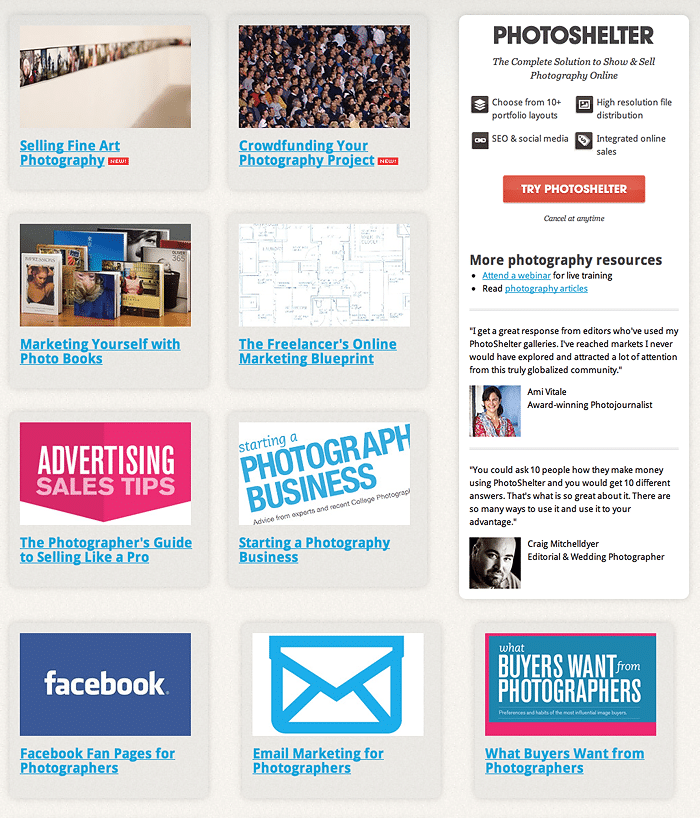
The complimentary guides help you grow your photography business:

PhotoShelter Free Guide Books

PhotoShelter is offering all Tiffinbox readers the following discount when you sign up for PhotoShelter before midnight on October 31st. When your readers sign up at www.photoshelter.com, they can enter the promotion code TIFFINBOX1110. The code entitles readers to the following discounts:

1) Annual Standard Account for $305.00/year – a $55 savings versus a monthly plan.
2) Annual Pro Account $529.00/year – a $70 savings versus a monthly plan

I am told that as of today, all new and existing standard accounts will receive 60 GB of secure storage (it used to be only 35gb), providing all standard accounts a safe space to store thousands of extra files. This increase comes at no additional cost.

Now that you have watched the video, can I ask a favor of you? Post a comment below & tell your friends. You have a variety of options below to spread the word. Thank you!

Filed Under: Business, Photography Tagged With: allen murabayashi, books, editorial photographer, editorial photographers, educational, guide books, Industry, photo, photo industry, photographer, Photography, photography industry, photoshelter, video interview, visual arts

Is Benign Neglect Killing Your Business?

June 21, 2011 by Phil Hollows

Today's guest blog is by Phil Hollows, the Founder and CEO of FeedBlitz, the email and social media automation service and premium FeedBurner alternative. He’s also the author of “List Building for Bloggers” – the leading book on email marketing and social media for people like us. See how to set up email services on FeedBlitz and follow Phil on Twitter.

Who, you? Neglectful? No, way!

Surely I’m talking about that other guy down the street. You take great care of your clients, your art and your business. Right? What could you possibly be neglecting?

You see, while we’re all busy worrying about blog posts and Facebook and Twitter, you’re probably neglecting your site’s most important asset – its email subscribers.

You’re not alone – tens of thousands of other bloggers, businesses and enthusiasts are making the same mistake right now. Tools, themes and widgets have enabled us all to become accidental email marketers, letting a fabulous resource go to waste.

The good news is, with a little work, you can make a huge difference to how quickly your list grows, how well subscribers engage, and – ultimately – into building your business through repeat sales and referrals.

Why? Because becoming an email subscriber is work. Squiggly letters to sign up. Dual opt in. Because of this work, though, these people are really committed to you. They loved what you say enough to put themselves through this process just so that they can hear from you again – what a compliment!

So don’t neglect them. Here are a few core tips, taken from my book “List Building for Bloggers” (use the code TIFFINBOX at check out for a 40% discount) that you can put into place right now:

1. Put your email subscription form above the fold.
2. Have exactly one email subscription form; choices can confuse.
3. Incentivize visitors with a reason to sign up.
4. Deliver that reward when they do using a custom landing page or autoresponder.
5. Brand your mailings so they stick in readers minds.
6. Subscribe to your own mailings so you get the real subscriber experience.

Once your list is growing and becoming more engaged, it can be used to help reward your most committed readers. A Facebook “like” is an air kiss – casual, with no commitment. An email subscriber’s commitment gets your foot in the door. Give them the same focus and attention they’ve shown you.

You can use that commitment and that trust. For example, as well as having your content emailed to them from your blog you can:

a. Ask for referrals.

b. Offer exclusive promotions and discounts (especially during quiet times of year)

So go on. Step it up! Stop being an accidental email marketer. Take a little care and take advantage of this powerful, universal medium. You won’t regret it!

So, do you have a list of people to whom you write to regularly? What lessons have you learned from your experience? If you don't have a list, would this blog post motivate you to start one? Let us know!

Remember to use “TIFFINBOX” when you check out List Building For Bloggers and get 40% off!

Filed Under: Business, Marketing, Photography Tagged With: audience, blogger, building, e mail, email, email marketing, engagement, feedblitz, feedburner, grow, income, list building, phil, strategies, to build, Twitter, world wide web

Keep A Work Log, Your Life Will Thank You

June 20, 2011 by Jocelyn Mathewes

Today's guest blog post is by Jocelyn Mathewes, a wedding and lifestyle photographer who works in both Boston and Baltimore. Given that it is a Monday and the start to your work-week, I figured her topic was highly appropriate. Follow her on Twitter and read her blog.

It's happened so often now, I've finally taken the time to listen: when folks look over my shoulder and see me taking notes, or have a chance to glance at my work notebook, they all say the same two things: “My, you're organized!” and “I love your handwriting!”

Handwriting and Notes

Yes, it's important to be organized (and there are several wonderful resources you should make use of below), but I'm here to tell you one thing that will be utterly amazing if you don't do it already…

Keep Track of Your Time

Much like the way financial advisers tell you to track every penny so you know where you're spending your money, track every minute of your work so you know where you're spending your time.

When I worked as a graphic designer in-house at a non-profit, I had to keep detailed records of all my activities and projects we worked on. The design department didn't really have a budget on its own; all of our work was funded by other peoples' budgets. When the end of the week came, we had to enter every increment bit of time we spent on a project to keep the engine going. My timesheet was a patchwork quilt of craziness!

This sounds daunting, scary, and annoying as hell, doesn't it? I'm going to tell you why it's SO IMPORTANT that you do this in your own business.

As it turns out, knowing where your time goes is an incredibly valuable thing, because it gives you feedback on how your business functions, and what (and how much) activity it involves.

I'm a mom with small children, and this is my part-time full-passion business. I know many others are in this very situation, or similarly restrictive ones. The moment they step away from the computer or return home from a shoot, they're flooded with the patter of feet, the dishes in the sink, or some party or practice to get to.

Having that restriction is a huge motivator to know where my time is going. Every minute I get to spend on my business is absolutely precious, because there's no guarantee I can make up work later in a day without sacrificing some part of my personal life or leisure. (I mean this literally! Have you seen the cost of childcare lately?)

Tracking your time reveals:

– inefficient processes that need to be refined.
– large chunks of work that could possibly be outsourced.
– repeated tasks that could be batched together for more efficiently.

Tracking your time also:

– shows what percentage of your effort going in to each area of your business.
– lets you estimate future task lengths based on past experience.

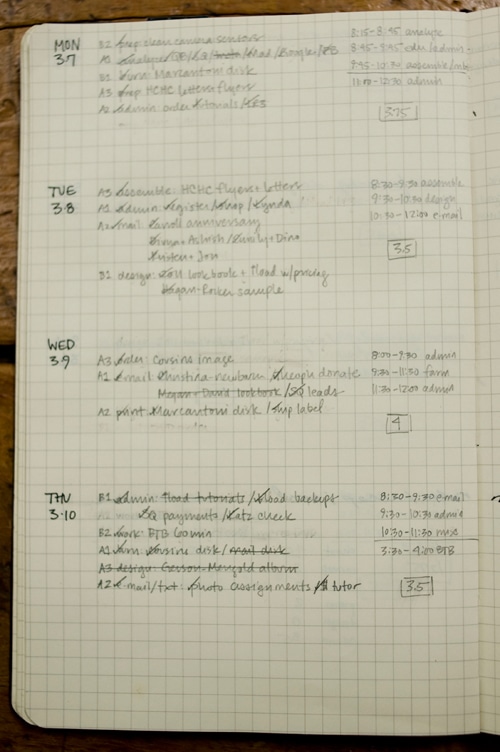
Organized Notebook Closeup

How I Do It

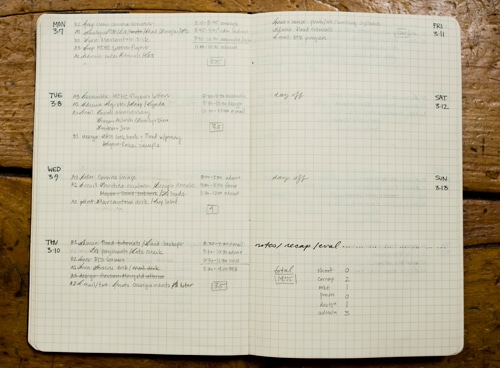
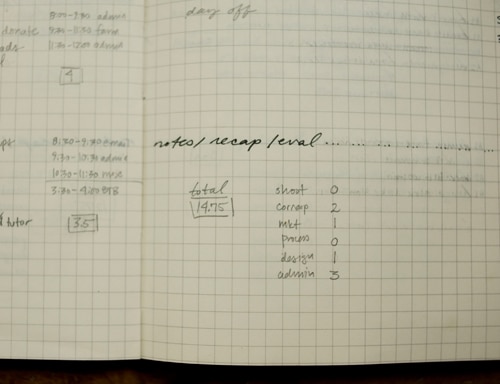
I have a notebook that I keep by my desk. Each spread is a week in my work life. Early in the week I enter in my tasks and prioritize them. As I go day by day, I write down the times I worked on certain projects, and tally the hours. I have set categories of activities that I keep track of in a separate tally.

Work Week Overview

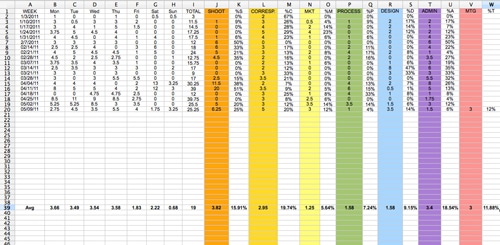
Every so often (and this isn't entirely regular), I take all these numbers and enter them into a simple Excel spreadsheet. The spreadsheet tracks number of hours worked on each of the days of the week, and the number of hours spent in particular categories I've determined are of interest to me. It then tallies the averages and spits out percentages: the heartbeat of my work.

The categories I'm interested in tracking are:

– shooting (time spent behind the camera or on my way to/from a shoot)
– editing (time spent in Lightroom or Photoshop, working on a shoot)
– correspondence (e-mail, phone calls, snail mail, and the like)
– marketing (social media time, designing marketing materials, distributing materials, and blogging)
– meetings (viewing sessions, prospective client meetings, conference calls)
– design (album designs as well as general in-house design work for my branding)
– administrative (filing, Quickbooks and accounting, analyzing my SEO, anything introspective)

Notebook Tally

Looking at all these tasks and percentages and numbers can make a person cross-eyed! But I'll tell you: it sure helps me to understand and the weeks where I worked hard and felt extra pressure, and where that pressure went (was I designing a lot, or was it a heavy shooting week?).

Also, knowing that particular kinds of activities take up a certain amount of time helps me designate days that I devote to that activity. Things that require minimal interruption (like editing and admin tasks) will happen on different days from more interruptive activities (like correspondence or social media tasks).

Worklog In Excel

If you like, feel free to download my little hackneyed spreadsheet and re-purpose it to your liking.

Of course, there are plenty of other electronic-based time tracking resources out there, but I prefer the paper version, because it forces me to take time and examine my priorities in a deliberate way. I also prefer to keep my work tasks and personal tasks in separate physical places, so that when I'm off work, I'm off work (a tough thing to do when running a business out of your home!).

Make it Yours

My system won't work for everyone, of course. The important thing I want you to take away is this: find a way to track your time. Build a system that works for you, and that gives you the insight into your activities that you need! Your life will thank you.

Productivity Resources

Making Ideas Happen
Scott Belsky of Behance.net, writes in an inspiring and clear way about what makes creative people (or teams) productive and effective.

Getting Things Done
David Allen's classic is a must-read for anyone who wants to get a little more task-oriented. Read more about it here.

43 Folders
Merlin Mann has an amazing set of articles available. Be sure to read his treatise on how to set up a “tickler file”.

Moleskine
Beautiful planners and notebooks that are just hecka fun to use.

Freckle
Time-tracking software for the iPhone and internet, also with invoicing capability (seems super useful for graphic designers).

So, tell us … do you track your time like Jocelyn? Do you have another system? What has worked for you and why?

Filed Under: Business, Photography Tagged With: notebooks, organize, own business, Photographers, Photography, profitability, profitable business, resources, spreadsheet, tracking time, work, work log

  • « Previous Page
  • 1
  • …
  • 20
  • 21
  • 22
  • 23
  • 24
  • …
  • 29
  • Next Page »

Subscribe To Tiffibox Treats!

Looking for a well-curated email newsletter that will leave you inspired and motivated about your photography business? Sign up below!

About Seshu

Seshu creates relaxed portraits of families and high school seniors in Avon, Connecticut. He also leads a successful headshot photography studio in Connecticut, helping professionals from a variety of disciplines project the very best versions of themselves. He created Tiffinbox as a way of inspiring photographers, to create better images and successful businesses. [Read More]

Email Templates For Headshot Photographers

Email Templates for Headshot Photographers

Recent Posts

  • How Capture One Changed My Event Photography
  • 10 Steps To Stay Positive In Times Of Great Stress
  • Why You Need To Read “Personal Branding For Photographers” Now
  • How To Master Your Website Content Step By Step?
  • Tony Taafe’s TNT Method For Headshot Photographers

Recent Comments

  • Stephen Davison on Are You A Business Owner Who Is Smart, But Stuck?
  • Ben A. on Don Giannatti Clinches The 8th Annual Tiffinbox Award
  • Dan on Don Giannatti Clinches The 8th Annual Tiffinbox Award
  • Donald Giannatti on Don Giannatti Clinches The 8th Annual Tiffinbox Award
  • Stephen Davison on G.E. Masana’s 6 Strategies For Wedding Photography Success
  • Naveen Kumar on Weddings In India Are More Than Being At The Right Place And At The Right Time
  • kartick on Weddings In India Are More Than Being At The Right Place And At The Right Time
  • Leonid Farbman on 6 Uncommon Trends To Grow Your Photography Business
  • Willow and Finch Wedding Photography on 11 Reception Tips To Help Your Wedding Photography
  • Web Designer Malaysia on How To Optimize Your Squarespace Website For Search Engines
  • Creastan on An Interview With Photojournalist G.M.B. Akash
  • Cindy Brown | Atlanta on An Open Letter To A Local Photographer

Become a Patron!

Copyright © 2026 · Tiffinbox · Site Design by Heather Mackan Creative · Built on Genesis