• Photography
  • Interviews
  • Business
  • Reviews

Tiffinbox

Inspiring Photographers

  • Home
  • About
  • Blog
  • Contact

How To Say “I Do” To Your Wedding Photography Business?

December 28, 2011 by Seshu | Editor & Publisher

This post and the one I just published about pre-designing albums have to do with wedding photographers but I am willing to bet portrait photographers can also glean quite a bit of useful information from the online webinars I am about to mention.

Let me be very clear (again) that I don't promote products, services or events if I don't personally feel they are valuable to me and by deduction, to you. So, with that being said, I have to tell you that in about an hour from now, wedding photographers will have the distinct opportunity to listen to some of the very best in our business – about the way they do business. The goal here isn't to blindly copy them, but to extract what you can and adapt it to your own unique situation.

The event is called I Do. It's a Joy of Marketing production and the awesome Sarah Petty and Erin Verbeck have brought us the following luminaries to chat with us about their businesses and what has made them successful in the past. If you are looking to do things differently in 2012, you'll want to register to listen for free or simply buy the recordings and the transcripts.
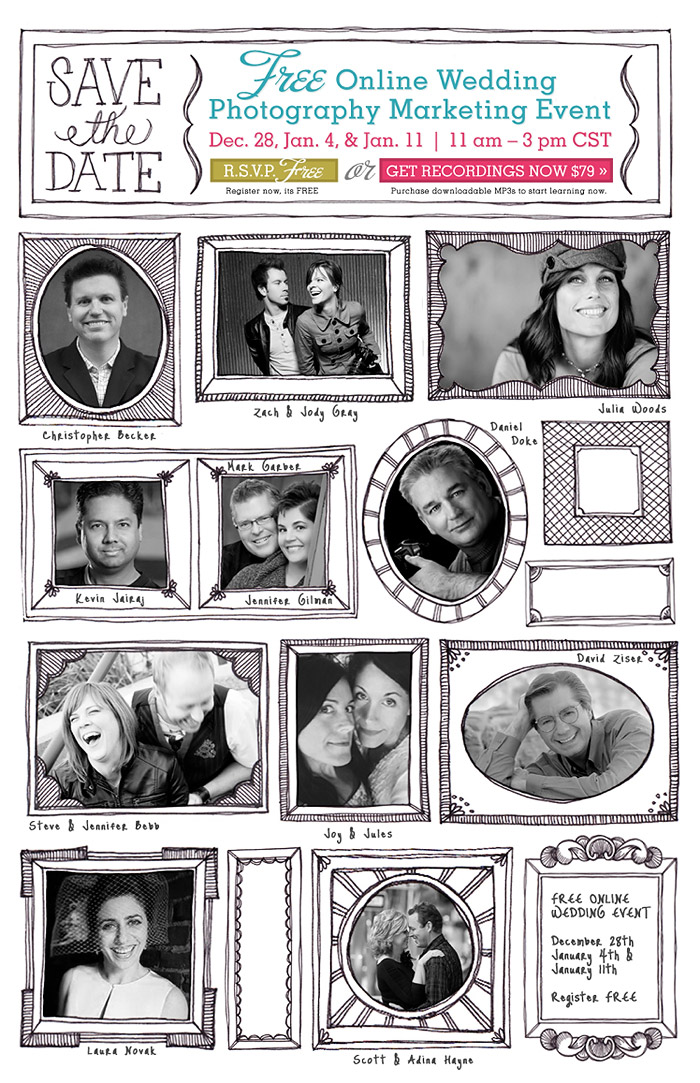
I Do. Joy Of Marketing.

Full disclosure – I received a complimentary set of just the transcripts and was blown away by how accurate and thorough they were. You can print them off one by one, as you are listening to each one of them and take notes or highlight whatever they are saying. This is how I plan on using them. The recordings are of course awesome because you can always go back to them and listen to them while you are on the road, working out in the gym or working on your edits on your computer.

If you haven't clicked on any of the links above and simply want to know who will be speaking, here is the list of presenters:

Christopher Becker
Zach & Jody Gray
Julia Woods
Kevin Jairaj
Mark Garber & Jennifer Gilman
Dan Doke
Steve & Jennifer Bebb
Joy & Jules Bianchi
David Ziser
Laura Novak
Scott & Adina Hayne

Learn more about the speakers.

The event is spread over 3 days – December 28th (that's today), January 4 and January 11. Here is the full schedule.

To be able to listen, you have to register. If you find the information useful, as I did, you can then make a decision to buy the recordings or the recordings and the transcripts. If you are reading this before the event launches at 12 pm EST, you may still be able to buy the recordings for $79. I know the price is going to go up after today. So, jump to it, if you are interested. And yes, if you click a link, say this one, and you end up buying the recordings, I get a small commission.

Filed Under: Marketing, Photography, Weddings

Make More Money With Album Pre-Designs?

December 28, 2011 by Eric OConnor

This guest blog post is written by Eric O'Connor, a Chicago wedding photographer, owner of Allori Photography and mylife-pages. Follow Eric on Twitter.

2012 will soon be here.

January is the perfect time to take a hard look at how to maximize profits in the upcoming year. These are a few recommendations that have helped me, follow all three and I know they'll work for you too.

1. What's in it for me?
2. Stay in Touch
3. Share the Love

What's In It For Me?

Your clients want information. They want to know every detail about their purchase. Give it to them! You are the expert. Share your knowledge and process with them. Whatever you do please don't wait until after the wedding to inform your client about the pre-design process. If you do they will feel cheated.  After they book with you make sure to take time or create a wedding album FAQ to walk them through the album process. This doesn't have to be complicated. Just a simple step by step from the day you shoot the wedding to the day you deliver their album. Set expectations and then deliver on them. It is important they understand you will be telling the story of their wedding day and you'll use as many pages as it takes to get it right. I always like to mention it gives them a great starting point. They can then customize the album to exactly what they want. Your clients will love this idea. Anytime they can take ownership in the process, you win!

Allori Photography FAQ

Stay in Touch

Take a minute and think about the excitement leading up to the wedding. Your clients are excited about their wedding and then … BAM! … the wedding is over. It doesn't take long and they are back to real life. Catch your bride and groom in that first 30 days and their wedding day excitement will do the selling for you. You likely only have a 30 day window to take advantage of the wedding high. If 30 to 90 days go by and your bride hasn't seen pictures or a draft of her album it is much harder to add pages or sell additional albums. I make it a point to have everything to my brides 7 days after their wedding. I used to deliver images 30 days after the wedding and routinely life got in the way and the brides wouldn't even think about their album for a few more months. There were always a lot of album edits and very little pages added. Now, 7 days after their wedding they can view their Animoto slideshow, image gallery, and album pre-design right on their wedding website. I make sure to give my clients a deadline. We want to have the album completed and ready to print in 3 to 4 weeks. This helps give them a target to have their changes complete. Extra albums page sales have gone from a few or none to five, ten or more from every wedding.

Allori Photography Album Site

Allori Photography Album Site

Share the Love

Quick turnaround time is essential but I find coupling that with excitement from friends has really helped additional album page sales. A few years ago I emailed PDFs to my brides and they would leave me comments for changes. This was pretty efficient but didn't help me much when it came to advertising or extra album pages. I don't pay for ads in magazines and only have one ad online that I tested out this year and will discontinue Jan 1.  Word of mouth, SEO, social media, and over the top customer service do the job for me. The next iteration of album sharing was a slideshow posted on YouTube. I found I was getting quite a few hits and at the same time album sales started to increase. Brides started telling me their friends loved watching their wedding album movies. This was one of those common sense moments when the light goes on in your head. Friends of the bride love the album and they start telling the bride about their favorite pages. This process makes it harder and harder for the bride to remove or change pages.

Album Views | Eric O'Connor

Finally I arrived at the perfect solution, Share the Love! Wedding album movies on a post wedding website are essential to higher album page sales. With a favorites gallery, Animoto slideshow, and movie of the album, my brides have a constant flow of compliments from their friends about how much they love the wedding images and album pages. As you can see in the graphic the album movie in this wedding was viewed over 200 times in 6 weeks. I have been completely removed from the album page sales process. Yes, I have to take images my clients love but my brides' friends do the rest of the work for me. I do not meet with my clients to sell or add pages. These days they all add pages without sitting down with me.

Album Views | Eric O'Connor | Allori Photography

Test out the three steps above. They are easy so don't cheat yourself and pick just one. Do all three. You will start to see a difference in sales. Click the image below to see how I display sample albums on post wedding websites.

Want to try a post wedding website? Your first site is FREE. Surprise one of your favorite clients with a wedding website with colors to match their wedding.

Filed Under: Marketing, Photography, Sales, Weddings Tagged With: Album, chicago wedding photographers, eric o'connor, Marketing, marriage, Photography, photography albums, pre designed, sales, Tips, Wedding, wedding album, wedding albums, wedding day, wedding industry in the united states, Wedding Photography, wedding website

Using Checkpoints For New Resolutions

December 23, 2011 by Aaron Hockley

This guest blog post is by Aaron Hockley, a professional photographer and writer who tweets too much and blogs a few times each week. His professional work finds him working with businesses for events, publicity, and editorial work; he also creates abstract and travel photos for leisure. In addition to photography for clients Aaron often works with other photographers to help them understand and refine their online and social media presence.

As we reach the end of 2011, we’ll be reading various articles online and in print about resolutions for the new year. Much like the proverbial gym membership which goes unused after the first few weeks of January, I’ve seen photographers drift away from their promises to change their practices once a new calendar begins.

Looking forward to 2012, I’d encourage folks to look at their photography world from two standpoints: that of the art and that of the business. If you’re a hobbyist, the business aspect is irrelevant. If you’re a professional, you’ll find that the art and business are intertwined. Instead of making a big list of resolutions, I’d suggest photographers pick a theme or two for their 2012 goals.

Baloon Burn at Lift Off | Aaron Hockley

An Artistic Resolution

From an art perspective, where do you want to go? Is it time to dive into the world of off-camera flash? Is this the year to spend some time learning how to make HDR images? Perhaps you want to get serious about black & white for output. It’s great to think about all of the things that you could do, but after that I’d challenge you to pick just one. Instead of a list, let’s choose one theme for the new year.

Getting Down to Business

If you’re a professional (either full or part-time), it’s also wise to make an objective evaluation of your business as we begin a new year. While each business is unique, here are a few items for evaluation:

• What aspect of your business brought in the most revenue in 2011?
• What aspect of your business brought in the least revenue in 2011?
• How much time and effort are required for each of the previous two answers? What’s the return on the time spent? We’re talking “bang for the buck.”
• What marketing are you performing, and what results can you attribute to each form of marketing?

After evaluating your current business situation, decide what will change in 2012. Pick a direction for a business change in the new year. Perhaps it’s the elimination of an unprofitable aspect to your business, or perhaps it’s time for something new. For my business, I’ve decided to begin marketing and selling my abstract photo art.

After the Theme: Action

So now we’ve picked a theme for something new or changed for the art and business of our photography. What next? Next is turning that big theme into actionable tasks. Sit down with your task planning system of choice. Perhaps it’s an application specifically for tracking tasks. Perhaps it’s a blank document in the text editor of your choice. Perhaps it’s a legal pad. It doesn’t matter.

Record your theme and then start brainstorming actions that will help you move towards that goal in 2012. The actions will be depend on your goal, but might contain:

• market research
• learning a technique
• going somewhere
• branding
• marketing plans
• studying others’ work
• connecting with other photographers in a genre
• outreach to past clients
• outreach to new clients

Massage your list into a plan. The next step is to do the work. Stop planning and start doing, starting January 1st if not before.

Empty Governance | Aaron Hockley

Checkpoints

Go to your calendar (again, either electronic or analog, it doesn’t matter) and add some items. Make a note to give yourself a checkpoint on your goals. Set checkpoints for at least once a month, with the first checkpoint no later than Janauary 15th. When you hit a checkpoint, take a look at your efforts and results. If you aren’t moving forward, why not? Do you need to adjust your goal?

Adjusting your goal based on situational feedback is fine and healthy. Abandoning your goal probably isn’t.

2012 can be a great year for your photography. I’d love to know what you’re planning to learn, explore, or change in the coming year. Sound off below in the comments section.

Filed Under: Call To Action, Photography Tagged With: aaron hockley, checkpoints, goals, Marketing, marketing plan, photographer, Photography, professional photographers, resolutions

Why You Should Consider Artist Residencies If You Are A Passionate Nature Photographer

December 21, 2011 by Joe Decker

Today's guest post is by Joe Decker, a nature photographer, writer and educator who lives in Northern California. Follow Joe Decker on Twitter to learn more about his workshops or read his blog. Learn about composition from him from his e-book, Tuesday Composition.

While I've had the opportunity to teach and work with hundreds of talented nature and landscape photographers, few if any of them ever consider artist residencies as a tool of developing their photography.

That's a pity.

Art Residencies by Joe Decker

Residencies offer artists a place to stay and focus on art. This adobe cabin is used to house resident artists at Petrified Forest National Park

What are artist residencies?  Residencies are programs which grant artists a place to live while they focus on their work. These programs can take many forms. In some cases, these residencies are created by fine arts programs, many of those residencies pull in several artists at a time with the hope of encouraging interdisciplinary work or at least a sharing of ideas. Many parks and organizations that manage natural areas have residencies which are usually more solitary, but that put the artist in close connection with the landscape, in part with the hope of encouraging artwork that promotes and communicates the features of that park. Even some commercial concerns create residencies, my shipboard arctic residencies provided me incredible access to hard-to-reach areas of the planet, with the expectation that I'd also provide some work back in the form of workshops and material for a passenger DVD.

Art Residencies by Joe Decker

Residencies are offered by many types of organizations, from fine arts collectives and parks to commercial cruise lines.

Why do so few photographers apply for such opportunities?  Part of the disconnect is cultural. There has always seemed to be a quiet divide between the photography community and the fine art community, and while artist residencies are a staple of the traditional fine art community, they're rarely if ever talked about in the photographic communities I've been a part of. There's also a mystique factor, because of this “quiet divide”, Many times talented, creative photographers make the mistake of thinking that their work won't be accepted by something they perceive as being part of the snooty “fine art” world. in reality, most residencies, particularly those applicable to landscape and wildlife photographers, are juried by people who do understand the creative potential of the photographic medium, and see art more broadly than many photographers might imagine.

Of course, there are some practical challenges to accepting a residency. Not everyone can afford the luxury of putting eight weeks into nothing but developing a new body of artwork. However, many people, particularly many talented amateurs, could afford two or three weeks if they understood the value they could get from a well-chosen residency.

Why You Should Consider a Residency

Why would a photographer wish to invest a few weeks in a residency? The most important reason to consider a residency is the opportunity for focused time. Whether you're a professional or an amateur, it is unlikely that you get to spend nearly as much uninterrupted time making photographs as you'd like. Whether it's the “day job at the factory” or the usual grind of marketing and selling your photographic work, the inevitable distractions of day-to-day life really get in the way of digging deeply into a photographic project. A few weeks dedicated to a project can bring depths to your work.

Cost is another reason. Few residencies offer anything in terms of cash, but there's no question that the value of simply having a decent place to stay for a few weeks in an area you'd like to work is substantial. My arctic, ship-board residencies are probably the most extreme example of this, the cabin that I stayed in during my Svalbard residency this year probably would have cost around twenty thousand dollars if I'd paid for it retail.

Climbing Lizard by Joe Decker

Some residencies offer access to unique resources, whether they be archeological, geological or cultural.

Which brings me to access. Every residency I've been awarded has offered me unique opportunities in terms of access to the locations I'd be working in. In my National Park residency, not only did I have the run of the park at night and sunrise t (when the park was otherwise closed to visitors), but I also had enormous support from the staff there, from access to their geologic archives to guidance on a couple hikes to lesser-known park locations, as well as access to many archeological resources. My arctic residencies included the support necessary to get me and my camera near to polar bears without risking my life.

Polar Bears by Joe Decker

Residencies often offer a variety of forms of other support, from access to art making equipment to support in getting to unique and otherwise inaccessible or dangerous locations.

How To Apply

First, find a program that's relevant to the kind of work you do, or at least the kind of work you'd like to do. You are more likely to be awarded a residency if it's clear how you and your work fits in with the opportunity being offered, and you'll are far more likely to benefit personally and professionally from a residency if the specific opportunity inspires you. If you're a wildlife photographer, you might want to skip that urban art center opportunity, unless you have a clear plan for applying your skills and interests to a new environment–and even then, you'll need to make a solid case in your application as to why you're the best person to benefit from the residency.

Carefully research each residency you apply for, and respond to each residency individually. In applying for my Petrified Forest residency, I proposed projects that both inspired me and that leveraged the unique features of that park, such as it's archeological resources and it's incredibly dark sky. The Park Service's own web site and in-park informational signage gave me a great deal of information about what they believed to be key features of the park, reflecting that understanding in my own proposal likely helped me win that particular residency.

Whether you're a professional or not, it is essential that you show that you're serious about your work. Few of these opportunities care about whether you make your living at photography, but all of them will care about whether you bring a serious, committed attitude to your art. There are many ways to show that in your application that don't require having been “in business” for ten years–have you being showing your work consistently over a period of time? Have you been published broadly?  Have you won awards or other recognition over time? Do you have references that can attest to the quality and longevity of your efforts?

Finally, don't give up. While there are a lot of residencies out there, there are also a large number of artists, not just photographers but painters, poets, sculptors and videographers often vying for the same slots. With effort and focus, you can take advantage of this wonderful opportunities to further your photographic efforts.

If you made it this far down, I have to ask you if you are now considering artist residencies to elevate your own craft. What, in Joe's article, moved you to make that decision? If you have any follow up questions for Joe, please feel free to ask him in the comments section below.

Joe has offered his e-book, Tuesday Composition, to one lucky person who comments below. Winner announced on December 30th.

Filed Under: Art, Nature, Photography Tagged With: Art, artist, artist in residence, artist residency, artist residency program, arts, Education, fine art, joe decker, landscape photographers, national parks, nature, nature photographer, nature photographers, photographer, Photography, residencies, residency, theatre

The Sylights Interviews: 1 of 4 | Michael Guarisco: Using Lighting Diagrams

December 19, 2011 by Olivier Lance

Olivier Lance of Sylights last wrote a guest blog post here back in August about why one should use lighting diagrams. He is back with a short series of quick interviews with photographers. Here is the first one, with Michael Guarisco, an amateur photographer living in Nancy, France. He shares his knowledge and tutorials here (in French).

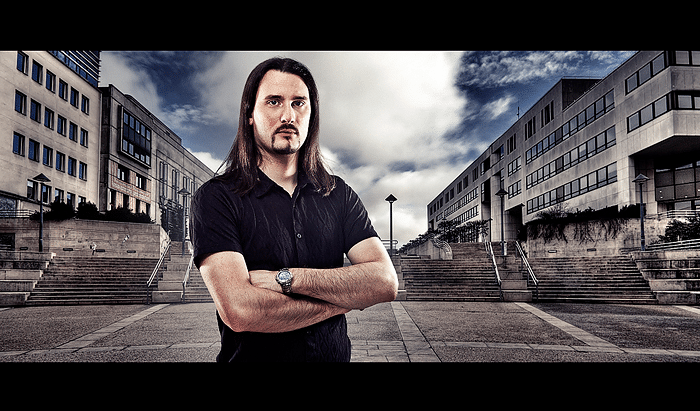
Michael Guarisco | French Photographer

Sylights: This picture is a composite image of at least two photos: one of the model and one for the background. Why did you choose this technique?

Michael Guarisco: This compositing technique is similar to the one used by Joel Grimes, an American photographer. He used it in some ads for Nike, for instance. I'm a fan of this style he achieved, so I wanted to try it myself. I love this work in different phases, it brings in several constraints: on lighting, on the choice of the background, and a heavy post-processing. I wouldn't make it my specialty but it's really instructive!

S: What is your workflow for that kind of compositing?

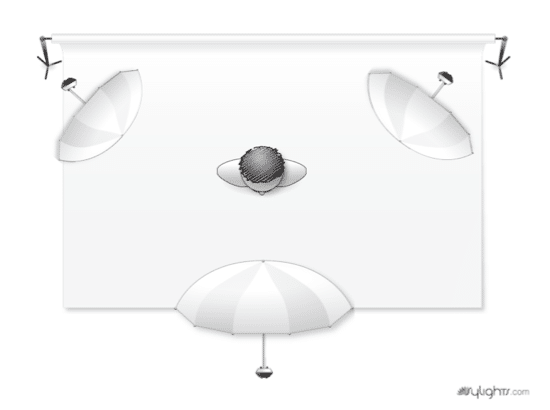
MG: I take a picture of my subject in a studio on a seamless background (black or white, depending on the subject's clothes, as I need a good contrast) to facilitate his extraction. The point being to find an effective lighting with three light sources, with the right modifiers, etc. … I know Joel Grimes uses large softboxes or beauty dishes. As an amateur, I'm happy with some simple umbrellas! After having processed and extracted my subject, I set off to find my background according the subject's attitude and style. It can take a lot of time, one needs to move and search a lot to find the background that will fit both the processing and the subject. When I've found my background, I take 5 photos with different exposures to perform an exposure fusion. Then I retouch the image a bit to get a satisfying result. If the subject's extraction has been done properly, the final compositing is done easily.

S: How do you make sure that the lights on your subject match those of the background? Do you have any special tips to achieve this?

MG: It's true that it's difficult to have matching lights between the background and the subject. You must simulate light coming from behind the subject to make it look real. Though I don't necessarily look for a perfect, logical lighting, I do make sure that my resulting picture as a whole looks coherent (prevailing color, temperature, etc.). I work a lot with the curves tool; I use it on my subject so that it integrates well into the background, then I use another curves layer on the complete image (I have a fondness for a slight cross-processed look). I completely assume using compositing and I think it's normal that anybody might see my picture is composited, but it's important not to neglect the image's fluidity. I want to hear people saying, “Yes, it's composited, but it works well!”

Michael Guarisco Lighting Diagram

S: What's the place of lighting diagrams in your work? Do you use them as a preparation tool or rather as a documentation tool?

MG: Lighting diagrams are certainly the most important aspect of working with flashes! First of all, they allow one to quickly learn what setups lead to different types of images. It's a very educational tool! Then, even when you're more experienced, it's still useful to plan a session by sketching a bunch of setups we'd like to use. I've always worked with lighting diagrams, I use them for myself as well as for showing others how I've created a photo, on my website. Even in the middle of a chat, a diagram scribbled in the corner of a napkin makes oral explanations way easier! In that sense, Sylights lets anyone archive flash photographs; the sharing aspect pops out, as anybody can understand how each posted image has been created. Moreover, when we work with many different setups it's pleasant to be able to find them back easily on the website!

Filed Under: Interviews, Photography Tagged With: amateur photographer, compositing, diagrams, Joel Grimes, light diagram, Lighting, michael guarisco, olivier lance, photo shoots, photographer, visual effects

  • « Previous Page
  • 1
  • …
  • 77
  • 78
  • 79
  • 80
  • 81
  • …
  • 164
  • Next Page »

Subscribe To Tiffibox Treats!

Looking for a well-curated email newsletter that will leave you inspired and motivated about your photography business? Sign up below!

About Seshu

Seshu creates relaxed portraits of families and high school seniors in Avon, Connecticut. He also leads a successful headshot photography studio in Connecticut, helping professionals from a variety of disciplines project the very best versions of themselves. He created Tiffinbox as a way of inspiring photographers, to create better images and successful businesses. [Read More]

Email Templates For Headshot Photographers

Email Templates for Headshot Photographers

Recent Posts

  • How Capture One Changed My Event Photography
  • 10 Steps To Stay Positive In Times Of Great Stress
  • Why You Need To Read “Personal Branding For Photographers” Now
  • How To Master Your Website Content Step By Step?
  • Tony Taafe’s TNT Method For Headshot Photographers

Recent Comments

  • Stephen Davison on Are You A Business Owner Who Is Smart, But Stuck?
  • Ben A. on Don Giannatti Clinches The 8th Annual Tiffinbox Award
  • Dan on Don Giannatti Clinches The 8th Annual Tiffinbox Award
  • Donald Giannatti on Don Giannatti Clinches The 8th Annual Tiffinbox Award
  • Stephen Davison on G.E. Masana’s 6 Strategies For Wedding Photography Success
  • Naveen Kumar on Weddings In India Are More Than Being At The Right Place And At The Right Time
  • kartick on Weddings In India Are More Than Being At The Right Place And At The Right Time
  • Leonid Farbman on 6 Uncommon Trends To Grow Your Photography Business
  • Willow and Finch Wedding Photography on 11 Reception Tips To Help Your Wedding Photography
  • Web Designer Malaysia on How To Optimize Your Squarespace Website For Search Engines
  • Creastan on An Interview With Photojournalist G.M.B. Akash
  • Cindy Brown | Atlanta on An Open Letter To A Local Photographer

Become a Patron!

Copyright © 2026 · Tiffinbox · Site Design by Heather Mackan Creative · Built on Genesis