• Photography
  • Interviews
  • Business
  • Reviews

Tiffinbox

Inspiring Photographers

  • Home
  • About
  • Blog
  • Contact

Using Sexy Light On The Beach

July 14, 2014 by MP Singh

Behind The Scene Look: How I Got That Shot

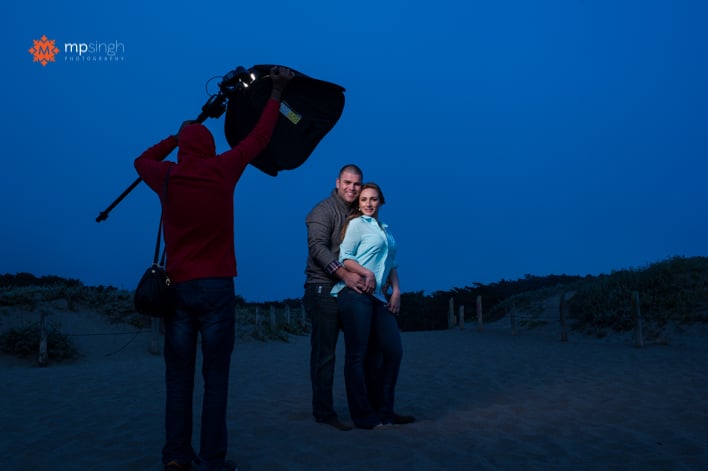
The image you see below was created as part of an engagement session. It was towards the end of shoot when we were at a beach and sun had already gone down. The park visiting hours were already over and there was a cop driving everyone out. And it was cold, the chill factor in the wind was sending shivers down our spines. We quickly grabbed couple of shots and drove out of the park.
MPSingh Photography - Couple On The Beach

This shot was taken with the help of an off camera flash, Nikon SB900 inside a Lastolite 24″x24″ softbox, triggered with my trusted Pocket Wizards. The following is a lighting diagram showing the set up for this shoot.
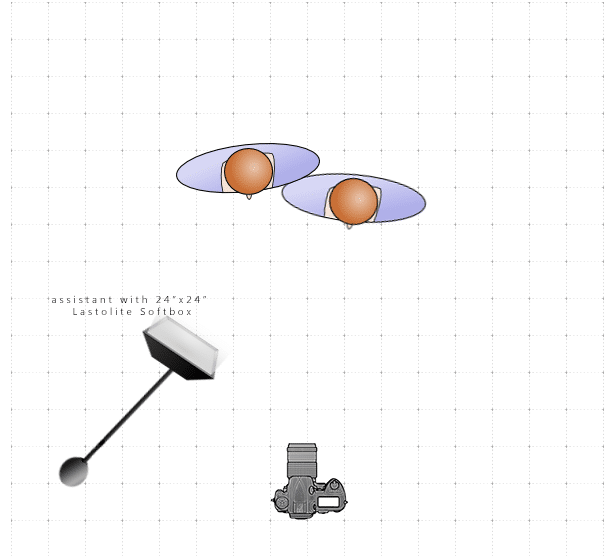
MPSingh Photography - Couple On The Beach Lighting Diagram

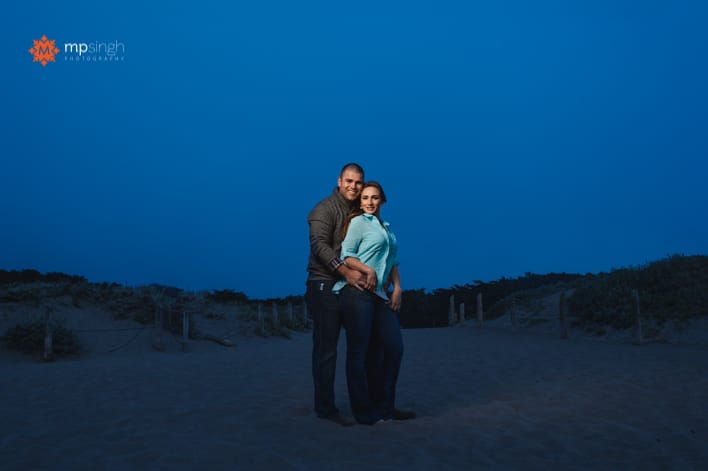
The flash had a full cut CTO (color temperature orange) gel on it. I wanted to give the feel for the post dusk bluish night sky. So I turned my camera to tungsten white balance. This gives the blue tint to the whole image. To compensate the blue tone on the subjects and bring the skin color back to normal yellow/orange tones, the flash had the orange gel on it. The full cut CTO gel fully compensates for the tungsten white balance.

Another challenge was that we required the light to be very close to the couple and we wanted wide angle shot to include more of the background for context. So the assistant was in the picture.
MPSingh Photography - Couple On The Beach

The Photoshop Work

To fix that we took two shots, one with assistant lighting the couple and in the shot. Before the second shot, the assistant ran out of frame and switched off the light. So the second shot was taken with the couple without any light. Once we take these two shots it is very easy to do a composite in Photoshop:

1. Open both the images in Photoshop as layers, with the image with assistant as the top layer.

2. Auto align layers (Edit –> Auto-Align). When we don't use a tripod there is always a slight movement of the camera and the frame changes. To compensate for that, we have to align the layers.

3. Once the layers are aligned, select the top layer and use layer mask to mask out the assistant. Now we are using everything else from this layer except area where assistant was. That area is picked up from the layer beneath.

4. Make other changes as required.

And, voilá, we have our final image. Do you have any questions? Feel free to ask below!

Filed Under: Home Middle Right, Lighting, Photography Tagged With: adobe photoshop, camera flash, Color Gel, digital photography, Flash, image processing, Layers, off-camera flash, Orange Gel, photographic lighting

Tips For Shooting On Location

September 14, 2012 by Brett Stoddart

Today’s featured photographer and guest blogger is Appleton, Wisconsin based Brett Stoddart. He shoots abandoned buildings. He shoots people. Sometimes he combines the two. He is a husband. A father. A traveler. An art and music lover. He says he has a wicked sense of humor, albeit an odd one. Check out his blog. Follow him on Twitter and or friend him on Facebook.

Recently I wrote about my experiences exploring and shooting in abandoned buildings. These places offer a plethora of interesting and unique shooting experiences. There are ornate interior design elements of days gone by; from peeling paint to exposed lathe and plaster and even the occasional hideous wallpaper (hideous by today's standards).

Brett Stoddart - Portrait Photography In An Abandoned Building

Brett Stoddart - Portrait Photography In An Abandoned Building

As photographers we are always searching out the next best location to shoot our clients, whether that is truly on location or a backdrop that has been procured to transform our interior shooting spaces to something they are not.

For me, the locations of choice have become those buildings that I so passionately explore. The grit, the grime, the decay; they have all become interesting elements in my portraiture.

I began my journey into portraiture at the urging of a friend and fellow photographer who also happened to be a model for many local merchants. Up until that point I was aiming a camera at another person or limited to your traditional snapshots at bars and parties. Now, I had practiced a little, I had studied, I kind of knew what was going on and I had watched others soaking it all up, but I never fully intended to become a portrait photographer. People scared me: they move, they talk. My buildings, not so much.

So it was with reluctance and great trepidation that I acquiesced.

A client and I drove out to a local farmhouse that had been abandoned for over 30 years, nearly empty of all remnants of human occupation. I set up my one light and softbox and shot that first frame. Wow. I was stunned. Who knew? The textures of the walls popped and at that moment I knew that I was on to something. We continued shooting and even went to a second location to shoot more. Three years later I still have 2 of the images from that day in my portfolio. Luck? Maybe.

Brett Stoddart - Portrait Photography In An Abandoned Building

Shooting on location always presents us with many challenges that we don't have to worry about in-studio: the logistics of getting there, hauling everything in, powering it, set up and tear down, etc. Many location shooters have probably been told to ‘move along' at some point in their career. It usually happens just when you've gotten into that groove and things are flowing nicely.

For me that is the risk 95% of the time when I shoot on location. Everyone wants their portraits at one of the abandoned buildings I shoot. But there are inherent risks in bringing a client into a structure that is not truly ‘safe'. In addition to potential structural damage, there could be health concerns, legal issues, and a myriad of risks that most people don't have to contend with. I try to obtain permission whenever possible if I will be shooting clients in these places. I have no problem signing waivers of liability that prevent me from taking action if something were to happen while on their property. Having the necessary legal documents tends to show that I am serious and not just a random trespasser. I carry blank forms with me for just this reason and it always helps to carry a book of my work. But finding owners is not always easy and truth be told it is rare that I get a chance to obtain permission.

I mainly shoot models in these locations, however this year I started shooting high school seniors too. The demand was too high to ignore although I have a different set of criteria for suitable locations for each.

For seniors, I really go the ultra-safe route by going to places where I know that our being there won't cause ‘trouble,' or have de facto permission from owners. They are the ones that are structurally sound, free of the most common health risks and in general: safe. The associated risks and nature of location are always discussed in depth beforehand.

When I'm with models, we will take a few more chances. We will go to the locations that are riskier, but with that risk there is certainly reward. In my opinion, a place rarely seen greatly enhances the value of an image. Models also understand the risks associated with these shoots, and I would never put them – or anyone – into a particularly dangerous situation. But we definitely push the envelope.

Brett Stoddart - Portrait Photography In An Abandoned Building

Brett Stoddart - Portrait Photography In An Abandoned Building

I am not a natural light shooter, I use off-camera flash. I don't like shooting natural light portraits; it doesn't give me the drama I like to create and presents a whole other set of logistical nightmares. How do you ‘sneak' into a building carrying 4 strobes, stands, modifiers, etc. and not be seen? Chances are you can't.

I usually have a good idea going into the shoot of what type of images I want and that allows me to plan my gear accordingly. Very frequently it is just one light, one stand, and one modifier. Travel light, get in, shoot and get out. Also, I always like to know the location I will be using beforehand. I don't like going into a fashion shoot location blind. It's not safe for me or the models.

Whether I choose to take a model in a $5000 wedding dress to an abandoned gothic cathedral, or clothe her in heroin chic and stick her in a filthy corner of a nasty factory, there are options to compliment or even contrast the look we are going after. I am in love with the juxtaposition of classic beauty mixed in with the beauty of decay.

Sure I can take safe studio shots of models and composite them into my abundance of already shot images from locations, but that would take all the fun out of it, and I don't like to continually be cooped up inside. I feel constant studio shooting drains me of creativity, although winter is approaching the Midwest faster than I would like.

Hmmm, maybe it is time to start to practicing those compositing skills … until next time, happy shooting and stay safe.

[blogshow id=9d07 player=1 autoplay=0 toolbar=1]


Filed Under: Lighting, Photography Tagged With: abandoned building, best location, brett stoddart, camera flash, location photography, Portraits, shooting experiences, shooting people, studios shoot

Strobist’s David Hobby Speaks With Tiffinbox

April 15, 2011 by Seshu | Editor & Publisher

Most of you probably already know who David Hobby is. He is a photographer, teacher and founder of the Strobist Movement, which encourages photographers to use their flashes off-of their cameras. His website Strobist is the go-to place to learn about off-camera flash techniques. His new project is HOCO360 – A Visual Journal of Howard County, Maryland, where he lives.

When David and Joe McNally decided to embark on The Flash Bus tour through the United States, I had to go. Boston was the closest of locations for me and so on April 9, I drove up to listen and watch two masters at work at the Boston Marriott Long Wharf.

Both David and Joe graciously allowed me to speak with them for a few minutes. In this post, we hear from David. He talks about creating a community and his new project.

All of this was arranged by Jeffrey Snyder of Adorama. So I am very grateful to him and the company that is truly there for photographers worldwide. Adorama is where I buy all my camera gear. Customer service is great and the price is right.

Watch the video and post your comments!

The Flash Bus tour wraps up soon, with most of the cities already sold out. The presentation in Boston was house-full. These guys not only know their stuff, they also know how to entertain. The repartees between them kept us all laughing out loud often. Now, if you can't make it any of their last remaining presentations, please consider buying David's Lighting In Layers DVD and Joe's The Language of Light. You will get a sense of what it is like to be in the audience from these excellent resources. I bought them and will have a full on review here soon. [Both are affiliate links. Support this site, buy through the links please!]

Filed Under: Off-Camera Flash, Photography, Reviews, Video Tagged With: adorama, boston marriott long wharf, bus tour, camera flash, david hobby, Flash, howard county maryland, jeffrey snyder, joe mcnally, marriott, marriott long wharf, masters at work, photographer, Photographers, strobist

Subscribe To Tiffibox Treats!

Looking for a well-curated email newsletter that will leave you inspired and motivated about your photography business? Sign up below!

About Seshu

Seshu creates relaxed portraits of families and high school seniors in Avon, Connecticut. He also leads a successful headshot photography studio in Connecticut, helping professionals from a variety of disciplines project the very best versions of themselves. He created Tiffinbox as a way of inspiring photographers, to create better images and successful businesses. [Read More]

Email Templates For Headshot Photographers

Email Templates for Headshot Photographers

Recent Posts

  • How Capture One Changed My Event Photography
  • 10 Steps To Stay Positive In Times Of Great Stress
  • Why You Need To Read “Personal Branding For Photographers” Now
  • How To Master Your Website Content Step By Step?
  • Tony Taafe’s TNT Method For Headshot Photographers

Recent Comments

  • Stephen Davison on Are You A Business Owner Who Is Smart, But Stuck?
  • Ben A. on Don Giannatti Clinches The 8th Annual Tiffinbox Award
  • Dan on Don Giannatti Clinches The 8th Annual Tiffinbox Award
  • Donald Giannatti on Don Giannatti Clinches The 8th Annual Tiffinbox Award
  • Stephen Davison on G.E. Masana’s 6 Strategies For Wedding Photography Success
  • Naveen Kumar on Weddings In India Are More Than Being At The Right Place And At The Right Time
  • kartick on Weddings In India Are More Than Being At The Right Place And At The Right Time
  • Leonid Farbman on 6 Uncommon Trends To Grow Your Photography Business
  • Willow and Finch Wedding Photography on 11 Reception Tips To Help Your Wedding Photography
  • Web Designer Malaysia on How To Optimize Your Squarespace Website For Search Engines
  • Creastan on An Interview With Photojournalist G.M.B. Akash
  • Cindy Brown | Atlanta on An Open Letter To A Local Photographer

Become a Patron!

Copyright © 2026 · Tiffinbox · Site Design by Heather Mackan Creative · Built on Genesis