• Photography
  • Interviews
  • Business
  • Reviews

Tiffinbox

Inspiring Photographers

  • Home
  • About
  • Blog
  • Contact

How To Get “The Big Picture” Of Your Photography Business

January 14, 2014 by Seshu | Editor & Publisher

Mr. Farnsworth was a terrific music teacher. Affable, yet stern. He would tell me each time I would return to take drum lessons, “Seshu, failing to practice is practicing to fail.”

It’s taken me nearly 30 years to absorb that. Sometimes, it would be obvious that getting my stuff done in time was beneficial and sometimes procrastination would get the better of me and I paid dearly. Still, creating a plan or a workflow and being organized simply has not come naturally to me.

Is that how you feel at least a few times a year? Do you feel that being organized would create at least a semblance of efficiency? Have you struggled to keep track of your client contact information or sales tax deadlines? Are you sometimes delivering your client orders later than when you promised them?

My friend Eric O’Connor, a wedding photographer in Chicago, tried to get me to think in about workflow. Several times. I remain in awe at how his allows him to photograph 30 weddings a year and be a father and a husband.

“Creating a system,” he told me once, was the ticket to being stress-free and happy.

I have a short stack of scratch paper filled with workflow ideas and what I would do the minute a potential client rang me. I had steps that I would follow after the portrait session was booked. But what would come after the shoot and in what order? Sadly, I had too many ideas and no action. This is mostly because having and maintaining a system requires clarity of thought and the “D” word … discipline.

Thankfully, Design Aglow is the photographer’s friend. I lean on the team there to provide me with ideas and templates. Just in time for the start of the new year, they launched a photographers’ studio planner called The Big Picture.

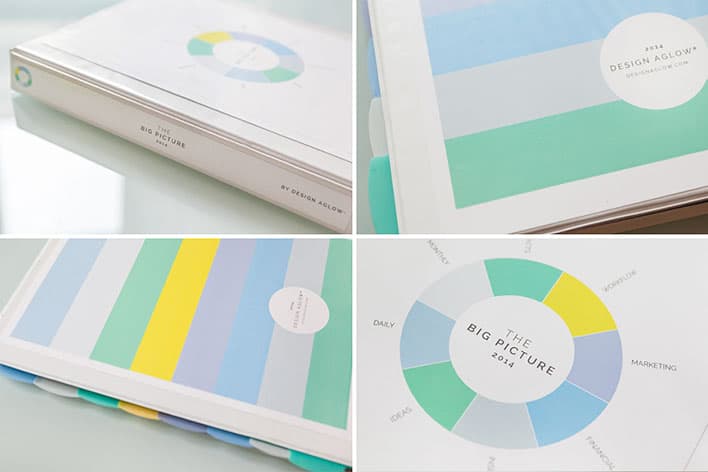
The Big Picture: Essential Studio Planner

The Big Picture: Essential Studio Planner

The Big Picture: Essential Studio Planner

Like all their templates, The Big Picture, does not disappoint when it comes to how it is presented. Minimalistic design meets elegance. The introductory section says, “it’s a repository for your hopes and dreams.” So true.

The Big Picture guides you through a short writing exercise where you enunciate your goals. Then you are gently coaxed into breaking down your goals into actionable tasks. Huge win for me.

There are templates for daily, weekly and monthly activities surrounding your studio. The exercise is in writing it all down and being able to refer back to it constantly. I think this is brilliant because it instills that sense of discipline and accountability to oneself that I mentioned above.

Keeping track of clients, venues and vendors (mostly for wedding photographers) is now easy as 1-2-3. There is a questionnaire and a time table that helps you through your online and off-line (local) marketing.

Want to track your website and blog statistics? Yes, there is a rather intricate table for that too. The Big Picture also includes income and expense reports that you fill out and also a mileage tracker (which I have usually forgot to log in the past).

The Big Picture ends with a long list of recommended business books one should read to stay informed and inspired. There were quite a few in this list that I hadn’t even heard of before. So, Design Aglow, thanks for that too!

I don’t think this team has missed any detail when it comes to putting this studio planner together. I know as I launch my new website and business this month, The Big Picture is going to help me stay focused and remain efficient through the year. It’ll be a binder that I take with me to client meetings and I’ll refer to it when I am trying to assess my business. It promises to provide me a macroscopic view of my business and will tell me about its health from month-to-month. I no longer have to fret about keeping tabs on my workflow or if my quarterly sales tax payments are late.

Now, there are a couple of things I would have liked to have seen in The Big Picture download: 1) InDesign files to further customize the templates and 2) perhaps down the road, an electronic version that we can refer to while we are in the field, say an iPad application that could display all of these bits of information?

[UPDATE: Both InDesign & Photoshop files are included! I had failed to open all of the folders that came as part of the zip'd download file! Sorry about the error!]

That said, The Big Picture is a remarkable achievement because it so neatly brings so many elements of one’s business in an easily accessible folder or binder. I know there are several other options in the market but as a die-hard Design Aglow fan, I have to urge you to take a look at this product first.

On January 15th (that’s tomorrow), the introductory pricing of $69 ends. Make this the first business expense you enter into The Big Picture for 2014!

In other words, buy it now.

Filed Under: Business, Most Popular Posts, Photography Tagged With: artists, Business, Clarity, efficiency, organization, photographer, Photographers, Photography, planning, productivity, Success, tracking progress

Five Steps That Ensures Your Marketing Rocks In 2013

January 1, 2013 by Angela Pointon

Good morning and a very Happy New Year to you all! Thank you for making 2012 such a special year for Tiffinbox. It's with your participation that we can make this site even better in 2013. I am truly excited to tell you that Angela Pointon, whose posts you have read here in the past, has agreed to come on board as a monthly contributor. Kicking that off is this very useful post for photographers who want to rock out their market in the new year. Read it, join us, comment!

A lot of photographers get confused by marketing. They consider it in the very beginning of their business, and those considerations typically include things they know they need, such as a website, business cards and a printed price list.

However, marketing is so fundamentally rooted when done well, that if you don't think about it properly, you'll end up spending a lot of money and wondering if it really made a difference in your business. Working on your own marketing is like being a doctor. If you don't truly understand the human body and how it functions, you cannot make it work better.

STEP 1:

Understand your target market deeply and fully. Often times, I find that business owners day dream about working with a certain target market, but find themselves consumed by working with another one. Thus, it creates an unfulfilling business and a bit of a feeling of quicksand that is difficult to get out of.

When you understand who you want to target, you take the first step toward landing more business from them.

STEP 2:

Understand what makes your business different. And remember, it has to be different in the eyes of your defined target audience… the people you want to be working with. I recently wrote an entire post about figuring out how to be a different, special and unique business in the eyes of your audience.

Read more about being different here.

STEP 3:

You have to define what financial bliss means for you. This is as unique as any other aspect of your business. Figure out how much you want to make and how many bookings you have to land in order to get there. Why is this important to marketing?

Your marketing should align with the goals of your business. If you do not define your monetary goal, how can you manage to market enough to obtain it? Oh, and one more thing about defining you financial bliss… it cannot limit you. Financial bliss is not a ceiling; it is just a target that you are shooting for. Exceeding it is highly possible and therefore, should be welcomed (assuming you're willing to work harder).

STEP 4:

Create the business goals you need to achieve in order to satisfy your financial bliss. These goals could include bookings, events you want to do or anything related to your business' success in 2013. I recommend including anywhere from 2-5 big goals.

STEP 5:

Take your big goals and break them down a bit. They should become a list of key steps you need to take in order to achieve the goals. As the days progress, your list of key steps will become daily tasks. I personally use Evernote, a free web-based tool and app, to keep track of the daily tasks I need to tackle in order to achieve my big goals. Goals become easier to obtain when they're broken down to small, easy-to-do daily tasks.

The One Page Marketing Plan

I recently launched a free webinar called the One Page Marketing Plan, where I went through the five steps listed above in greater detail and provided a free template for recording all of your thoughts and ideas. Download it here for free.

Photography Marketing Academy

On January 3rd, I am launching a new educational program called Photography Marketing Academy. This simple three-session program offers you access to up to five of your photographer peers and me. Together, we'll walk through your business goals for 2013, your current marketing, and you'll leave the sessions with clear, actionable steps you need to take in order to achieve a year of your dreams in 2013.

Angela Pointon's Photography Marketing Academy

Learn more about Photography Marketing Academy and register. Space is limited and registration will likely close the morning of January 3rd.

Filed Under: Business, Marketing, Photography Tagged With: Business, five steps, Marketing, Marketing Academy, Photographers, Photography, Photography Marketing, Success, Your Marketing

Crafting Your Photographic Vision Leads To Success

September 1, 2010 by Guest

Daniel Milnor, AvatarThis guest post is by Daniel Milnor who splits his time between the chaos of Southern California and the spiritual landscape of New Mexico. He is happiest with his notebook, Leica and trusty leather boots, sizing up whatever situation is happening in front of him.

Milnor is the author of the blog, Smogranch, which allows him to speak his mind, post his mother’s poetry and bring together like minded people around the globe. Connect with him on Twitter.

For being a “creative industry” we sure love to conform.

A trend develops, no pun intended, and suddenly the industry publications, blogs, advertising, seminars and trade shows are filled with what is hot, new and temporary.

I’ve never completely understood this.

This isn’t unique to photography. Look at television. One reality show becomes a success and suddenly three or four similar shows pop up, all slightly less relevant than the original. Within a year or two the public is saturated, bored and searching for a new thrill.

Today’s photography world is filled with more photographers than ever before as the barrier for entry into the professional world falls lower and lower.

So what gives? How do we look to the future with a positive glow in our eyes?

Well, to me it comes down to finding our individual vision and refining our style, and accomplishing this isn’t possible by following industry trends or what’s hot.

Finding your vision comes from intense soul searching, time in the field and mastering the basics of photography, things like light, timing and composition, not to mention actually having something to say, something unique and native only to you, or me, and not simply what the industry wants us to say.

Children's Portraiture by Daniel Milnor

Often times, words like “vision, soul, passion, style,” are thrown around with reckless abandon, but most of the time this is only for show. These things, these traits are easy to talk about but very difficult to actually acquire. The good news, you already have them and all you have to do now is find them inside yourself.

Why do you need vision? Style?

Well, in essence, your vision is the most valuable thing you have. Making unique imagery, instantly recognizable imagery, is what will create the demand around your business.

Yesterday I received an email from a potential portrait client who said, “I had another photographer booked to photograph my kids, but after I saw your work I canceled with them and knew you were the photographer I was looking for.”

Mirage by Daniel Milnor

If I followed the industry trends, used all the same tools that the masses of photographers were using, then how does the client differentiate between my work and the masses? What do I have to negotiate with?

If I’m using camera A, lens A, Photoshop action A, Filter A, and you are using all these same things, then where is the value in my work? Why would anyone hire me over the photographer down the street?

When photographers conform and follow the masses, what typically happens is the job comes down to price and how much the photographer is prepared to give away. What gets lost? The photographs.

This is NOT the situation you want to find yourself in.

When you produce unique imagery clients recognize they are seeing something they can’t get everywhere. This doesn’t’ mean you are going to book every job, the reality is far from this, but what becomes the focal point of the negotiation is the IMAGERY.

My point with this little story is that finding your vision isn’t easy and might require time alone and asking some serious questions.

“Who am I with a camera in my hand.”
“What am I trying to say?”
“What do I REALLY want to do?”

You might think this last question is an easy one but I can’t tell you how many photographers I’ve spoken with who have simply followed what the industry has told them to do, or what they feel “They have to do.”

How did I find my vision?

I found my vision by NOT working as a photographer. I began working as a photographer, full time, around 1993. By 1997 I knew something wasn’t right. I was working but I wasn’t particularly thrilled with what I was producing and after looking back at what I had produced over the entire year I realized I didn’t have anything to show.

So, I took a job working for Eastman Kodak and signed a non-competition letter stating I wouldn’t accept any assignments during my time working for the company. I sold all of my equipment except for one Leica M body and one lens.

Over the following four years I learned much about the industry, other photographers, but more importantly I had the time to learn about my own work.

Over the four years I worked for Kodak I shot extensively on the side, not for anyone else, strictly for myself. When I picked up a camera I had only my own vision in mind.

After four years I looked at what I had accomplished and finally recognized who I was with a camera in my hand.

I made the decision to leave Kodak and become a photographer once again only this time I had a personal vision to lead my way.

Mirage In The Desert, by Daniel Milnor

Had I NOT stopped working as a photographer I don’t think I would have ever come close to finding my vision. The industry and the controls being placed on me were just too powerful. There was little room to explore and what was expected of me was cut and dry.

My jobs today come more from me making suggestions than from a client telling me what to do. This is a very liberating feeling. When I book a portrait shoot or a wedding I book it because my work looks different and I have a clear vision of what I want to accomplish. Working this way feels like you are part of a creative collaboration as opposed to having to adopt to someone else’s idea of what images should look like.

My advice? Think about studying photography, really studying. Take classes, go to bookstores, go to galleries, museums and study what photography really has to offer. Learn who the masters were and are, and not just those in your genre. I’ve learned FAR more about how to photograph a wedding by looking at documentary work than I ever have from the wedding industry.

Also, think about taking on a long-term personal project, a project that is entirely controlled by you and preferably something outside your normal comfort zone.

Children's Portraits by Daniel Milnor

And finally, approach one of your best clients and suggest a new direction.

We can make all kinds of excuses about conforming, about not taking the time to find our unique point of view, but ultimately we simply owe it to photography to continue to explore the limits of our vision.

Finding your vision can be frustrating, confusing, sure, but when you begin to see a pattern or begin to see the proverbial light at the end of the tunnel the positive feeling will far outweigh any struggles you had to endure.

So go forth, take chances, break some eggs and keep your eyes open for the spark that can set you free.

Desert Mirage by Daniel Milnor

Milnor is a former newspaper, magazine and commercial photographer who now tries to work solely on his own projects, projects that allow him to work in the fashion he feels most likely to produce images that go beyond the temporary. Milnor is also a member of the advisory board at Blurb, a print on demand book publishing company comprised of some of the most creative and talented folks he has ever encountered.

He has taught at Art Center College of Design, The Santa Fe Photographic Workshops, The Julia Dean Workshops and is scheduled to teach in Peru, California and New Mexico in 2010. He has also found considerable success with his portrait work, which is represented by the agency Masterfile.

Filed Under: Commentary, Photography Tagged With: craft, crafting, creative industries, current trends, daniel, daniel milnor, event photographer society, industry trends, milnor, photographer, Photography, Success, vision, vision led, visual arts, Wedding Photography

Kick Start Your Year With “The View From Here”

January 1, 2010 by Seshu | Editor & Publisher

Selina Maitreya is a a photo consultant. She has been one for the last 30 years. Want to know how to approach your business? She's got answers. Ever had trouble editing your images down and showing your clients the very best? Yes, she can help. Are you looking for a mentor who can guide you through some murky business waters? She's the one.

Selina has authored two very popular books: Portfolios That Sell: Professional Techniques for Presenting and Marketing Your Photographs and How to Succeed in Commercial Photography: Insights from a Leading Consultant

She charges $300 an hour and for good reason, too. She is good. No, very good at what she does. But for a photographer who is just starting to set up her or his business, her consulting fees can add up fast. So, Selina brainstormed and came up with The View From Here, a nine-hour, 12-chapter series of MP3 recordings that covers all that you may be looking for and more.

As I listened to her, I found myself furiously taking notes as she gently outlined for me (and yes, it does sound like she is speaking with and not to me) the steps any photographer must take to be successful in this industry. Let me correct that … steps any photographer must take to THRIVE in this industry. Now, as a documentary wedding photographer, I have certain take-aways that may differ from someone who is a photojournalist or a commercial photographer. I say, make it your own. However, the business foundation for all genres of photography is nearly identical. Start by setting specific goals, have an incredible product to offer and create honest and meaningful relationships with your clients.

“The View From Here – it's priceless! I am getting the real time coaching from Selina in whatever topic I select to consult or learn how to continue growing my photography business.” Raymundo, Ohio

In full disclosure, Selina generously gifted the entire set of MP3 audio files for me to check out and review here on Tiffinbox. But as I have said before, if a product I am writing about doesn't meet my high standards for quality or it will not elevate my business (and subsequently yours), I won't review or even mention it.

Selina has clearly put her heart and soul into this project and I know you will get tremendous value out of it. I know it is the beginning of a new year. Do yourself and your business a favor and consider buying The View From Here today! Use the code: FOSSES to get it for only $99 (original price is $199). See, I am also committed to finding you the very best offers out there that will help your bottom line!

Still not sure? Then download this free chapter from The View From Here

If you have any questions or comments, please feel free to post them below. I would love to hear from other photographers who have bought the program from Selina, listened to it and can share what they have learned from her.

Filed Under: Books, Photo Biz, Photography Tagged With: audio book, Consulting, MP3, Photography Business, Success

Subscribe To Tiffibox Treats!

Looking for a well-curated email newsletter that will leave you inspired and motivated about your photography business? Sign up below!

About Seshu

Seshu creates relaxed portraits of families and high school seniors in Avon, Connecticut. He also leads a successful headshot photography studio in Connecticut, helping professionals from a variety of disciplines project the very best versions of themselves. He created Tiffinbox as a way of inspiring photographers, to create better images and successful businesses. [Read More]

Email Templates For Headshot Photographers

Email Templates for Headshot Photographers

Recent Posts

  • How Capture One Changed My Event Photography
  • 10 Steps To Stay Positive In Times Of Great Stress
  • Why You Need To Read “Personal Branding For Photographers” Now
  • How To Master Your Website Content Step By Step?
  • Tony Taafe’s TNT Method For Headshot Photographers

Recent Comments

  • Stephen Davison on Are You A Business Owner Who Is Smart, But Stuck?
  • Ben A. on Don Giannatti Clinches The 8th Annual Tiffinbox Award
  • Dan on Don Giannatti Clinches The 8th Annual Tiffinbox Award
  • Donald Giannatti on Don Giannatti Clinches The 8th Annual Tiffinbox Award
  • Stephen Davison on G.E. Masana’s 6 Strategies For Wedding Photography Success
  • Naveen Kumar on Weddings In India Are More Than Being At The Right Place And At The Right Time
  • kartick on Weddings In India Are More Than Being At The Right Place And At The Right Time
  • Leonid Farbman on 6 Uncommon Trends To Grow Your Photography Business
  • Willow and Finch Wedding Photography on 11 Reception Tips To Help Your Wedding Photography
  • Web Designer Malaysia on How To Optimize Your Squarespace Website For Search Engines
  • Creastan on An Interview With Photojournalist G.M.B. Akash
  • Cindy Brown | Atlanta on An Open Letter To A Local Photographer

Become a Patron!

Copyright © 2026 · Tiffinbox · Site Design by Heather Mackan Creative · Built on Genesis