• Photography
  • Interviews
  • Business
  • Reviews

Tiffinbox

Inspiring Photographers

  • Home
  • About
  • Blog
  • Contact

An Interview With Photojournalist G.M.B. Akash

November 11, 2010 by Seshu | Editor & Publisher

G.M.B. Akash, AvatarThis is a very special interview with an international, award-winning photojournalist G.M.B. Akash. He is based in Dhaka, Bangladesh and represented by Panos Pictures. Wrangling him into finding the time to answer these questions took some doing because he was always on the road working on one project or another. So, I am truly honored to host his images and his responses to a few of my questions here on Tiffinbox. If you have any questions or comments for him, please do submit them at the end of this post!

1) Tell us a little bit about yourself. Where are you from? How old are you?

I grew up in a home far removed from my profession. Throughout my childhood I did not have access to photographers, their work, or even a camera. Photography did not exist for me in theory or in practice. Then a decade ago I found my father’s old camera and my life took a different turn. My fascination for the captured image was uncontainable and overcame everything — even my inexperience. Not knowing what I was doing or why, I went everywhere shooting anything and everything that caught my attention. The only thing I was certain of were the subjects I photographed. I concentrated on people living on the edge of society because their faces, lives, and living conditions held a particular fascination for me. Gradually I became absorbed in their daily lives for months on end, learning from their experiences. My desire to capture it all on film pushed me to go to places and to meet people I never would have encountered otherwise. Each visit gave me a deeper understanding of humanity.

I am from Narayangonj, a city which is 200 km away from Dhaka. I come from a middle class, very ordinary family. I was born in 1977. I was always a last bencher in my school. I always felt inside that I have no talent like other kids. But photography gave me a new life.

G.M.B. Akash, A Photojournalist

2) Some would consider you Bangladesh's best known photojournalist. What has led to that success?

Hard work, honesty and respect towards the people whom I photograph.

G.M.B. Akash, A Photojournalist

3) Where were you trained as a photographer? And why, photojournalism? Why not advertising or travel?

My passion for photography began in 1996. I attended the World Press Photo seminar in Dhaka for 3 years and graduated with a BA in Photojournalism from Pathshala. I believe that the formal study of photography is necessary to survive in the industry today. But most important things are to be really passionate and dedicated.

The formal study helped me a lot but most of the time I learned from other photographers. I have learned from painting, songs and movies as well. Everyday I go through the work of other photographers and I learn from them. I have learned from many photographers.

Photography pushed me to go to places and to meet people I never would have encountered otherwise. Each visit gave me a deeper understanding of humanity. Today, I count myself blessed, having become a photographer. To be able to articulate the experiences of the voiceless, to bring their identity to the forefront, gives meaning and purpose to my own life.

In 1998, I saw a photo exhibition on AIDS victims, titled ‘Positive Lives’ at gallery in Dhaka. And realized for the first time how images can influence social perception. My first reaction, on seeing the exhibit was a complete subversion of my original perception of AIDS patients. It struck me how patients with AIDS are alienated and scorned by us because of social misconceptions, and I realized how I as a photographer could help dispel these misconceptions. I discovered the power that images have over us.

To me, photojournalism is a huge responsibility and a tough job. A photojournalist must be honest, hard worker, punctual, and he or she must respect other people.

I believe photography can bring lot of changes in our life. It can bring positive changes. In my case, “my images are my voice, I want to show the things that should be corrected or should be appreciated.”

G.M.B. Akash, A Photojournalist

G.M.B. Akash, A Photojournalist

G.M.B. Akash, A Photojournalist

4) What drives you to make images? Do you see it as a job or as a calling?

What I find most amazing about the work I do is that it opens my eyes to all these little pleasures of life. There is great pleasure in meeting people who are despised by the world, in sharing a cup of tea with them, and discovering that they are still capable of affection, though they themselves go unloved.

This is not a job about making money or succeeding; it is about pursuing art, and opening people’s eyes. That is the responsibility of every photographer.

G.M.B. Akash, A Photojournalist

G.M.B. Akash, A Photojournalist

5) How do you take on projects? Are they self-financed or do you write grants?

Most of my projects are self–financed. I keep saving my money from other assignments to keep doing my personal projects. I do not like using my camera for begging. Each of my projects usually lasts over a year or even two and I begin to use my camera only when I have earned the trust of the people whose lives I want to document.

To portray a community or a way of life, you first need to understand it well yourself, otherwise the images become superficial, and neither you, nor those who look at your photographs, will be touched or moved. In fact, I let the year pass in regular visits to a small community of transvestites in Dhaka, before I eventually started taking their photos. I like to mingle with my subjects, I visit them often, and I invite them to my house, to get it across that I see them as people rather them mere subjects of photography.

G.M.B. Akash, A Photojournalist

G.M.B. Akash, A Photojournalist

6) There is great sensitivity to people in your images? How did you cultivate it? How do you approach people when you are doing stories?

With every picture you take, you enter a space that is unknown to you as a photographer. In the beginning it feels like forbidden territory, a place you are not supposed to enter surrounded by borders of privacy you are not supposed to cross. You, the photographer, are there at a factory, an old home or a brothel with your simple black bag hanging from your shoulder, eying everything around you as you are eyed by the people there. The first days following these intrusions I never take pictures because they would not be good. I wouldn’t know the people I met, wouldn’t understand the place I had just entered – my photography would be stale and meaningless. But there is always that moment when it feels completely natural to open that bag. And also there is no way of telling why it comes. Suddenly, I have a friendly conversation, or the afternoon light makes everybody around me relaxed and mellow, or someone looks at me in a trusting yet familiar way.

Then I take out my camera, and for me and everybody around me it is the most natural thing to do. There is consent. People don’t accuse me, or reject me or pose in unnatural ways. They are just there, doing what they normally do. Then I click away, and it feels like a conversation, a conversation between me and the people, between me and the location, between me and the light, between me and the souls that make this place alive. In such moments a landscape becomes a soulscape.

After such moments, life where I am working becomes trivial again, and the next day everybody asks for their photographs, and there is no difference if the people are girls from a brothel, children who work in a factory or farmers from the countryside. But these little exchanges bring us closer to each other, and the ties between us, which started with small talk and conversation and continued with the first pictures I took, will begin to become deeper and more meaningful, and so will the pictures I take. And the closer I get to them and the deeper our friendship becomes, the simpler my photography gets. I am no longer looking for special angles or artistic points of views; I just open myself to these people, take a good look, frame and wait for the right moment. When I walk home, I have all the moments that I missed in my head, and they will become my source of inspiration in the days to come.

I see the beauty of people and the human soul in the pictures I take. And though the circumstances of some of the people I portray may be grim, back-breaking, depraved, the people themselves are always remarkable characters and souls. And it is my duty as a photographer and artist to point with my pictures at every aspect of existence in the society and world I live in, to show what can be shown, to go deep into every milieu and also into every aspect of poverty, deprivation and hardship that I encounter – because the only sin for a photographer is to turn his head and look away.

G.M.B. Akash, A Photojournalist

7) You keep winning award after award and you are very good about making it known that you were either nominated or you won. Where did you learn such a basic marketing strategy – that is, to be in forefront of everyone's mind when it comes to photography? What or who inspired you to follow that template?

I am very much alone in the Bangladeshi photography industry. I do not even have photographers as friends. I learned everything for my survival. I keep doing the hard work. And my God was always so kind to me and my friends and family.

G.M.B. Akash, A Photojournalist

G.M.B. Akash, A Photojournalist

8) What is the photo world like in Bangladesh? Does most of it revolve around Dhaka? Are Pathashala and Drik still the only resources for emerging photojournalists?

Lot of people are getting interested in photography in Bangladesh. It is becoming a very popular art form. Pathshala is one of the main photography schools. But there are many other schools which also
give a very good education.

It is very tough to survive as a freelancer now days. Especially in Bangladesh. Wire services like AFP, Reuters, AP, EPA capture all the markets. They are very fast and very powerful. They have a huge investment and network. They have their staff everywhere. It is really hard to publish your work as a freelancer.

But what I believe is this: “if you remain true to your work then your work will remain true to you”

G.M.B. Akash, A Photojournalist

9) Do Bangladeshi photojournalists have a network? Is there a sense of camaraderie and competition between photographers?

We have huge competition and huge politics in Bangladeshi photography. Lots of groups and nepotism. Few people control the whole system and they only favor their own people.

G.M.B. Akash, A Photojournalist

10) What challenges do you face when you are commissioned by magazines or newspapers around the world?

Every assignment is a new experience to me. Till today, I have received more than 40 international awards from all around the world and my work has been featured in over 50 major international publications including: National Geographic, Time, Sunday Times, Newsweek, Geo, Stern, Der Spiegel, The Fader, Brand Eins, The Guardian, Marie Claire, Colors, The Economist, The New Internationalist, Kontinente, Amnesty Journal, Courier International, PDN, Die Zeit, Days Japan, Hello, and Sunday Telegraph of London.

It is challenging to work with so many international magazines. Bangladesh is not an internationally important country. I've met so many people who even don’t know where Bangladesh is. Magazines seem to only want photographs from Bangladesh when there are big floods or big disasters.

We have also lot of problems in acquiring travel visas. If something happens in India or Pakistan, we cannot go there instantly. It takes a few days for getting the proper visa. It is so easy for a photographer from a developing country to get a visa but that's not the case for Bangladeshi photographers; it is almost impossible to go into a conflict zone.

But all these awards and publications bring lot of attention on those issues that I have been working. After seeing my work, so many individual people and organizations have shown their interest to help/improve the situation of child labor in Bangladesh and other issues.

My work on “home for elderly people in Nepal” has been printed in a German magazine. After it got printed so many individuals and organizations came to help them. We raised lot of money for this old home. The situation at that old home was very bad and the elderly people who lived there found it hard to get food three times a day.

G.M.B. Akash, A Photojournalist

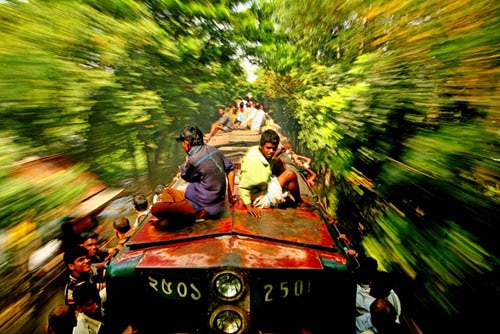
11) Are you mentoring anyone interested in pursuing a career in photojournalism? Have you considered conducting workshops in South Asia?

I am trying to help a few of my friends. But no workshops at this time. I am very busy with assignments, traveling and working on my personal projects. And I really want to keep taking lot of photos. I need more time for organizing and giving workshops.
G.M.B. Akash, A Photojournalist

12) Have you ever been tempted to work with video? Will still photography always be your main mode of communication?

I have never tried video but I really want to start making short videos. I mainly concentrate on still photography now.

13) What are you trying to say with your photography?

I see the beauty of people and the human souls in the pictures I take.

G.M.B. Akash, A Photojournalist

Filed Under: Interviews, Photojournalism Tagged With: akash, bangladeshi, dhaka, g.m.b. akash, human interest, international award, interview, Journalism, meeting people, News, optics, people, photographer, Photography, photojournalist, photojournalists, positive lives, shahidul alam, world press photo

Children’s Photography, A Contemporary Approach

October 29, 2010 by Seshu | Editor & Publisher

My wedding season is winding down, but my children's portrait photography sessions are starting to pickup. It's just the nature of things as we cycle from one season to the next.

In my pursuit to be better than I was last year, I looked around to see whose work and expertise could elevate me as an artist. One name that kept popping up to the top of my head was Tamara Lackey.

Let me at the outset tell you that Tamara is a friend. We first met at a workshop hosted by Jesh de Rox. Tamara and I continued to stay in touch (and that's one good way to be on top of someone's mind, eh?) but both our studios got busier and things got a little quiet. Then all of a sudden I heard that Tamara had written a book called The Art of Children's Photography.

Subsequently, I met her at Learnfest, another workshop hosted this time by Tamara, Audrey Woulard, Lena Hyde and Laura Novak. (Learnfest is now on an indefinite hiatus and that's why the link points to a very good review of that workshop!)

Inside Contemporary Children's Photography

In early January of this year, Tamara announced that she had co-produced a DVD with Rex Ballard, called Inside Contemporary Children's Photography. I sent Tamara a message saying that I was intrigued by the DVD and wanted to know where I could buy it. Her prompt response was to simply ask for my address. A couple of days later I received her generous gift. So, let me be clear that I did receive this DVD gratis. This blog post, however wasn't solicited by her or me. It was truly an after thought because I absolutely loved what Tamara was able to teach me in 90-very-quick-minutes. I say “quick” because it left me wanting to hear and see more.

Her breakdown of different kinds of children and how to approach them was my biggest take away. I have two kids of my own whom I photograph constantly, but that doesn't make me an expert on all the different kinds of kids there are in the world. Tamara, of course, generalizes to some extent. But her opinions come from the vantage point of a lot of experience. Just look at her images and you will be amazed at how intact the children's souls remain. In some children, she is playful and down-right goofy. While working with some others – those who are cranky or shy, her approach is much more reserved and quiet. In any of the scenarios, you can tell that being respectful of children is very important.

Tamara Lackey Photographing A Child

There is also a fairly detailed section of the DVD where Tamara and her studio director talk about how to run a successful portrait photography business. If you are starting out, this is going to be doubly valuable to you.

I wholly recommend this DVD if you are considering specializing in children's photography or at least making it part of your business.

Be sure that your approach is going to be different (and Tamara and I hope that it will be), so please don't think of this DVD as a template for what you MUST do. Think of it as a template of what you CAN do. These are suggestions and very good ones that will help you make your business sing if you adopt even just a few of them.

I wholly recommend this DVD if you are considering specializing in children's photography or at least making it part of your business. Tamara's approach is genuine and her love of children is as clear as a sunny day. The DVD itself is very well produced. After all, Rex Ballard's litany of achievements as a Director of Photography and Cinematographer include National Geographic and The History Channel.

You can buy this helpful tutorial as a DVD or a download here. [This isn't an affiliate link and I don't get a dime for promoting it!]

BONUS: If you are going to be in New York City this Friday (October 29, 2010), Tamara Lackey will be presenting at Photo Plus Expo. She is an enthusiastic speaker and her presentation is not to be missed.

UPDATE: Tamara has generously given Tiffinbox readers a $30 discount if you buy her DVD by Friday – November 5, 2010. That brings your price down to $169. This is NOT an affiliate offer and I don't make a dime for promoting it here. Yeah, it's that good. Get it!

Filed Under: Photography, Review, Tutorials Tagged With: approach, contemporary, dvd, films, human interest, kids, photograph, Photography, portrait photography, portrait photography business, Portraits, tamara, tamara lackey

3 Considerations When Photography Turns Into Passion

October 27, 2010 by Guest

Pavithra Ramasubramanian, AvatarThis guest post is by Pavithra Meera Ramasubramanian, a San Diego-California based photographer turning passion into profession by photographing Nature, Portraits, and Lifestyle. Learning is the key and you can see her work progress by following her on Twitter and seeing her work on her blog.

Learning photography as an art and becoming a professional is a hard balance to understand. I just began my journey towards becoming a professional and this is the biggest lesson that I am still learning.

I love photography and my passion drives me towards it. So after finishing my Biology degree this past year I set myself to becoming a professional photographer. The one question that keeps running through my mind when I’m learning the ins and outs of this industry is: Are you working for yourself or someone else as a Professional Photographer?

Morning Bath

Coming from a culture that strongly believes in biology or engineering as the career of choice, it has been very hard to endure the numerous questions and advice on why I shouldn’t pursue this field. Although career changing is not so uncommon these days, it has been hard for me to convince not only my family but also my friends that this is what I want to do. It was bestowed on me, a South Asian woman, that I should pursue a normal life with a safe job. And Photography, as I have learned, is not the normal or safe job according to the people I encounter.

I say this because I have had to sit through many birthdays and parties where people just hand me their point and shoot camera and say something like: “since you want to become a pro photographer … take our picture.” More than a compliment it had been said in a condescending manner. I go home thinking wait is that all I get to do? Where is the art or vision in photography if there seems to be little respect or little satisfaction of having composed something beautiful? So photographers just work to please others but not themselves?

These moments in the past really have brought me to ground to rethink photography and my vision. In that period, I started forming a huge gap between my camera and me. It was very difficult understanding what people want and what I want out of me. It wasn’t bad that I was questioning myself but the fact that I was questioning what I am passionate about was something I wasn’t ready for.

The Push

Everyone needs a good support system to be successful in what we do. Whether it is our family, friends or the best of all a good audience for our photography, we all need some kind of push to help us love our work. It was at my low point that my family gave me the right push. They began to truly believe in me by being right by my side and pushing me to take the next step. They guided me to start asking some serious questions to myself and to listen to my heart. I started to find my inner peace to know that you win some and you loose some. It was tough to deal with people who didn’t appreciate my work but it was even more grateful to know that I have a good group of viewers enjoying my photographs. It was these viewers who helped me understand that I have the ability to find beauty in everyday life.

Gratitude

Lonely Rock

For those of you who are just entering into this field and changing a hobby to a passion here are some things that you should consider and understand:

1. Take both forms of advice, good and bad – but apply what you know and feel is right, the one that helps you move forward.

2. Don’t do it alone- take all the support you can get- this is the biggest key to help you succeed.

3. And remember at the end of the day you have to answer to yourself- your thoughts and your happiness- if you do something you love, you will work hundred times harder at it and prove many people wrong.

Moonrise Over The Dunes

Live In The Sunshine

You will soon find yourself in a place where you will know how to combine both the artistic world of photography and see that others are also pleased with your work. And learn that you have a clear complete vision of who you are and what your photography means to you.

Filed Under: Photo Biz Tagged With: albums, consideration, considerations, learn photography, love photography, outline, passion, photographer, Photography, professional photographers, pursuit, san diego california, social history, turns

Chris Orwig’s TED Talk On The Poetics Of Photographs

October 22, 2010 by Seshu | Editor & Publisher

Chris Orwig, an author and teacher asks us to redefine our notion of what a photograph is in this video. I think it is instructive of how photography must go back to its roots – when things we saw in front of us were genuinely appreciated and the person making the images was so much present in the images they were making.

As Orwig says, the world does not need another Ansel Adams or Annie Leibovitz. The world just needs YOU behind your camera. Creating images that are more indicative of who you really are. I hope you enjoy this video as much as I did. One of these days, if Chris' schedule opens up and he is interested, I would love for him to guest blog here too.

Chris Orwig's Visual Poetry

If you want to hear or read more about what Chris Orwig is saying, I wholly recommend his book Visual Poetry. Here is a dedicated website for it.

Filed Under: Art, Photo Books, Photography Tagged With: annie leibovitz, ansel adams, authors, chris orwig, guggenheim fellows, orwig, photograph, photographs, Photography, poetics, redefine, talk, teacher, ted, visual arts

How To Find Your Perfect Photography Printing Lab?

October 21, 2010 by Guest

Ingrid Spangler, AvatarThis is a guest post by Ingrid Spangler. Ingrid has been involved with photo sharing and social media (before it was called social media), with an account on Flickr going back to 2004, and before that was active on Fotolog and Fotola for two years. She has been with AdoramaPix for over 3 years, and is responsible for all the social media, as well as copywriting, promotions and marketing. She has been an avid photographer from the time she was a child, and studied film at Temple University in Philadelphia, where she learned to shoot on a Bolex 16mm movie camera as well as studying film theory and visual aesthetics. Some of her favorite all-time photographers are Lee Friedlander, Robert Frank, and Harry Callahan. Currently, Ingrid says, “I'm just crazy over Matt Eich and Noah Kalina. I'm lucky that in my job I get to see lots of photographs and I'm constantly inspired by the work I see rolling out of our printers everyday.”

Choosing an online lab for your print fulfillment can be overwhelming. There are a lot of labs out there, how do you wade through all the choices and find the right lab for your clients' images?

Start by asking what is most important to YOU. Is it price? Is it quality? Is it a wide selection of products? Is it having access to knowledgeable customer service?

Of course I'm sure you've answered that ALL these things are important. You want the highest quality materials and print quality at the best price. You want to be sure that you have access to someone who has the power to make things right if there is ever an issue with an order. Is it possible to get everything you want in one lab?

Store and More

Red Boy, by Ingrid Spangler

Let's start with the order process and the website's ease of use. I'd look for a lab with plenty of storage for your images and the ability to share links directly back to your images. This is important because you want to be able to maintain your images for as long as your clients are going to want to order copies. This could be indefinitely! Lots of clients may come back a year or more after a wedding or portrait session to reorder prints for themselves or as gifts; you won't make a sale if their images have expired and/or are no longer available.

Try Before You Buy

Window, by Ingrid Spangler

Does the lab offer test prints? This is important for a couple reasons. First, it allows you to experience the order process, if it's difficult or not user-friendly, now is the time to find out, not when you have sweaty palms and a deadline looming. Test prints will also allow you to gauge turnaround time and how well your potential lab keeps you informed of your order's progress. Do they let you know when your order has shipped? Do they provide tracking numbers, if applicable? Do they let you know in a timely manner if there is a problem with your order?

Your test order should also give you the chance to try out the various papers and processing options that the lab offers; compare what a glossy print versus a matte print looks like. Do they offer color corrections and how do those affect your images?

Will or can the lab print your studio name or copyright information on the back of the prints? How does this show up?

Control

Tree and Baseball, by Ingrid Spangler

It's not just a Janet Jackson song. What kind of control does the lab give you over your images?

Cropping

Nairobi Cart, by Ingrid Spangler

As you know, digital images are often in different proportion than many traditional print sizes. If the aspect ratio of the image file does not match that of the print size chosen, how does the lab deal with this discrepancy? Ideally, you should be able to control the cropping, if necessary, or at the very least see how the lab will print the images.

ICC Profiles

Red Hand In Window, by Ingrid Spangler

Does the lab offer ICC profiles? With a properly calibrated monitor, profiles allow you to soft-proof your photos and see your images the way the lab will print them. Profiles (along with a calibrated monitor) are the key component in maintaining the most control over color and what your final printed images will look like.

Auxillary Products

Sweet 16, by Ingrid Spangler

Can you do one stop shopping for prints, photobooks, canvases, etc?

Quality

Nathan's Flag, by Ingrid Spangler

This is probably the most important thing to look for when shopping for a lab. What good are all these other options without quality materials and quality personnel producing your prints?

Are you familiar with the reputation of whatever brand of materials are used? If not, do you like the way the prints look and feel? Is there a good choice of different kinds of papers for different types of images? Do they print in-house or outsource? Is there some kind of quality control in place?

How is your potential lab's customer service structured? Can you get to a living, breathing person on the phone (or instant messenger, live chat, etc.) if you need to? If you have a question or if there is an issue with your order, how is it handled? Are the customer service agents knowledgeable? Ideally, they should work in the lab (not be outsourced), understand the workflow and know the products offered inside and out.

The bottom line is that your reputation is only as good as your photography and people will judge your photography mostly by the prints they see.

Your clients will see your images for a short time online or in print when they see proofs, but they'll live with them for a much longer time. Make sure they have good thoughts about you whenever they look at their prints by choosing a lab that does justice to your photography!

Get $10 in print credits when you sign up with AdoramaPix – http://www.adoramapix.com

Filed Under: Photo Biz, Photo Books, Photo Technology, Photography Tagged With: adorama, how to find, ingrid, ingrid spangler, lab prints, labs, online labs, photo sharing, Photography, photography lab, photography prints, print quality, printing, prints your pictures, spangler, to find your perfect photography printing lab

  • « Previous Page
  • 1
  • …
  • 25
  • 26
  • 27
  • 28
  • 29
  • …
  • 34
  • Next Page »

Subscribe To Tiffibox Treats!

Looking for a well-curated email newsletter that will leave you inspired and motivated about your photography business? Sign up below!

About Seshu

Seshu creates relaxed portraits of families and high school seniors in Avon, Connecticut. He also leads a successful headshot photography studio in Connecticut, helping professionals from a variety of disciplines project the very best versions of themselves. He created Tiffinbox as a way of inspiring photographers, to create better images and successful businesses. [Read More]

Email Templates For Headshot Photographers

Email Templates for Headshot Photographers

Recent Posts

  • How Capture One Changed My Event Photography
  • 10 Steps To Stay Positive In Times Of Great Stress
  • Why You Need To Read “Personal Branding For Photographers” Now
  • How To Master Your Website Content Step By Step?
  • Tony Taafe’s TNT Method For Headshot Photographers

Recent Comments

  • Stephen Davison on Are You A Business Owner Who Is Smart, But Stuck?
  • Ben A. on Don Giannatti Clinches The 8th Annual Tiffinbox Award
  • Dan on Don Giannatti Clinches The 8th Annual Tiffinbox Award
  • Donald Giannatti on Don Giannatti Clinches The 8th Annual Tiffinbox Award
  • Stephen Davison on G.E. Masana’s 6 Strategies For Wedding Photography Success
  • Naveen Kumar on Weddings In India Are More Than Being At The Right Place And At The Right Time
  • kartick on Weddings In India Are More Than Being At The Right Place And At The Right Time
  • Leonid Farbman on 6 Uncommon Trends To Grow Your Photography Business
  • Willow and Finch Wedding Photography on 11 Reception Tips To Help Your Wedding Photography
  • Web Designer Malaysia on How To Optimize Your Squarespace Website For Search Engines
  • Creastan on An Interview With Photojournalist G.M.B. Akash
  • Cindy Brown | Atlanta on An Open Letter To A Local Photographer

Become a Patron!

Copyright © 2026 · Tiffinbox · Site Design by Heather Mackan Creative · Built on Genesis