• Photography
  • Interviews
  • Business
  • Reviews

Tiffinbox

Inspiring Photographers

  • Home
  • About
  • Blog
  • Contact

Professional Photography Is Dead. Long Live Professional Photography!

March 14, 2012 by Dhiraj Kacker

This is Dr. Dhiraj Kacker's second guest blog post here. Read his first post on album manufacturing too. He is the CEO and co-founder of Canvera, an online digital photography company based in Bangalore, India. Dhiraj can be found online on Twitter, his company blog or his personal blog.

This post has been on my mind for a long time as I think a lot about the changing role of pro-photographers in the digital age. But in some ways I got beaten to the punch by a much more spunkier take on the issue by Allen Murabayash, CEO of Photoshelter, on his blog post “Rant: I Love Photography”. Please go read it. My post here will be much more sedate and boring! With that warning, let’s dive into it.

I have much more insight into the market where pros get hired for personal or corporate events (such as weddings, portraits, bar/bat mitzvahs, etc) so I will focus on that and not on commercial, editorial and stock photography which has its own set of dynamics in the digital world.

What do we all hear and say everyday: DSLRs are getting cheap, everyone has a camera, it’s getting tougher to earn a living being a pro! A lot of it is true. Digital Photography combined with the internet and cheaper and cheaper capture devices have made it simpler for all and sundry to take and share images like never before. Unshackled from the physical limitations of film and the cost of taking each picture everyone today can pretend to have some proficiency in photography. There are weekend wedding photographers who are taking business away from full time pros just based on price. There are pro-sumers who are building online galleries, showcasing their work and in fact selling their work.

But here’s the funny thing:

– For the first time in the history of pro-photography we have celebrity wedding photographers! Celebrity status was limited to fashion and editorial photographers, never to wedding photographers. How did this happen?

– Family portraits on the wall look like model shoots today, not just people saying cheese into a camera and accepting whatever came out. Perfect lighting, perfect smile are must!

– Corporate mug shots make management look like celebrities and anything lower quality doesn’t speak well of the company

– I am hearing more and more that right after a wedding date is fixed the first or second service provider that gets booked is the photographer; this used to be an afterthought

– Senior shoots are blurring the line between model portfolios and what was considered just pictures of the teenage years

– Parents want their kids’ sports pictures to look like shots from pro sports

– Never before have engagements & boudoir shoots been taking place in such large numbers. The smart photographers have also created the “trash the dress shoot” as well!

I don’t believe any of this was common a decade ago.

Dhijar Khacker | Pinterest Home Page

So what’s really going on? Let me talk a little from my personal experience. I had a run of the mill point and shoot film camera in the 90s and in 2000 bought my first 3MP digital camera – an Olympus 3000 for a $1000 (yes, a thousand bucks for a 3MP P&S camera). I remember the excitement of getting pictures back in the film world and just being able to relive those memories was amazing. At the time the pictures looked great but today, they look mediocre (and I am being generous). Too much sharpening, probably done by the minilab and too much contrast because of the film I bought. And of course I had no eye for composition or lighting. Initially I really liked my P&S digital camera – it was quite simply the excitement of digital. But my appreciation of photography kept going up and at some point that quality was just not good enough.

After my first kid was born, I finally invested in an SLR and for a few years managed with the default lens. And then I got fancier with the lens. It is safe to say that today with two young kids I shoot a lot of pictures, but here’s the kicker: unlike in the film world where I did not know any better, I can immediately tell how many decent shots I got. It takes me possibly 100 shots to get one really good one! I don’t have an eye for light or composition, and I rely on sheer volume to get lucky. So much so that on a recent birthday party I did the unthinkable: I called up a pro friend of mine to hire him to take pictures. By playing around a lot I have come to realize just how difficult it is to consistently take good shots. It is kind of like playing sports and developing a greater appreciation for the professional who plays the same sport. Isn’t it true that the omnipresence of little leagues and minors grows the business for the majors?

Here is what is happening: never before have average consumers been exposed to this much high quality imagery – web, mobile, magazines, hoardings, blogs – you name it. The quality of images on Pinterest or Tumblr is just mind blowing. Sub-consciously consumers have developed a greater appreciation for good images. Everything I’ve listed above is happening because of this trend. I believe that today consumers (like me) are experimenting a lot more with photography trying to reproduce the quality they observe. And like me they are coming to appreciate how difficult the art and craft of photography is. So when it comes to important life events (operative words being “important life events”), my prediction is that over the next decade pros will be hired in record numbers. Consumers will be spending in record amounts.

None of this means that things have not changed and pros can simply fall back to what they did in the 90s (which was essentially to build a physical portfolio and get referral business). Like a pro-sportsperson, they have to be savvy business people. I am writing on a photographer’s blog so I know that this audience is aware that from building a brand, to marketing to sales and operations, a pro has to do a lot more; a pro’s life has become lot more complicated. But boy, I don’t think there has ever been a greater appreciation for the art and craft of photography as it is today and I think we are at the start of a golden age of professional photography fueled by the omnipresence of images in our lives.

So, what do YOU think? Pen your thoughts below!

Filed Under: Business, Opinion, Photography Tagged With: camera, dhiraj kacker, digital camera, digital cameras, digital photography, fine art photography, life event, personal blog, photographer, Photographers, Photography, pro photography, professional photographers, stock photography, Wedding Photography

A Photographer’s Thoughts On Storytelling And Our Community

January 26, 2012 by Jerod Foster

Today's guest post is by Jerod Foster, an editorial and natural history photographer based in Lubbock, Texas. His book, Storytellers: A Photographer's Guide To Developing Themes and Creating Stories With Pictures, was published in 2011. Follow @jerodfoster on Twitter.

Many thanks to Seshu for providing me the opportunity to guest appear on such a resourceful blog. Once again, the ability to create positive relationships over an ever-growing online community of photographers astounds me.

Man With A Kite |  Jerod Foster

Speaking of community, if you’re reading this post, there’s no doubt that a good many of you came here via a link posted on Twitter or Facebook, perhaps Google+, your own RSS feed, or a variety of other means of connecting you to, well, here. Word spreads fast in the photography world, especially when that world spans across a very diverse and prolific online community. Needless to say, the photography community, online or not, is large. Very large.

It’s so large and diverse that it’s often difficult to distinguish who we are at times. Just think about it for a moment. We’re so vast and varietal, and in some cases so niche, that we’ve become enclaves of particular areas of the entire art and craft of photography. At the same time, however, we know we all relate to each other on one level or another, but what?

A quandary? Perhaps. Maybe we can be a bit deductive in finding out just who we are as a community. Consider this an exercise in getting to the essence of photographers in general.

Let’s break some of the diversity down by types of photographers, starting with some of the more obvious. A lot of us are wedding, engagement, bridal, and family photographers, established in a particularly special and popular area of photography that have, if you think about it, one of the most important jobs in the world. Others of us are photojournalists, visualizing the life around us for a variety of outlets, including the tried and true newspaper industry, magazine publications, and a boatload of online resources for both traditional and new media content. Still, there are those of us that concentrate solely on the natural world, training our vision and gear on awe-inspiring landscapes and the wildlife that populate such environments. We can’t leave sports shooters of the list, either, since they carry quite a bit of the load for both personal and media audiences (globally, I might add).

Story is not something new, but it is indeed a constant. It’s what each and every one of us as a community (online or not) has in common.

Hold up, though. I’m creating a rather clear separation of the types of photographers out there (I also realize the listing is quite truncated). It’s also apparent among the community that not all of us are 100% one type or the other. Many of us that sling a camera over our shoulder do so with just as much commitment to shooting a family as we do the magazine story assignment we picked up last week. I know sports photographers that can shoot a heckuva wedding, and vice versa. Lest we forget, there are specializations upon specializations in the photography field as well, ranging from different styles of portraiture and cultural photography, to underwater shooting, science and medical image making, to fine art forms of the craft. Some of us are primarily focused on publishing in coffee table books and magazines, while most of us will never see the inside of what those that do call the land of the yellow border (although that shouldn’t stop one from trying).

Finally, but certainly not the least, there are those of us that do not necessarily aspire to be labeled a “type” of photographer, but instead are content and productively happy being generalists and avid shooters. This position is true for many, if not the most, of us, and it includes all levels of photographic achievement/aptitude, from the most basic hobbyist to the amateur wondering if she can earn some side money photographing her neighbors’ children, to the emerging professional right out of university.

Man With Classic Cars |  Jerod Foster

Cowboy |  Jerod Foster

So, if the photography community is so diverse, what keeps us together, stumbling upon (if you will) other parts of the industry, different shooters, and strange and interesting sources of visual inspiration? No matter what type of photography you lean toward, the thing that connects each and every one of us is the fact that we’re all telling stories with the images we produce. Story, for that matter, has been a part of what connects us all since the dawn of time! Story and storytelling is what and how we use the information we are continuously consuming to learn and interpret our world. Photography, in this sense, is one of the most important modes of telling story and has been since its commercial inception in the early 19th century.

I’m going to go out on a limb and say that storytelling is vital to being a photographer. In some ways, it’s our responsibility to tell stories with images. Not in a cliché way either—I believe that we photographers (no matter what level of professional or hobbyist achievement) are a very important part of what keeps this world in tune with itself. Whether you’re shooting a global humanitarian campaign, a national advertisement, or your child’s first birthday, you have something to pass along with your images, and it keeps informing those around you.

Countryside Landscape |  Jerod Foster

Boats In The Landscape |  Jerod Foster

That being said, I also believe that in order to grow as a photographer, we have to tie quite a few things together—things that are discussed quite a bit by the online community I mentioned earlier. Gear, technique, technical aptitude, vision, visual language, style—all are used in order to increase how we see and create compelling images. In addition, and more importantly, each helps us tell stories (they can get in the way as well; a post for another time). Our job is to make sure we’re doing just that. We may improve as photographers, but in essence, we grow as storytellers.

At its core, photography is meant to tell story. At our core, we are storytellers. Whether you’re just starting out, or you have shot professionally for the past 30 years, whether you’re in the studio or on some exotic location, whether you’re shooting solo or as part of a budgeted production crew, story is the central element of the visuals you produce. Story is not something new, but it is indeed a constant. It’s what each and every one of us as a community (online or not) has in common.

We are, in essence, a community of visual storytellers.

Nature Photographers |  Jerod Foster

Filed Under: Photography Tagged With: Community, family photographers, jerod foster, Journalism, mass media, News, online community, photographer, Photography, photography communities, Photojournalism, stock photography, story, storyteller, storytelling, visual journalism

How To Grow Your Photography Income?

April 22, 2011 by Rosh Sillars

Today's guest blog post is by Rosh Sillars, a veteran photographer with a photojournalism background specializing in people, food and interiors. He earned his BFA in photography at the College of Creative Studies (CCS), Detroit. Rosh offers his services to traditional media, new media and corporate clients. He owns the creative representation firm The Rosh Group, Inc. and teaches photography at two universities and serves as a marketing and social media consultant for Synectics media. Rosh is also the coauthor of the book Linked Photographers guide to marketing and social media.Please visit his new project The Driven Business.

Is it really possible to increase dramatically your photography income?

Yes.

Photography has changed over the last 10 years. Digital cameras have made everyone a photographer; many of the basic point-and-shoot jobs have been lost. But, that doesn’t mean the opportunities are gone.

The truth is, there are more opportunities than ever. The secret is to make your competition irrelevant.

How?

Great photography and your creative ideas are the answer. Photography can be combined with writing, video, Photoshop, and other digital technologies to help you create unique offerings.

You must find your niche.

If you don’t have a good website, you are not in business. Make sure it is easy to use and well-optimized (If you don't know what that means, find out.) to attract the people who are searching for what you do. Don’t take search engine optimization lightly. Make sure you have a blog that is updated weekly with great images and text.

Get out of your home, office, or studio. Business is about people and developing relationships. Go to at least one networking event a week. Make sure you have business cards, portfolio cards, and your freshest images ready to share on your smart phone or tablet. Always have a portfolio available. You never know when opportunity will come knocking.

Follow up using the social web. Keep your new connections alive through social media. Develop new relationships using Facebook, LinkedIn and Twitter. Don’t sell to your followers, educate them. Teach them how to find leads for your business and you return the favor with opportunities and valuable introductions.

Create partnerships with companies that focus on the same target market. Develop packages and market your products in cooperation.

Don’t just sell your product. Sell the experience of working with you. You can’t hide behind your products. Photographers today need to understand that if they are going to be successful they are part of the product. Customers, in many cases, are buying the photographer more than the photography.

Make it easy for someone to do business with you. It is important to protect your copyrights. If copyrights were not important, people wouldn’t be working so hard to take them from you. Keeping your copyrights will increase your income by providing more opportunities to resell your images at the appropriate time. But, the issue of copyright, business practices, and contracts doesn’t have to be an us versus them battle. Keep it simple.

Unless you photograph events, you should be using the per-image-pricing model. Your rates should be based on the value of each image, not your time. It is much easier for customers to justify a few hundred dollars per commercial image than $1,500 a day for the photographer's time. This model can easily be adjusted and applied to portraits and family photography. Each image has value; never give away a valuable CD full of images.

Don't forget to follow up.

Communicate regularly with past clients. They are the best referral sources you have, so make sure you collect e-mails and addresses. Don’t let them forget what a great experience they had working with you. Keep them up-to-date with you newest images. Give them the tools and the opportunity to refer you.

The best marketing campaign you can participate in is to regularly send hand-written thank-you notes. People like to be appreciated. Your appreciation is often rewarded with additional income.

What strategies will you employ to grow your photography income? What are you trying now? Willing to share so that can learn from each other? Post your thoughts below!

Filed Under: Business, Photography Tagged With: business cards, digital cameras, family photography, grow, how to grow, income, News, photographer, Photography, rosh sillars, search engine optimization, stock photography, teaching photography, visual arts, Wedding Photography

“Going Amateur”

December 29, 2010 by Stuart Sipahigil

This is a guest post by Stuart Sipahigil. He is an amateur photographer in the traditional sense of the word; that is, he does it for the love of the craft. His photographs have won awards, appeared in publications, and have made their way into homes and businesses around the country. Stuart also teaches workshops to help other amateur photographers find great photographs close to home. Stuart’s work can be found at TheLightWithout.com.

So, you're “just” an amateur photographer… but you've discovered that you have a love for making photographs and you seem to be pretty good at it. Your friends and family are telling you they love your photographs and several have said you are “good enough to be a professional.” Maybe you've entered a local photography contest or two, and you've done pretty well. Or perhaps you've even sold a few prints of your photographs to the local coffee shop or restaurant.

Now you're thinking to yourself, “maybe I could be a professional photographer,” and then, “how would I do that?” So you check out a couple of books about being a pro photographer — David duChemin's VisionMongers: Making a Life and a Living in Photography or Dane Sanders' Fast Track Photographer, for example — and discover that it's actually quite a bit of hard work. You already have a career right now and well, it's paying the bills and you're doing okay, even in this economy. Shifting gears to becoming a pro is a big change and would disrupt your life quite a bit. It might be doable, but it would be painful, and you're just not sure it would be worth it.

So now what do you do?

Traditionally, there were the only two paths available to you: turn pro, with all of the responsibilities that entails and the costs associated with it. Or remain an enthusiastic amateur, occasionally selling a print or two at your local art fair, or maybe shooting your cousin's wedding for a few hundred bucks (and thus, pissing off an entire group of professionals—but that's another story). However, I think there are several other choices you can make; several other paths you can trod that don't involve becoming a traditional “pro” to find satisfaction as a talented amateur photographer.

The Internet has changed everything. You have many more outlets for your work now than ever before. Traditionally, if you wanted to get your photographic work out into the public eye you had only a few choices; magazines, gallery showings, or stock photography, for example. Today, you can sign up for a blogging service and start your own photography blog, publishing your work to a worldwide audience in about five minutes. If you're a little more ambitious, you can self-publish your own “coffee table” book of your photographs using services like Blurb or Inkubook. Or publish a photography ebook, either on your own or through a publisher like Craft & Vision. All of these things were prohibitively expensive and perhaps even impossible to do on your own only five years ago.

There used to be an old saying, “Those who can, do. Those who can't, teach.” That's simply not true these days (and it never really was). Many professional photographers like Joe McNally, David duChemin, and Zack Arias — all terrific photographers — offer workshops and seminars about the vision, the craft, and the business of photography. But not everyone is ready for (or can afford) workshops with these big names.This can create an opportunity for you to step up and use your skills to help others that are as passionate about this craft as you are. Is there a local arts center in your town? This can be a great place to start and to hone your teaching skills. If you don't have that opportunity, why not just try leading a few photo walks, either on your own or in concert with Scott Kelby's Worldwide Photo Walk in July? Signing up to be a walk leader is easy and can get you started on the path to becoming a photographic instructor.

Are you good at talking about photographic tips and techniques? Do you think you can interview other photographers? Maybe you should start a photography podcast. In a few minutes, you can set one up in Apple's iTunes and publish it to a worldwide audience on a regular basis. The folks at Faded & Blurred have done just that, combining it with their own regular photo walks and a lively online community to create a terrific resource for passionate photographers.

If you are currently a professional photographer, you too can benefit from “going amateur.” I don't mean that you should give up your business and find something else to do, but to try to carve out a little time in your life to do some work for yourself. Personal projects are your connection back to why you started in the field to begin with: your love of photography, the feel of the camera in your hands, and the joy of seeing something that moved you appear on film or in the LCD. There is enormous value in removing the pressures of running a successful photography business and just do it for yourself.

Maybe there are other opportunities that you could use to expand your business (and reputation) as well. Matt Brandon, a professional travel and humanitarian photographer, publishes regular interviews with other pros like Ami Vitale, Gary S. Chapman, and Chris Orwig on his Depth of Field podcast. David duChemin created the Craft & Vision eBook publishing business by starting with a few of his own ideas about photography. Chase Jarvis has added The Best Camera, a best-selling book and phone app, as well as the Creative Live educational video series to his successful endeavors. Many other pros are adding to their repertoire of services by taking advantage of these new avenues.

And if your photography business isn't very successful, why not step back and take a fresh look? Is it just a production job for you now: prepare, shoot, post-process, deliver? Have you lost that love for the art that you used to make? Perhaps it's time to re-think photography as a professional career. That may seem a bit harsh, but I'm simply saying your photographic life might be more rewarding without the pressures of trying to make a living at it. Or perhaps you just need to shift gears and, like some of these other pros, add some new roles to your career, such as broadcaster or teacher. There may be opportunities available to you that you just haven't considered.

There are great rewards to becoming a professional photographer if you're willing and able to put in the time and effort it requires, but there is no shame in trying to be a great amateur photographer. Making money with photography doesn't always equate to making exceptional photography. If you love photography and want to do more than just make slideshows for your friends and family, there are more opportunities now than ever before. Overcome your doubt and hesitation, step out and see what you can accomplish as “just” an amateur.

Please support this site and buy Stuart's awesome e-book, Close To Home, through the Craft & Vision website. [affiliate link]

Filed Under: Photo Books, Photo Exhibit, PhotoBlog, Photography Tagged With: amateur, amateur photographer, david duchemin, event photographer society, fast track, photographer, Photography, photography contests, Photojournalism, professional photographers, stock photography, stuart sipahigil, Wedding Photography

Around The World, Yet Across The Street

July 30, 2010 by Guest

Trudy Hamilton, AvatarThis is a guest post by Trudy Hamilton, a portrait and lifestyle photographer and blogger, originally from Florida and now residing the the San Francisco Bay area. She can also be found on Facebook and Twitter.

Most photographers that I know enjoy the adventure that travel brings into their lives. Whether it be personal travel, such as visiting family, or business travel, such as the destination wedding or a location commercial shoot, travel is both a pleasure and necessity. However, unless we're all Joe McNally, we probably don't travel as much as we'd like to.

One of the best reasons to travel is simply to experience the culture of another, hopefully though an open mind, heart and camera. However, you don't have to travel all of the time to experience and photograph another culture. An exciting and economical way to do so is to explore the cultural events of your community. I photographed my first community cultural event in 2006 and I have been interested in them ever since. The beauty of people, music, food, fashion and uniqueness has always excited me and appealed to me. This is why I travel, but also why my mind and heart can travel even when I am home.

A few good reasons to embrace your local community cultural events are:

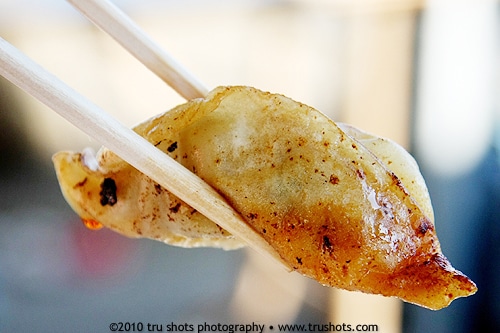
1) It's a learning opportunity. If you are open to it, a community cultural event can be a learning experience for you. Certainly I could have read an article on the Obon Festival, but I chose to attend one in Japantown of San Jose, CA a few weeks ago. I have been to Japan, but certainly couldn't pick up and go again a few weeks ago. But by attending the festival, I chatted with and photographed Japanese, Japanese Americans and others at the event, listened to the powerful yet soothing sounds of the San Jose Taiko and enjoyed gyoza–some of the same activities I did while I was actually in Japan a few years ago. For several hours, it was like I was transformed from traditional Bay Area Cali and merged into Japanese culture.

Japanese Woman In A Kimono

Japanese Man Drumming by Trudy Hamilton

Gyoza by Trudy Hamilton

2) It's a photographic opportunity. Certainly most photographers desire paid work versus unpaid work, especially the ones running a business. However, sometimes it is good to photograph truly for the sake of creation. Cultural photojournalism differs from my portraiture work. I use different camera settings, I have different compositional ideas and a different intent and message with every photograph that I create at a community cultural event. It's great exercise for me for when I do have paid event photography and great exercise in my creativity and storytelling, in general.

3) It's a networking opportunity. I am an introvert. Though I am not shy, as introversion does not always equate to shyness, I am usually uncomfortable and drained by traditional networking events and conventions. However, at a community cultural event, such as one I attended a month ago in San Francisco, Juneteenth, I can stay below radar and only photograph if I choose, or chat with people who ask me about my work simply from seeing me with what they call a big camera. At this aforementioned event, someone came up and talked with me. I ended up booking them as a client on the spot. So not only was it a great cultural experience (even just to embrace stories of Black people in America–ones that I could see in the very skin of the men I photographed below, who are only a few generations removed from slavery) but it was a business opportunity as well.

Man In Cowboy Hat by Trudy Hamilton

Street Photography by Trudy Hamilton

Acknowledging, embracing and understanding the cultures of others doesn't just make us better photographers, it makes us better humans. So I encourage you to view your city's website or a site like Yelp and look for the next event in your area, whether it be a Japanese, Chinese, Italian, Filipino, Jamaican or Irish festival (I've been to all of these types) and check it out. It may truly be a learning, photographic and networking opportunity for you as it has been for me. Embrace the true beauty within yourself, by embracing the beauty of others.

Filed Under: Culture, Photography Tagged With: as a, business travels, Community, cultural, cultural events, Culture, embrace, embracing, japanese culture, Journalism, mass media, photograph, photographer, Photography, Photojournalism, san francisco, stock photography, visual journalism

Subscribe To Tiffibox Treats!

Looking for a well-curated email newsletter that will leave you inspired and motivated about your photography business? Sign up below!

About Seshu

Seshu creates relaxed portraits of families and high school seniors in Avon, Connecticut. He also leads a successful headshot photography studio in Connecticut, helping professionals from a variety of disciplines project the very best versions of themselves. He created Tiffinbox as a way of inspiring photographers, to create better images and successful businesses. [Read More]

Email Templates For Headshot Photographers

Email Templates for Headshot Photographers

Recent Posts

  • How Capture One Changed My Event Photography
  • 10 Steps To Stay Positive In Times Of Great Stress
  • Why You Need To Read “Personal Branding For Photographers” Now
  • How To Master Your Website Content Step By Step?
  • Tony Taafe’s TNT Method For Headshot Photographers

Recent Comments

  • Stephen Davison on Are You A Business Owner Who Is Smart, But Stuck?
  • Ben A. on Don Giannatti Clinches The 8th Annual Tiffinbox Award
  • Dan on Don Giannatti Clinches The 8th Annual Tiffinbox Award
  • Donald Giannatti on Don Giannatti Clinches The 8th Annual Tiffinbox Award
  • Stephen Davison on G.E. Masana’s 6 Strategies For Wedding Photography Success
  • Naveen Kumar on Weddings In India Are More Than Being At The Right Place And At The Right Time
  • kartick on Weddings In India Are More Than Being At The Right Place And At The Right Time
  • Leonid Farbman on 6 Uncommon Trends To Grow Your Photography Business
  • Willow and Finch Wedding Photography on 11 Reception Tips To Help Your Wedding Photography
  • Web Designer Malaysia on How To Optimize Your Squarespace Website For Search Engines
  • Creastan on An Interview With Photojournalist G.M.B. Akash
  • Cindy Brown | Atlanta on An Open Letter To A Local Photographer

Become a Patron!

Copyright © 2026 · Tiffinbox · Site Design by Heather Mackan Creative · Built on Genesis